
Albertus Magnus
About 1200 to 1280
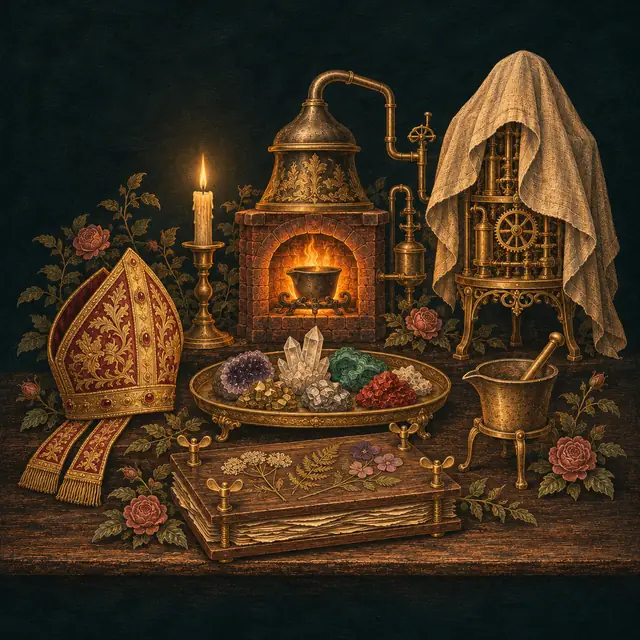
Who was Albertus Magnus, and what is truly known of them?
What is known
German Dominican friar, bishop and teacher, born at Lauingen in Swabia about 1200. He joined the Dominicans at Padua in the 1220s, taught at Paris, where Thomas Aquinas was his pupil, and in 1248 founded the school of the order at Cologne. He was bishop of Regensburg from 1260 to 1262. His commentaries covered nearly the whole of Aristotle, and he added his own observations of plants, animals and minerals. In his book on minerals he says he had alchemists’ gold tested and found that it did not survive repeated firing. He died at Cologne in 1280, was canonised in 1931, and is the patron saint of natural scientists.
The teaching
Taught from his own books on nature, above all On Minerals, On Plants and On Animals.
What nature does by her own causes
Albertus draws a clear line at the start of natural science. In studying nature, he writes, we do not ask how God the Creator, by his free will, uses his creatures to work miracles and show his power; we ask what nature, by the causes within it, can bring about. God can do anything, but the student of nature studies what nature does, and he holds both truths without confusing them.
Experience alone makes certain
In such matters, he says, experience alone gives certainty. A thing seen once is not proved: a sound observation is made many times and under every condition before it is trusted. So he sets beside what the old books say what he has seen himself, what others told him and who they were, and what he has tested and found false. It is said that the ostrich eats iron; he offered iron to ostriches and they would not take it, though they swallowed stones.
A statement does not become true by being written down. Whoever believes that Aristotle was a god, he says, must believe he never erred; whoever believes he was a man knows that he could err as we do. The student honours the old authors by checking them, wherever what they describe can be gone and looked at.
How metals are born
Metals grow in the veins of the earth from two things: a moist, flowing vapour, which is quicksilver and gives them their matter, and an earthy, fatty vapour, which is sulphur and works on that matter as a seed works. Joined in the earth and cooked by the heat of the place, they become metal, and the metals differ by the purity of the two and by how well the cooking went. Gold is the most perfect, made of the purest quicksilver and the finest sulphur in the best cooking; the base metals are the same work left impure or unfinished.
Art can help nature
Alchemy, if it is to be true, must follow nature: it must cleanse the quicksilver and the sulphur and cook them as the earth does, for art can help nature but cannot take her place. The alchemists who only tint a base metal yellow with sulphurous waters, or whiten it with arsenic, change its colour and not its kind, and their gold is gold to the eye alone. The test of a metal is the fire, again and again, and no art passes it by colour.
The powers of stones
Stones have powers beyond anything their elements explain: the magnet draws iron, and the lapidaries tell of gems that guard, heal or reveal. Albertus holds that such a power comes from the stone's form, which the heavens give it in the place and hour of its making, and not from any spirit dwelling in it. He gathers what the older lapidaries say of each gem, the sapphire, the emerald, the jasper and the rest, and keeps apart what he has tried from what is only told. Pictures sometimes found inside stones he explains by the vapours and the heavenly powers that shaped them.
This is the lore of stones as the thirteenth century held it, taught as what he says. A stone is no treatment, and its virtues are not a reason to delay seeing a doctor.
Natural magic and its limit
Natural magic, the use of the hidden powers that things have by nature, is lawful in his eyes; the calling up of demons is not. The Mirror of Astronomy draws the line among images, the figures cut in stone or metal under chosen stars. Some are abominable, made with fumes and invocations offered to spirits; some are detestable, made with written characters and names by which spirits are bound; and some take their power only from the figure of the heavens at the hour of their making, and these alone it allows.
The study of the stars is honest, for the heavens act on bodies. But they incline and do not compel, and a wise man can go against what his stars incline him to.
Plants, part by part
On Plants teaches the student to describe a living thing part by part: root, stem, bark, branch, leaf, flower, fruit and seed, and how each changes through the year. A plant has a soul of the lowest kind, the power to feed, to grow and to bring forth its like, but no sense and no movement of its own. He sets his descriptions of the plants he knew beside what he had read, and treats the cultivated garden as well: how grafting, manuring and pruning change a plant, so that a wild tree can be made gentle and a sour fruit sweet.
Animals and their judgement
On Animals adds to Aristotle what he saw for himself, from the whales and fish of the northern seas to the ways of eagles and bees, with a whole treatise on falcons: how they are kept, trained and healed. Animals have a power of judging what helps and what harms them, which makes a sheep flee a wolf it has never seen before, but they do not have reason. Reason is the mark of the human being, who alone can know the causes of what he sees.
His counsel to the student is the same throughout: look for yourself, compare, ask who saw it, and do not believe a thing because it is old.
Orders and memberships
The Order of Preachers, the Dominicans, of which he was provincial for Germany. No other body is documented. He held that natural magic, the use of the hidden properties of things, was lawful, and that dealing with demons was not.
The legend
That he built a brazen head or a talking automaton which Thomas Aquinas smashed, that he made a garden bloom in winter for a king, and that he owned the philosopher’s stone. The tales grew in the centuries after his death.
What was forged, or is false
The Secrets of Albert, the Great Albert and the Little Albert, books of charms sold for centuries under his name, are not his, and neither are most of the alchemical tracts that bear it. Whether the Mirror of Astronomy is his is still argued.
Their works
- On MineralsTreatise, 1250s
His book on stones and metals, their formation and their powers. In it he says he had alchemists’ gold tested and found that it did not survive repeated firing, and he gathers what was believed of the virtues of gems from older lapidaries and his own inquiry. It is a chief source for the medieval lore of stones.
Ask the Oracle about it - On PlantsTreatise, 1250s
Seven books on plants, which take an older text then thought to be Aristotle’s and add his own careful descriptions of the plants of the Rhine and of Germany, their parts, growth and uses. It is one of the best works of botany written in the Middle Ages.
Ask the Oracle about it - On AnimalsTreatise, about 1260
Twenty six books on animals, in which he adds to Aristotle many observations of his own, from falcons and fish to whales, and tests and doubts some old fables, such as that the ostrich eats iron. It shows him as a watcher of nature as much as a reader of books.
Ask the Oracle about it - Mirror of AstronomyTreatise, about 1260s
A short book that sorts the books of astrology and magic in circulation into the lawful and the forbidden, defending the study of the stars while condemning the conjuring of spirits. It is a key guide to what a learned churchman of the time thought allowed.
Whether it is his is still argued.
Ask the Oracle about it - The Book of SecretsBook, about the 13th century
The Liber aggregationis, a book of the virtues of herbs, stones and animals and of the marvels of the world, printed again and again under his name from the 1470s. Later French compilations, the Great Albert and the Little Albert, became books of charms sold by pedlars for centuries.
It is not his, though it was long sold as his.
Ask the Oracle about it
How the house tells a life
This life is told from the record, with what is documented, what is legend and what was forged kept apart. A membership in an order is stated only where documents show it. A person’s chart explains none of their deeds.
The arts it feeds
Lives near it in time
Thinkers and teachers
MilarepaAl-GhazaliHildegard of BingenJoachim of FioreSuhrawardiIbn ArabiRumiRoger BaconRamon LlullMeister EckhartMarsilio FicinoJohannes ReuchlinThe whole tree

