
Milarepa
About 1040 to 1123; some sources give 1052 to 1135
Who was Milarepa, and what is truly known of them?
What is known
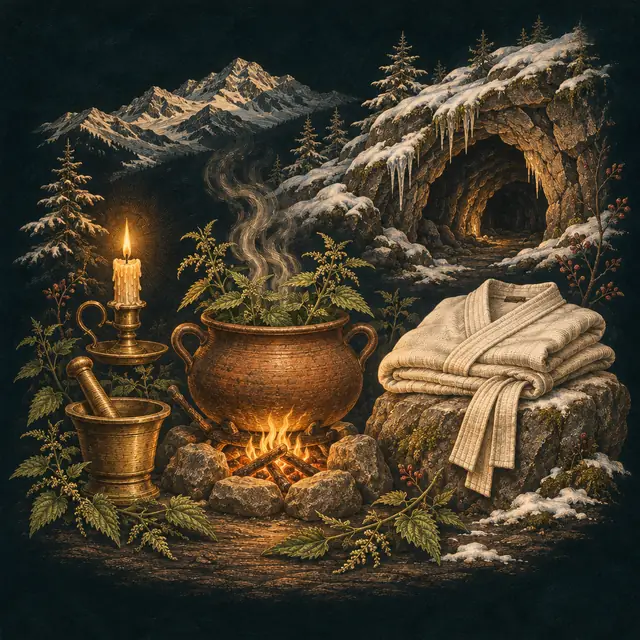
Tibetan yogi and poet, the best loved figure of Tibetan Buddhism. He was a disciple of the translator Marpa and the teacher of the monk Gampopa, who founded the first monasteries of the Kagyu school; on that much the early records agree. The story everyone knows comes from the Life of Milarepa and the Hundred Thousand Songs, both put into their standard form by Tsangnyon Heruka in 1488, more than three and a half centuries after his death: the boy who learned sorcery to avenge his family, the towers Marpa made him build and pull down, and the years in mountain caves on a broth of nettles.
The teaching
Taught from the Life of Milarepa and the Hundred Thousand Songs, as Tsangnyon Heruka set them down.
Death, and the human birth that is hard to find
The songs begin where the path begins, with death. Everything gathered is scattered in the end, everything built falls, every meeting ends in parting and everything born dies, and no one knows the hour. Milarepa sings this to pupils, hunters, patrons and his own sister, not to frighten them but to wake them: a life spent on the gain and comfort of this world is spent on what cannot be kept, and only what has been done for awakening goes on.
Against that he sets the worth of a human life. To be born human, with the leisure and the chance to hear the teaching and practise it, is rare and easily lost, and it is the footing from which awakening can be reached. The songs ask the hearer not to put practice off until later, because later may not come.
The fruit of deeds
Every deed bears its fruit, in this life or another, and nothing done is lost. The Life makes this its spine. The killings and the hail of Milarepa's youth are not undone by remorse alone; they have to be purified, and the purifying is the hardship Marpa lays on him, labour without reward and obedience without explanation, which Marpa tells him at the end was given to wash those deeds away.
The lesson his followers take from it is that remorse must become practice. A heavy past is a reason to work harder, never a reason to despair, and the one who did great harm can still reach the end of the path if the turning is complete.
The teacher and the line
No one finds the way alone. The instructions come down a line of teachers, from the Indian masters Tilopa and Naropa to Marpa and from Marpa to Milarepa, and they carry their blessing only when they are received with faith and kept in practice. Milarepa opens song after song with homage to Marpa, and holds that devotion to the teacher is what makes the instructions work: the teacher is honoured as the one through whom the teaching reaches the pupil. The bond is a test on both sides, and the Life shows a teacher who tries a pupil hard before he gives him anything.
Solitude and few needs
The place for practice is the mountain. Marpa sends him to remote caves, and Milarepa urges his own pupils to leave the comforts and quarrels of the village behind. He names the eight worldly concerns that bind the mind: the hope of gain and the fear of loss, the hope of pleasure and the fear of pain, the hope of praise and the fear of blame, the hope of fame and the fear of disgrace. A practitioner who still serves them, he sings, has not really left home.
His own needs are few: a cave, a single cotton cloth, whatever food comes. Contentment with little is itself part of the practice, because a mind that wants nothing has nothing to defend.
The inner heat
His name, Repa, means the cotton-clad, because he lived through Tibetan winters in a single cloth. The practice behind it, the songs say, is tummo, the inner heat, one of the six yogas that came down from Naropa. It works with the breath and with the channels and drops of the subtle body, kindling a warmth at the navel that rises through the central channel. Its aim is not warmth but bliss joined to the seeing of emptiness; the warmth is only a sign along the way. In the songs of the snows of Lachi he tells of a winter shut in by snow, through which the inner heat kept him alive.
In his school the inner heat is taught only after long preliminary practice, by a teacher of the line who gives it in person and watches over it. Its methods hold and press the breath, and tried from a book they can harm the heart, the lungs and the mind. His years of cold, solitude and nettle broth are the marks of one life, told to inspire, and they are never imitated: no teacher of his school sends a beginner into the cold or onto a starving diet.
The demons are mind
The first story of the Hundred Thousand Songs is a lesson in what to do with fear. Coming back to his cave, Milarepa finds it full of demons. He tries to drive them out, with gentle words and then with fierce mantras, and they stay. Then he remembers what Marpa taught him, that everything that appears is mind and that mind itself is empty and clear, and he sings that the demons are his own appearances, as his fear of them is. At that they vanish.
The teaching is that what is fought as an enemy outside is fed by the fighting. Recognised for what it is, it has nothing left to stand on.
View, meditation and conduct
Many of the songs sum up the path in three. The view is to see the nature of mind as it is, empty and clear, beyond grasping. Meditation is to rest in that view without distraction, neither forcing nor drifting. Conduct is to carry it into every act, without attachment and without show. The fruit, he sings, is nothing new: it is the mind's own nature, recognised.
When Gampopa reports to him the visions and the states of bliss and clarity that come in his sitting, Milarepa tells him that such experiences are neither good nor bad, that they rise and pass like weather, and that the practitioner holds on to none of them and keeps going.
The last instruction
When Gampopa takes his leave, Milarepa tells him there is one instruction he has kept back, too precious to give lightly. Then he turns, lifts his cloth and shows him his body, hardened like hide from years of sitting on stone. There is no instruction deeper than this, he says: practise, and keep practising.
Behind all the songs stands that one counsel. The teaching is to be lived, not collected, and a little of it practised outweighs a great deal of it known.
Orders and memberships
The Kagyu school of Tibetan Buddhism, in the line that runs from the Indian teachers Tilopa and Naropa through Marpa and Milarepa to Gampopa. He lived as a hermit and took no monastic vows.
The legend
That he killed thirty-five people at a wedding feast by black magic and brought hail down on his village, that he flew, and that he reached Buddhahood in a single life. Earlier lives of him differ on many points from the famous one, which is written in his own voice though it was composed long after him.
Their works
- The Life of MilarepaBiography, 1488
The life of Milarepa in its standard form, written in his own voice by Tsangnyon Heruka, the mad yogi of Tsang. It tells of the boy who learned sorcery to take revenge, the towers Marpa made him build and pull down, and the years in mountain caves. Translated into English in 1928, it is one of the best loved books of Tibet.
It was composed more than three and a half centuries after his death, and earlier lives differ from it on many points.
Ask the Oracle about it - The Hundred Thousand SongsPoem, 1488
The collection of songs Milarepa is said to have sung to pupils, hunters, demons and his sister, each with the story of its singing. Put together by Tsangnyon Heruka beside the Life, it is the great book of Tibetan religious verse.
The songs were gathered long after him, and how many go back to him is unknown.
Ask the Oracle about it - The Blue AnnalsAccount, 1476
A history of Buddhism in Tibet by the scholar Gö Lotsawa, which tells of the lines of teachers and gives an account of Milarepa within the Kagyu line from Marpa to Gampopa. Written a few years before the famous Life, it is a witness to how he was remembered before it.
Ask the Oracle about it
How the house tells a life
This life is told from the record, with what is documented, what is legend and what was forged kept apart. A membership in an order is stated only where documents show it. A person’s chart explains none of their deeds.
The arts it feeds
Lives near it in time
Thinkers and teachers
ProclusBodhidharmaAdi ShankaraPadmasambhavaAl-KindiAvicennaAl-GhazaliHildegard of BingenJoachim of FioreSuhrawardiIbn ArabiAlbertus MagnusThe whole tree

