
What is measured
The small electric and magnetic fields of the heart and the brain.
What does physics actually measure of the body’s electromagnetic field, in the heart and the brain?
Where physics and the esoteric traditions truly met, and where they did not. The house tells apart what is measured, where physicists read the mystics, and what is only a likeness.
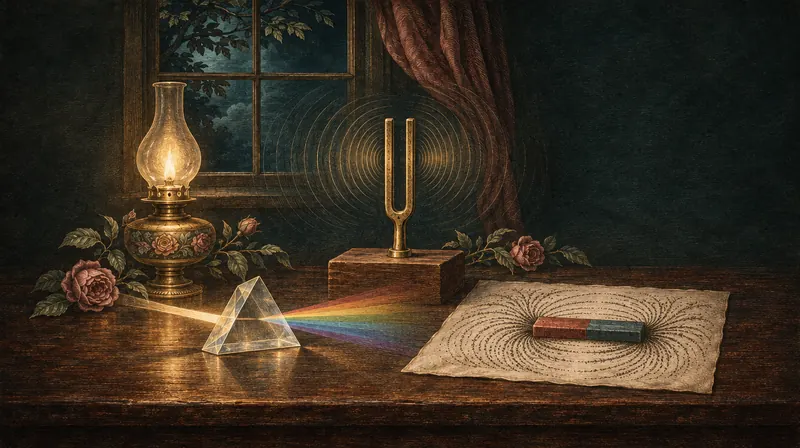
Where they truly met, and where they did not
Ask the OracleHow do quantum physics and the esoteric traditions truly meet, and where do they not?
Physics and the esoteric traditions have met in three ways, and the three are easily confused. Instruments do measure small electric and magnetic fields made by the heart and the brain. Several of the makers of quantum physics did read the Upanishads, the Chinese classics or Carl Jung, and said so. And since the 1970s a large popular literature has used the word quantum for things that are not physics at all.
The house keeps the three apart. What is measured is told as measurement, with its numbers. What the physicists took from the mystics is told as their own reading, in their own words. What is only a likeness is called a likeness: nothing shows that thoughts or feelings travel as waves and change events, and the sayings about 3, 6 and 9 credited to Tesla have no known source.
As the physics of fields and quanta in the company of the mystics teaches it.
The first lesson of this art is to know what kind of sentence one is reading. A sentence of physics speaks of something measured. Its words name quantities, each with a unit and an instrument that reads it: a voltage in volts on a meter, a magnetic field in teslas on a magnetometer, a frequency in hertz, the cycles counted in one second. A law of physics is a relation between such quantities, written in mathematics, that says before a measurement is made what it will show. It is trusted because others, rivals among them, have made the measurement and found the same, and it stands only until a measurement goes against it.
A sentence of the mystics speaks of something found in direct experience: in prayer, in contemplation, in the stillness of meditation. It has its own discipline, a practice, a teacher and a tradition that weighs one experience against another, but it has no unit and no meter, and no rival's instrument can try it. Neither kind of sentence is the lesser. They answer different questions, and most of the confusion in this art comes from reading one as though it were the other.
The astronomer Arthur Eddington, a Quaker, opened a book of lectures on the new physics with an image that still serves. He had sat down, he said, to write at two tables. One was the table he had known all his life: solid, coloured, lasting, with a top that held up his paper. The other was his scientific table, mostly empty space, sparsely scattered with electric charges rushing about at great speed, which held up his paper because those charges kept striking its underside. They are the same table. Physics gives the second account with great exactness; ordinary experience gives the first.
Eddington drew the lesson that physics knows the world through pointer readings, the positions of needles on dials, and the relations among them. It tells the structure of things and how much there is of each, and it is silent on what a thing is in itself and on what it is like to be the one who looks. That silence, he held, leaves room for the mystic's kind of knowing, which physics can neither prove nor rule out. Erwin Schrödinger reached the same place from another side, by what he called the principle of objectivation, which is taught with the physicists on their own page.
A handful of words travel between the two kinds of sentence, and each is exact in physics. Energy is the capacity to do work, counted in joules. A wave is a disturbance that carries energy from place to place while the water or air it passes through stays roughly where it was. Frequency is how many times a repeating motion happens in one second, and a vibration is that motion itself. A field is a quantity with a value at every point of a region, as the pull of a magnet has a strength and a direction everywhere in the space around it. A quantum is the smallest amount in which energy of a given frequency is given off or taken in.
In the teachings of the spirit the same words name other things. Energy stands for the life-force that the yogic traditions call prana and the Chinese call qi; vibration and frequency stand for the level or the mood of a soul; a field stands for a medium joining one person to another. These meanings belong to their own traditions, and they are not the physicist's meanings. No instrument has found a thought or a feeling travelling out as a wave, and nothing measured shows one changing events. So a student asks, each time one of these words appears, which sense is meant, and notices when a sentence borrows the weight of the physicist's sense while speaking in the other.
The exact meanings are taught at length on their own pages. The body's measured fields are on What is measured. The quantum words are on the page called Likeness, not physics. Energy, frequency and vibration are on the page about Tesla and 3, 6, 9.
The mystical teachings that physicists have set beside their science are few, and each is old. The Upanishads teach that the self at the core of each person, the atman, is one with brahman, the ground of all that is, and put it in three words, tat tvam asi, thou art that. In the Vedanta that Schrödinger loved, the many things and the many selves are appearances of that one reality.
The Tao Te Ching teaches that opposites arise together and complete each other: being and not-being give rise to each other, hard and easy complete each other, long and short shape each other. The Tao that can be spoken of is not the constant Tao, so the deepest thing is pointed to and never caught in words. Yin and yang, the dark and the bright in one circle, each holding a seed of the other, are the image of this teaching.
The Buddha teaches that nothing stands alone and nothing stays: every thing arises in dependence on others and passes as they pass. When this is, that is; when this arises, that arises. In Greece, Heraclitus taught that all things flow, and that the world is an ever-living fire, kindled and quenched in measure.
These are the teachings the physicists heard: Schrödinger the one self of the Upanishads, Niels Bohr the complementary opposites of the Tao, Werner Heisenberg the fire of Heraclitus, and David Bohm an undivided whole in which each thing is enfolded in all the rest. Their own words are given on The physicists who read the mystics.
The Mundaka Upanishad divides knowledge in two. The lower is the knowledge of the sacred texts and of the sciences, grammar, metre and astronomy among them. The higher is the knowledge by which the imperishable is grasped. In that division the whole of physics, however deep, belongs to the lower knowledge, and the mystic's seeing to the higher; the one is had by measuring and reasoning, the other by a change in the one who knows.
The sources of this art differ on how the two kinds meet. Fritjof Capra, in The Tao of Physics, holds that they arrive by two roads at one view of the world, a web of relations in ceaseless motion, and sets the sayings of physicists and sages side by side to show it. Schrödinger, Heisenberg, Einstein and most of the founders who read the mystics held instead that physics neither proves the mystic's view nor needs it, and kept their faith and their science apart. Wolfgang Pauli hoped for a day when physics and psyche would be seen as two faces of one reality, and Bohm proposed an order beneath both, but neither offered it as a finding. A student can learn from Capra's likenesses and still keep the founders' caution: a likeness of words is a meeting of minds, not a result of experiment.
A student begins with one sentence that joins physics and spirit, taken from a book, a talk or a post, and asks three questions of it. Is a quantity named, with its unit, its size and the instrument that measured it, and has anyone outside the group that made the claim measured it again? Whose words are these, on what page, and are they physics, philosophy or personal faith? And where the sentence speaks of the observer, does it still say what it means to say when the word detector is put in its place?
The answers are written in a notebook beside the sentence. Over a few weeks the notebook sorts itself: what is measured, what the physicists said in their own voices, and what is a likeness. A likeness can be kept with pleasure, as a poem is kept; the art asks only that it be called by its name.
Two habits belong to the first weeks as well. One is to read a single primary text whole; the epilogue of What Is Life? is short enough for an evening, and in it Schrödinger marks for himself where the science ends and his own view begins. The other is to keep one's own experience in plain words. A warmth felt in the hands during prayer is a warmth felt in the hands, and is honestly set down as that, whatever it is later taken to mean.
What is measured is the ground: the small electric and magnetic fields that the heart and the brain truly make, how strong they are and how fast they fade. The physicists who read the mystics gives the founders in their own words, from Schrödinger's one mind to Bohm's implicate order. On the page called Likeness, not physics, the quantum words are taught as the textbooks use them: the observer, entanglement and the field of possibilities, each beside the teaching that borrows it.
The page about Tesla and 3, 6, 9 sets what Tesla built and wrote beside the sayings credited to him, for which no source has been found, and shows why the famous numbers behave as they do. Synchronicity gives Jung's teaching of meaningful coincidence, which he worked out with Pauli's help. A student does well to start with What is measured and with the physicists, since those two pages hold the art's firm ground, and to come to the likenesses after, carrying the three questions.
The brain and the heart do make small electric and magnetic fields, and instruments measure them. Nothing shows that thoughts or feelings travel as waves and change events. The quantum physics named in spiritual teaching is a likeness, not the physics, and the sayings about 3, 6 and 9 credited to Tesla have no known source.
Each one is a question you can ask.
The small electric and magnetic fields of the heart and the brain.
What does physics actually measure of the body’s electromagnetic field, in the heart and the brain?
Schrödinger, Bohr, Pauli, Bohm.
Which makers of quantum physics read the mystics, and what did they take from them?
Where “quantum” in spiritual teaching stops being physics.
Where does quantum physics stop and spiritual metaphor begin?
What Tesla did, and the sayings credited to him without a source.
What did Nikola Tesla truly say about energy, frequency and vibration, and the numbers 3, 6 and 9?
Jung and Pauli’s name for a coincidence that means something.
What did Jung and Pauli mean by synchronicity, and how does it relate to quantum physics?
Each opens its page in the dictionary.
Austrian-born physicist, Nobel laureate of 1945 for the exclusion principle, one of the makers of quantum mechanics. From 1932 he was analysed in Carl Jung’s circle, and the two exchanged letters until his death. In 1952 they published a book together: Jung’s essay on synchronicity beside Pauli’s on the archetypes in Kepler’s astronomy. Pauli hoped for one language for matter and psyche; he never claimed that physics had proved it.
Serbian-American inventor and engineer. His induction motor and polyphase system (patents of 1888) made alternating current the way the world moves power; the Tesla coil (1891) and work on wireless signalling and remote control followed. His tower at Wardenclyffe, meant to send power without wires, was never put to work. He died alone in a New York hotel in 1943. Biographers record his compulsions with the number three: he walked round a block three times before entering a building, and wanted rooms whose numbers divided by three.
American painter, sculptor and self-taught philosopher of nature. In The Universal One (1926) and The Secret of Light (1947) he described a universe of one still Light dividing into paired waves, and drew spiral charts of the elements. With his wife Lao he founded the University of Science and Philosophy at Swannanoa in Virginia.
Swiss psychiatrist, founder of analytical psychology. He studied alchemy, Gnosticism, astrology and the I Ching as pictures of the psyche: Psychology and Alchemy (1944), the idea of synchronicity, and The Red Book, written from 1914 to 1930 and published in 2009. He wrote that he sometimes cast a patient’s horoscope to understand them, and his own statistical test of astrology and marriage proved nothing either way.
DreamsTarot, runes, I ChingAlchemyConspiracies, examinedThe sixth sense
Make today specific
The same sky reaches everyone differently. Your birth details turn a general forecast into one theme, and one thing worth doing about it.
One instrument, one answer. Explore the preview; membership opens every tool.
Read more

