
Erwin Schrödinger
1887 to 1961
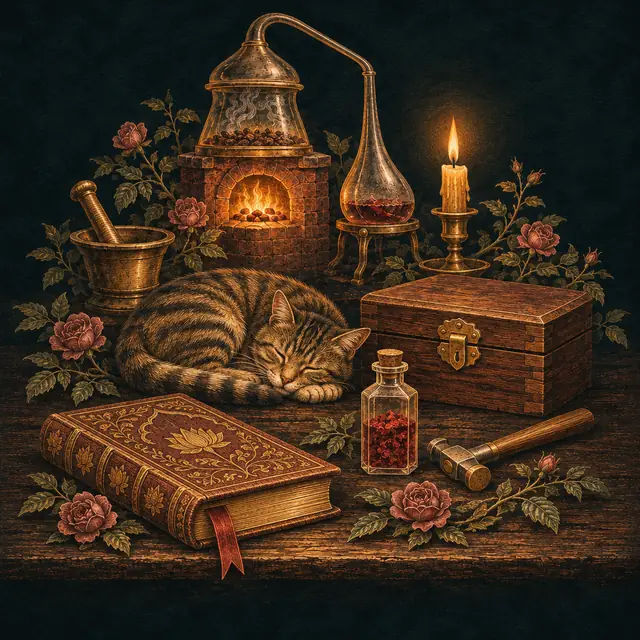
Who was Erwin Schrödinger, and what is truly known of them?
What is known
Austrian physicist. His wave equation of 1926 is the working tool of quantum mechanics and brought him the Nobel Prize in 1933. He left Germany that year, lost his chair at Graz after the annexation of Austria, and worked from 1939 to 1956 in Dublin, where he wrote What Is Life? (1944). The cat in the box is his thought experiment of 1935. He read Schopenhauer and the Upanishads all his life and set out a Vedantic creed, that there is one mind and the many selves are its appearances, in My View of the World, written in 1925 and 1960. His biographers also record his pursuit of girls in their teens, after which Trinity College Dublin moved in 2022 to take his name off a lecture theatre.
The teaching
Taught from his own papers and books, above all the papers of 1926 and 1935, What Is Life? (1944) and My View of the World.
The wave equation
Schrödinger's papers of 1926 describe the electron in an atom not as a point in an orbit but as a wave, and the stable states of the atom as the standing patterns that wave can form. A violin string held at both ends can vibrate only in certain ways, its fundamental and its harmonics, and the whole numbers that count them come from the string itself. In the same way the allowed energies of the atom are the proper values of his equation, and the whole numbers of quantum theory arise, as he wrote, as naturally as the number of nodes of a vibrating string, with no rule laid on from outside. The wave function the equation governs became the working tool of the physics of atoms, molecules and solids.
The cat and the entangled pair
In 1935 he set out a case he called ridiculous. A cat is shut in a steel chamber with a tiny amount of radioactive substance, a counter, a hammer and a flask of poison, so arranged that if one atom decays within the hour the counter fires, the hammer breaks the flask and the cat dies, and the chance of that is even. If the quantum description were taken as a picture of reality, the state of the whole chamber after the hour would hold the living and the dead cat smeared out in equal parts. His point was that such a blurred model cannot simply be accepted as a picture of the world: the theory needs a clearer account of what its description means.
In the same year he named the feature that makes such cases possible. When two systems have interacted and separated, the best possible knowledge of the whole does not include the best possible knowledge of its parts; their descriptions are entangled, and he called this not one but the characteristic trait of quantum mechanics.
Order from order
What Is Life? asks how a living thing, made of atoms, keeps its order while the rest of nature runs down toward disorder. The laws of physics and chemistry, he explains, are statistical, true for the great numbers of atoms in ordinary things, which is why an organism must be large compared with an atom; this is order from disorder. But heredity rests on very few atoms, the gene, and keeps its pattern unchanged through generations, so it must work by a different principle, order from order, the stability of a molecule held by quantum forces.
He pictured the gene as an aperiodic crystal: not a repeating lattice like salt, but a solid whose atoms are arranged in a sequence that varies, carrying in a small space what he called a code-script, the whole pattern of the individual's future development. Mutations are quantum jumps in that molecule. A living body avoids decay by drawing order from its surroundings, feeding, as he put it, on negative entropy.
The one mind
His philosophy, that consciousness is never found in the plural, that the many minds are one, and that science leaves the knowing subject out of its picture of the world, is taught in the branch The physicists who read the mystics of Physics and the mystics. He held it beside his physics as a view of his own, taken from the Upanishads and from Schopenhauer.
My View of the World gives it the form of a meditation. Sit, he writes in effect, before mountains and fields, and consider that this knowing, feeling and choosing that you call your own cannot have sprung from nothing a few years ago; it is, in the conviction of the Vedanta, eternal and numerically one in all who feel. Then you may lie on the ground, stretched out on the earth, certain that you are one with her and she with you, and as firmly established as she. The Brahmins, he writes, put it in a formula at once mystic and simple: tat tvam asi, this is you.
Orders and memberships
No lodge, church office or secret order is documented. He was a member of several academies of science and senior professor at the Dublin Institute for Advanced Studies. He called himself an atheist while taking his view of the one mind from the Upanishads.
The legend
That his equation shows that the mind makes the world, or that the cat is in fact alive and dead at once. He devised the cat to show how absurd it would be to carry the quantum description up to everyday things. His Vedanta was a philosophy he held beside his physics; he offered it as his own view and never as a result of the science.
Their works
- Quantisation as a Problem of Proper ValuesEssay, 1926
Four papers in the Annalen der Physik in which he set out his wave equation for the electron. It became the working tool of quantum mechanics and brought him the Nobel Prize in 1933. It is pure physics and makes no claim about mind.
Ask the Oracle about it - The Present Situation in Quantum MechanicsEssay, 1935
The paper in which he set out the thought experiment of the cat in the box. He devised it to show how absurd it would be to carry the quantum description up to everyday things. It is often misread as saying the cat is truly alive and dead at once.
Ask the Oracle about it - What Is Life?Lectures, 1944
Public lectures given in Dublin in 1943 on how living things keep order and pass it on. Its idea of a code held in the molecules of heredity inspired several of the scientists who later found the structure of DNA. Its epilogue sets out his view that there is one mind.
Ask the Oracle about it - Mind and MatterLectures, 1958
The Tarner lectures he gave at Cambridge in 1956, on consciousness and its place in the scientific picture of the world. He argues that the many minds are one, a view he took from the Upanishads. He offered it as his own philosophy and never as a result of the science.
Ask the Oracle about it - My View of the WorldEssays, printed 1961
Two essays written in 1925 and 1960, setting out his Vedantic creed that there is one mind and the many selves are its appearances. It is the most personal statement of his philosophy. He held it beside his physics, as a view and not a finding.
Ask the Oracle about it
How the house tells a life
This life is told from the record, with what is documented, what is legend and what was forged kept apart. A membership in an order is stated only where documents show it. A person’s chart explains none of their deeds.
The arts it feeds
Lives near it in time
Thinkers and teachers
Ramana MaharshiAlvin Boyd KuhnHazrat Inayat KhanNapoleon HillNiels BohrRené GuénonErnest HolmesKrishnamacharyaParamahansa YoganandaAldous HuxleyJiddu KrishnamurtiJ. B. RhineThe whole tree

