
Ramana Maharshi
1879 to 1950
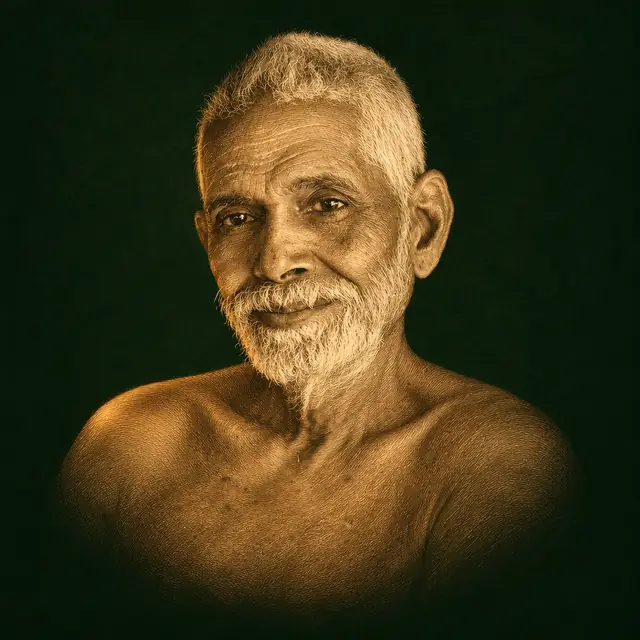
Who was Ramana Maharshi, and what is truly known of them?
What is known
Born Venkataraman Iyer at Tiruchuli in Tamil Nadu. By his own account, at sixteen, in July 1896 at Madurai, a sudden fear of death made him lie down and ask what it is that dies, and the asking left him settled in the sense of a self that does not. Six weeks later he left home for the temple town of Tiruvannamalai, at the foot of the hill Arunachala, and never left it again. He lived for years in silence in the temple and in caves on the hill, and an ashram grew round him from 1922. He wrote little, a few hymns and short works, and taught chiefly by the question “Who am I?”. Paul Brunton’s A Search in Secret India (1934) made him known in the West.
The teaching
Taught from his own words, above all Who Am I? and the Upadesa Saram, with the talks recorded at his ashram.
Happiness and the self
All living beings, Ramana teaches, want to be happy always, without any misery, and in everyone there is the greatest love for oneself. Happiness is the cause of that love, and happiness is one's own nature, known every night in deep sleep, where there is no mind. To gain that happiness one must know oneself, and the chief means is the enquiry in the form of the question Who am I?
Not this, not this
Who am I? The gross body, made of the seven humours, I am not. The five senses of hearing, touch, sight, taste and smell, I am not. The five organs of action, of speech, movement, grasping, excretion and procreation, I am not. The five vital airs that breathe and digest, I am not. Even the mind that thinks, I am not; and even the ignorance of deep sleep, which holds only the traces of things, I am not. When all of these have been set aside as not this, not this, the awareness that alone remains, that I am. Its nature is existence, consciousness and bliss.
The mind and the I-thought
The mind is a wondrous power residing in the self, and apart from thoughts there is no such thing as mind. Apart from thoughts there is no world either: in deep sleep there are no thoughts and no world, and in waking and dreaming there are both. As the spider spins its thread out of itself and draws it back again, the mind projects the world and withdraws it. When the world appears the self does not appear, and when the self shines the world does not.
Of all the thoughts that rise in the mind, the thought I is the first, and only after it do the others come, as the second and third persons come only after the first. If one asks where in the body the thought I first rises, one finds that it rises in the heart, and that is the mind's source.
The enquiry
When other thoughts arise, do not follow them, but ask: to whom have they arisen? It does not matter how many arise. The answer comes: to me. Then ask: who am I? The mind turns back to its source, and the thought that arose subsides. With repeated practice the mind learns to stay in its source. Keeping it there, in the heart, is called inwardness, and letting it go out is called externalisation; when it stays in the heart, the I that is the source of all thoughts goes, and the self that always exists shines. Whatever one does, he adds, one should do without the sense of I as the doer.
The enquiry is needed as long as the impressions of things remain in the mind. As long as there are enemies inside a fortress they keep sallying out; destroy each as it comes out, and the fortress falls. Nor should anyone weep that they are too great a sinner: let them give up the thought I am a sinner and keep to the enquiry. The mind is one, he says, and it is only its impressions that are good or bad. The enquiry is meant to quiet the mind; anyone it disturbs should rest from it and speak with a teacher or a doctor.
Breath, mantra and food
Other means, he teaches, can make the mind quiet, but not destroy it. The mind and the breath have one source, so that when the breath is controlled the mind is still, but only so long as the breath is held, and when it moves again the mind wanders as before; breath control is an aid, not the way, and the house adds that the breath is never to be forced. Meditation on a form of God and the repetition of a mantra make the mind one-pointed, as an elephant given a chain to hold in its trunk holds that and nothing else, and a one-pointed mind finds the enquiry easy. Of all the rules of restraint, the best is to take pure food in moderate measure.
His thirty verses of the Upadesa Saram give the same order: action done without desire for its fruit purifies the mind; worship by body, speech and mind follows, and the repetition of a name is better silent than aloud, and better unbroken, like a stream of oil, than broken; breath control holds the mind as a net holds a bird; and the enquiry into the mind finds that there is no mind, which is the direct path.
Surrender
There are two ways, he told visitors: ask yourself who am I, or surrender completely. The greatest devotee is the one who gives himself up to the self that is God, remaining in the self without letting any other thought rise. Whatever burdens are thrown on God, He bears them; we are like travellers who have boarded a train and still carry our small luggage on our heads, when we could put it down and let the train carry it.
The guru, books and silence
God and the guru, who are not different, show the way to freedom, but they do not carry anyone there; each must walk it by their own effort and know the self with their own eye of knowledge. Does Rama need a mirror to know that he is Rama? Books all say that the mind must be made quiet, and once that is understood there is no need for endless reading: a time comes when one must forget all one has learned. Telepathy and knowledge of the future are not wisdom; wisdom is to remain quiet, the mind resolved in the self. That stillness he called silence, and it was his chief teaching: he taught more by sitting in silence than by words, and many who sat with him spoke of the silence as what taught them most.
Orders and memberships
None. He took no formal vows, was initiated by no teacher and named no successor, though his teaching agrees with Advaita Vedanta and he is often placed in that tradition.
The legend
A meteor was reported crossing the sky towards Arunachala at the hour of his death on 14 April 1950, by the photographer Henri Cartier-Bresson among others; that it was a sign is the belief of his devotees. The healings and the animals drawn to him that are told in the ashram’s books are given as his followers experienced them.
Their works
- Who Am I?Teaching, printed 1923
His answers, given about 1902 to a visitor named Sivaprakasam Pillai, to questions on the self and how to know it. He was then keeping silence and wrote some of the answers in the sand. Printed and revised many times, it is the core of his teaching of self enquiry.
Ask the Oracle about it - Five Hymns to ArunachalaPoem, about 1914
Hymns in Tamil to the hill Arunachala, which he took as the form of the divine. The first, the Marital Garland of Letters, was sung by his followers as they went for alms. They show the devotion that stood beside his teaching of enquiry.
Ask the Oracle about it - Upadesa SaramPoem, 1927
The Essence of Instruction, thirty verses he wrote in Tamil at the request of a poet, setting out the paths of action, devotion, yoga and knowledge. He later put it into other Indian languages himself. It is one of the shortest summaries of his teaching.
Ask the Oracle about it - Forty Verses on RealityPoem, 1928
Ulladu Narpadu, forty Tamil verses on the nature of the self and the world, with a supplement of forty more. It is his fullest written work. Commentaries on it have been written by his followers since.
Ask the Oracle about it - Talks with Sri Ramana MaharshiAccount, printed 1955
Conversations with visitors from 1935 to 1939, recorded by Munagala Venkataramiah in the ashram. It shows how he answered questions from many kinds of people. It is the largest record of his spoken teaching.
Ask the Oracle about it - A Search in Secret IndiaAccount, 1934
The book by the English journalist Paul Brunton telling of his travels among Indian holy men, which ends with his meeting with Ramana. It made Ramana known in the West, and many visitors came because of it. It is a traveller’s story and not a study.
Ask the Oracle about it
How the house tells a life
This life is told from the record, with what is documented, what is legend and what was forged kept apart. A membership in an order is stated only where documents show it. A person’s chart explains none of their deeds.
The arts it feeds
Lives near it in time
Thinkers and teachers
Charles HaanelD. T. SuzukiWalter RussellFlorence Scovel ShinnSri AurobindoP. D. OuspenskyAlvin Boyd KuhnHazrat Inayat KhanNapoleon HillNiels BohrRené GuénonErwin SchrödingerThe whole tree

