
Sri Aurobindo
1872 to 1950
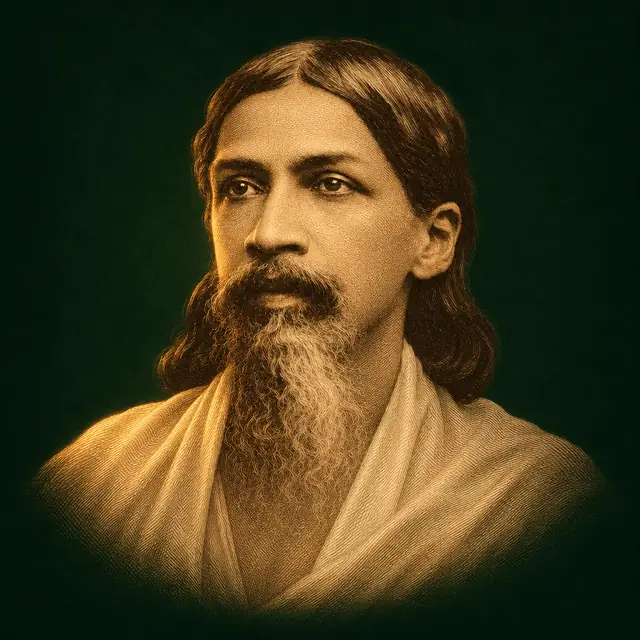
Who was Sri Aurobindo, and what is truly known of them?
What is known
Aurobindo Ghose, born in Calcutta and schooled in England from the age of seven; he read classics at King’s College, Cambridge. After thirteen years in the service of the princely state of Baroda he became a leader of the radical wing of the national movement in Bengal and editor of the paper Bande Mataram. He was held for a year in the Alipore bomb case of 1908 and acquitted in 1909, and said that an inner turning came to him in the gaol. In 1910 he withdrew to French Pondicherry, where he wrote The Life Divine, The Synthesis of Yoga and the long poem Savitri, and taught what he called integral yoga. He was nominated for the Nobel Prize in Literature in 1943 and for the Peace Prize in 1950.
The teaching
Taught from his own books, above all The Life Divine, The Synthesis of Yoga, Essays on the Gita and Savitri.
Sachchidananda and the descent
Sri Aurobindo begins from the Upanishads: the one reality is Sachchidananda, existence, consciousness-force and bliss. The world is not an illusion laid over it but its self-expression, and he describes it as a sevenfold chord of being: existence, consciousness-force and bliss above; supermind, the truth-consciousness that holds them together; and below it mind, life and matter. The spirit has descended through all these into matter, hiding itself there, and this descent he calls involution.
Evolution is the return. Because the spirit is involved in matter, matter has brought forth life, and life has brought forth mind; and since mind is not the last term of what was involved, evolution cannot stop with it. The next step is the emergence of supermind in a new kind of being, and a divine life on earth, not an escape from it.
The Ignorance and the planes above mind
Our present consciousness is the Ignorance: not a fall and not a mistake, but a self-limitation of knowledge, a partial knowledge working its way toward the whole out of an Inconscient beginning. Mind is its instrument, and mind divides, measures and seeks. Above the ordinary mind he names a series of planes: the Higher Mind, which thinks in masses of ideas at once; the Illumined Mind, which works by vision and light; Intuition, which sees the truth directly; the Overmind, a global consciousness that holds many truths together but separately; and the Supermind, the truth-consciousness in which knowledge and will are one.
All life is yoga
All life is yoga, The Synthesis of Yoga declares, and his integral yoga takes up the old paths of works, knowledge and devotion, with the yoga of self-perfection, into one. Its aim is not release from the world but the transformation of the whole nature, mind, life and body, so that it can express the divine. It is not done by the seeker's effort alone: the work is that of the divine Shakti, the Mother, the conscious force of the Divine, to whom the seeker opens.
Its method, as he and the Mother taught it, is threefold. Aspiration is a constant, vigilant call to the Divine from the heart. Rejection is the steady refusal of the movements of the lower nature, desire, ego, falsehood and fear, not by suppression but by not consenting to them. Surrender is the giving of oneself and all one is and has to the Divine. He warns that higher forces brought down into a nature still ruled by ego bring confusion, which is why purification and sincerity come first.
The psychic being
Behind the heart, deeper than mind and emotion, is the psychic being, the evolving soul: a spark of the Divine that passes from life to life, taking into itself the essence of each experience and growing. In most people it stays veiled and acts only as a faint sense of the true and the good. The first change of the yoga, the psychic transformation, is to bring this soul forward to lead the nature, so that thought, feeling and action turn of themselves toward truth, love and beauty.
The second is the spiritual transformation, the descent from above of peace, light, force and bliss into the whole being, which widens it into the cosmic consciousness. The third, the supramental transformation, is the hope of the whole work: the descent of the truth-consciousness into the nature, even into the body.
The Gita and divine works
In Essays on the Gita he reads the dialogue on the field of Kurukshetra not as a call to leave the world but as a teaching of divine works. Krishna, the divine teacher in man, tells Arjuna to act without desire for the fruit, to offer every work as a sacrifice, to rise above the three qualities of nature, and at last, in the secret of secrets, to abandon all lesser rules of conduct and take refuge in the Divine alone. Action so offered becomes a way to God as surely as contemplation.
Savitri
In the Mahabharata, Savitri, a king's daughter, chooses for her husband Satyavan, though she is told that he must die within a year. On the day foretold, Death comes for him in the forest; she follows Death, refuses to be turned back, answers him with wisdom and love, and wins her husband's life. Sri Aurobindo's long poem makes the tale a symbol, as he says in his note on it: Satyavan is the soul carrying the divine truth of being, descended into the grip of death and ignorance; Savitri is the divine Word, daughter of the Sun, come down to save; her father Aswapati is the concentrated spiritual effort that calls her down; and her victory over Death is the conquest that the whole evolution is moving toward.
Orders and memberships
He belonged to no religious order. The community that gathered round him became the Sri Aurobindo Ashram in 1926, which he placed in the charge of his French collaborator Mirra Alfassa, known as the Mother. In his political years he was tied to secret revolutionary societies in Bengal.
The legend
That his body lay for some days after death without decay because it was charged with light, as the ashram announced in December 1950. And the hope, taught by him and the Mother, that a higher consciousness he called the supermind would descend and change human nature: it is a teaching, and nothing that can be measured has been claimed for it.
Their works
- The Life DivineBook, 1914 to 1919
His chief philosophical work, printed first in his monthly Arya and revised as a book in 1939 and 1940. It sets out a view of the universe as the gradual unfolding of spirit in matter, with the hope of a higher consciousness he called the supermind. It joins Vedanta to a modern idea of evolution.
Ask the Oracle about it - SavitriPoem, 1950 to 1951
A long poem in blank verse retelling the tale from the Mahabharata of Savitri, who wins her husband back from Death. He worked on it for some thirty years and saw it as the fullest statement of his vision. It is among the longest poems written in English.
Ask the Oracle about it - The Synthesis of YogaBook, 1914 to 1921
His account of integral yoga, which joins the yogas of knowledge, devotion and work into one path. It was printed in Arya over seven years and gathered as a book later. It is the main guide to the practice of his ashram.
Ask the Oracle about it - Essays on the GitaEssays, 1916 to 1920
A long commentary on the Bhagavad Gita, read as a teaching of action in the world rather than of withdrawal. It was printed first in Arya. It became one of the best known modern readings of the Gita.
Ask the Oracle about it - Bande MataramNewspaper, 1906 to 1908
The English paper of the radical nationalists of Bengal, which he edited and largely wrote. Its call for full independence from Britain led to his trial for sedition in 1907, at which he was acquitted. It records the political years before his turn to yoga.
Ask the Oracle about it
How the house tells a life
This life is told from the record, with what is documented, what is legend and what was forged kept apart. A membership in an order is stated only where documents show it. A person’s chart explains none of their deeds.
The arts it feeds
Lives near it in time
Thinkers and teachers
W. B. YeatsGeorge GurdjieffCharles HaanelD. T. SuzukiWalter RussellFlorence Scovel ShinnP. D. OuspenskyRamana MaharshiAlvin Boyd KuhnHazrat Inayat KhanNapoleon HillNiels BohrThe whole tree

