
P. D. Ouspensky
1878 to 1947
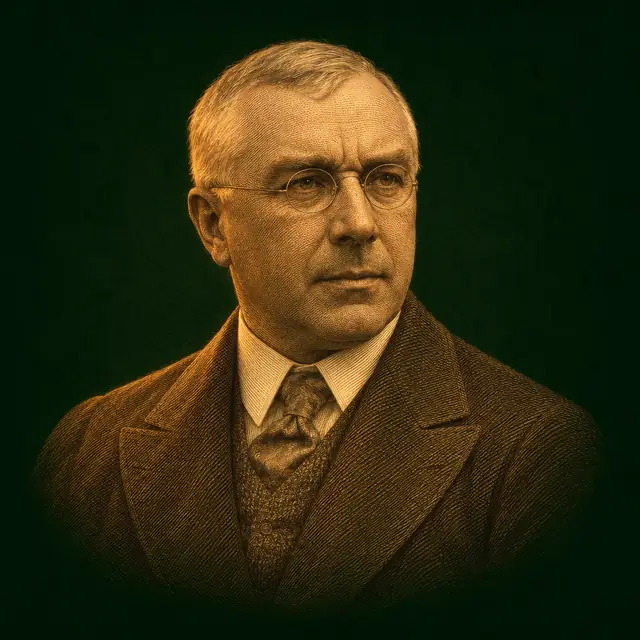
Who was P. D. Ouspensky, and what is truly known of them?
What is known
Russian journalist and writer, born in Moscow. Tertium Organum (1912) argued that time is a fourth dimension the mind does not yet see, and made his name. He travelled to India and Ceylon in search of a school, came home at the outbreak of war, and in 1915 met Gurdjieff in Moscow and became his pupil. He parted from him by stages after 1918, settled in London in 1921 and taught “the system” there to private groups for twenty years, then in America. In Search of the Miraculous, his record of Gurdjieff’s teaching, was printed in 1949, two years after his death in Surrey.
The teaching
Taught from his own books, above all Tertium Organum (1912), A New Model of the Universe (1931) and The Fourth Way.
The world as we perceive it
Ouspensky begins Tertium Organum from Kant. We do not know the world in itself; we know only our perceptions of it, and space and time are the forms in which our perceiving mind arranges them. What we call the world is a section of something larger, cut by the limits of our senses, and a different consciousness would perceive a different world. Behind every phenomenon stands a noumenon, its hidden meaning, and art, love and mystical experience are the faculties by which the noumenal side of things is glimpsed.
Time as the fourth dimension
His great argument is by analogy. A being that could perceive only a line would experience whatever crossed its line from outside as an event in time, appearing and vanishing. A being of a plane would take a solid passing through its plane for a figure that grows, changes and disappears. So, he argues, our time is an imperfect sense of a fourth dimension of space, and the motion and change we see are our way of perceiving, in sections, a body of four dimensions.
He finds the same ladder among the animals. A snail, he holds, lives in a world of one dimension, feeling only the line of its path, with everything else coming to it as time. A dog or a horse lives in a world of moving planes: the angles and curves of solid things, which shift as the animal moves, appear to it as motion, so that our third dimension is its time. A human being perceives three dimensions and feels the fourth as time; the higher consciousness that mystics describe would perceive it as space, and see whole what we see moment by moment.
The logic of the infinite
Tertium Organum, the third instrument of thought, takes its name from Aristotle's Organon and Bacon's Novum Organum, and claims to be older than both. Their logic, that A is A and cannot be not-A, holds for the finite world of separate things. In the world of the infinite and of causes, he argues, its axioms fail, and if one tries to put the higher logic into words it comes out as an absurdity: A is both A and not-A; everything is all. The absurdity is the sign that the mind has touched the noumenal world, and he gathers the testimony of mystics of many ages, from the Upanishads' that thou art to Plotinus and Boehme, as reports from it.
Eternal recurrence
A New Model of the Universe extends the dimensions further. Beyond the three of space and the fourth, time, the fifth is eternity, in which each moment does not vanish but exists for ever, and the line of time bends into a circle; the sixth is the realisation of all the possibilities that the line of one life leaves unrealised. A life, in this teaching, recurs: when it ends it begins again, and a person lives the same life once more, with the same events, unless something in them has changed.
His novel Ivan Osokin puts the doctrine into a story: a man is granted his life again from his school days, knowing everything, and makes every mistake again, because knowledge without inner change alters nothing. The only hope, as Ouspensky teaches it, is to change in this life, so that the next turn of the circle is not the same.
The tarot as pictures of the inner life
Before he met his teacher he wrote prose poems on the twenty-two trumps of the tarot, reading each card not as a fortune but as a picture of an inner state, and he set them out in a triangle with seven cards on each side and the Fool at its centre. The tarot, as he treats it, is a picture alphabet of the inner life, to be contemplated rather than used to foretell.
The system as he taught it
In his London groups he taught the system he had learned from Gurdjieff, and he began always with the same fact: man, as he is, does not know himself, has no permanent I, and cannot do. There are four states of consciousness: sleep; the waking state, which is really a waking sleep; self-consciousness, which people believe they have and do not; and objective consciousness. The work is to reach the third. Its first method is self-observation, and its key is self-remembering, which he described as a divided attention, an arrow pointing two ways at once, toward the thing observed and back toward the one observing.
He laid special stress on the struggle against the expression of negative emotions, which he held to be useless and to belong to no real centre, and on the study of lying and imagination in oneself. He taught that man is an unfinished being whose further evolution is possible but not automatic, and comes only to the few who make conscious efforts; that such work needs a school, which cannot be invented, but only received from those who know; and that it goes along three lines at once, work on oneself, work with others, and work for the school.
Orders and memberships
He joined the Theosophical Society in St Petersburg after 1907, lectured to it, and left in 1916. No other order is documented; the groups he led in London from 1921 were his own, and he asked their members not to publish what was taught.
The legend
That he found the hidden school he went east to look for. By his own account he did not: he met his teacher in a Moscow café. In his last months, in 1947, he told his pupils that there was no system and that each must begin again; what he meant is still argued over.
Their works
- Tertium OrganumBook, 1912
His book arguing that time is a fourth dimension the mind does not yet see, and that a higher consciousness can come to perceive it. Its title sets it after the logic of Aristotle and of Francis Bacon. It made his name in Russia, and in English translation in America.
Ask the Oracle about it - In Search of the MiraculousBook, printed 1949
His record of Gurdjieff’s teaching in Russia from 1915 to 1918, written from memory and notes. It is the clearest account of the system ever printed, and many readers know Gurdjieff’s ideas chiefly from it. It was published two years after his death.
Ask the Oracle about it - The Symbolism of the TarotBook, 1913
A short book of prose poems on the trump cards of the tarot, written in Russia before he met Gurdjieff. It reads the cards as pictures of inner states. It was later included in his A New Model of the Universe.
Ask the Oracle about it - Strange Life of Ivan OsokinNovel, 1915
A novel in which a man is given his life to live again from his school days and makes the same mistakes. It puts into story his thought on recurrence and the difficulty of change. It was first printed in Russian and in English in 1947.
Ask the Oracle about it - A New Model of the UniverseBook, 1931
A large book of essays on esotericism, yoga, the tarot, dreams, eternal recurrence and the fourth dimension, many written before he met Gurdjieff. It shows the range of his own thinking. It was much read among those interested in his London groups.
Ask the Oracle about it - The Fourth WayLectures, printed 1957
Questions and answers from his meetings in London and New York, edited by his pupils after his death. It shows how he taught the system to groups over many years. It is often read with In Search of the Miraculous.
Ask the Oracle about it
How the house tells a life
This life is told from the record, with what is documented, what is legend and what was forged kept apart. A membership in an order is stated only where documents show it. A person’s chart explains none of their deeds.
The arts it feeds
Lives near it in time
Thinkers and teachers
George GurdjieffCharles HaanelD. T. SuzukiWalter RussellFlorence Scovel ShinnSri AurobindoRamana MaharshiAlvin Boyd KuhnHazrat Inayat KhanNapoleon HillNiels BohrRené GuénonThe whole tree

