
René Guénon
1886 to 1951
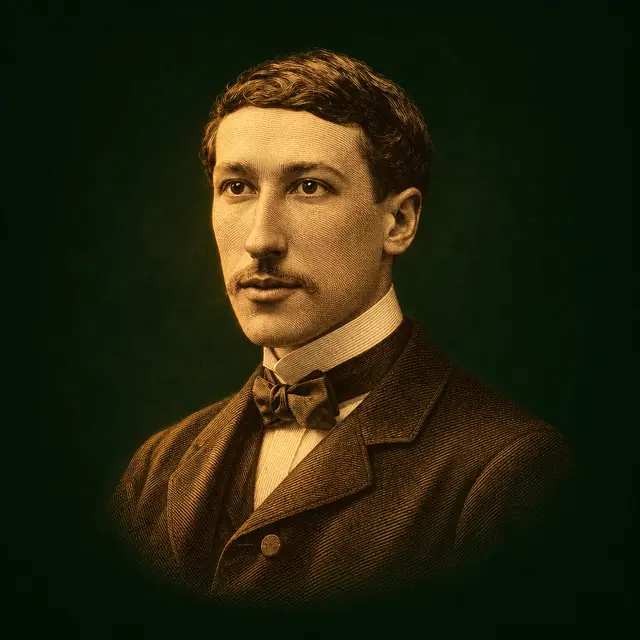
Who was René Guénon, and what is truly known of them?
What is known
French writer on metaphysics, born at Blois and trained in mathematics. As a young man in Paris he passed through nearly every occult group of the day and then turned on them, in books against Theosophy (1921) and against Spiritualism (1923). He held that one primordial tradition lies behind the Hindu, Taoist, Islamic and medieval Christian teachings and that the modern West has lost it: The Crisis of the Modern World (1927), The Reign of Quantity (1945). He was received into Sufism, took the name Abd al-Wahid Yahya, moved to Cairo in 1930, married there and died an Egyptian citizen.
The teaching
Taught from his own books, above all The Crisis of the Modern World (1927) and The Reign of Quantity (1945).
Metaphysics
Guénon teaches that there is a knowledge above philosophy and above all the sciences, which he calls metaphysics in its true sense: the knowledge of universal principles, of what lies beyond every individual state and beyond the world, beyond even Being, in the Infinite. It is not reached by reasoning, which belongs to the individual, but by intellectual intuition, a direct knowing in which the knower is identified with what is known, and its fruit is not an opinion but a realisation, the Supreme Identity of the self with the principle. Of all the forms in which it has been taught, he holds the Vedanta of India to be the fullest that survives.
The primordial tradition
Behind the Hindu doctrines, Taoism, Islam, Judaism and the Christianity of the Middle Ages stands, in his teaching, one primordial tradition, of more than human origin, of which each is a form adapted to a people and an age. Tradition means for him what is handed on: doctrine, rites and symbols received from a source above humanity and transmitted without break, and a civilisation is normal only so long as it is ordered by it. He speaks of a supreme spiritual centre, hidden in this age, from which the traditions descend, and in The King of the World gives it the names of Agartha and the Pole; no historical evidence supports such a centre, and he offers it as symbol and doctrine.
Exoteric and esoteric
Every tradition has two sides. The exoteric side is religion, addressed to all, with its law, its dogmas and its aim of salvation, the happy state of the individual after death. The esoteric side is initiation, open to few, whose aim is deliverance, the passing beyond the individual altogether. Initiation is not a matter of private study or of experience: it requires attachment to a regular traditional organisation, through which a spiritual influence is transmitted by rites in an unbroken chain, and self-initiation is impossible. What is received at initiation is a seed, a virtual initiation, which only long inner work can make effective.
The cycles and the dark age
History, he holds, is not progress but descent. Each great cycle, a manvantara in the Hindu reckoning, falls into four ages whose lengths stand as four, three, two and one, from the golden age to the dark age, the Kali Yuga, and the present is its last part. The descent is a movement away from the principle, from quality toward quantity, from essence toward matter, and the modern world is its end, which he sees as the beginning of a new cycle as well.
The crisis of the modern West
The modern West, he argues, is an anomaly: the only civilisation to have built itself on the denial of tradition. Since the Renaissance it has put the individual in place of principle, reason in place of intellectual intuition, the profane sciences, which know only the measurable, in place of the sacred ones, and material progress in place of the inner life; it has made the many the judge of the few, though the higher cannot come from the lower. The East, in his day, still kept its traditions, and the remedy he hoped for was an elite, few in number, who would recover the traditional understanding and keep it alive.
He held, too, that a traditional society rests on castes, functions answering to the natures of those who fill them; that is a ranking of people by birth and role, and the house does not hold it.
The reign of quantity
The Reign of Quantity describes the last phase. The world is first solidified: matter is conceived as pure quantity, time itself seems to contract, and uniformity, the likeness of interchangeable units, takes the place of true unity. Then the hardened world begins to crack, and through its fissures come influences from below, the lower psychic world, and a counterfeit of the spiritual that he calls the counter-initiation. Its mark is parody: the outward forms of tradition imitated and turned upside down.
The psychic is not the spiritual
Against the Theosophists and the Spiritualists of his youth he makes one distinction above all: the psychic is not the spiritual. What the medium contacts, in his teaching, is not the immortal being of the dead but psychic residues, fragments of the individual left behind like a shell, which other forces can animate. He rejects reincarnation as the Theosophists taught it, holding that a being never passes twice through the same state, and he calls the confusion of the psychic with the spiritual one of the signs of the times.
The language of symbols
Symbols, for Guénon, are the natural language of metaphysics, because the lower can stand for the higher by analogy, and every true symbol has meanings at every level. In The Symbolism of the Cross the horizontal line stands for the full extent of one state of being, and the vertical for the hierarchy of states; their meeting is the centre, where the Universal Man stands, and the vertical is the axis of the world. The heart, the centre and the pole are the same symbol in different forms, the point where the human state opens on what lies above it.
Orders and memberships
About 1906 to 1912 he belonged to Papus’s Martinist Order, from which he was expelled, was made a bishop of the small Gnostic Church, and joined a Masonic lodge in Paris. He was received into a Shadhili Sufi order through the painter Ivan Aguéli, in 1910 or 1912. All documented.
The legend
That the primordial tradition came down from a polar homeland at the start of the present age, and that a hidden centre, Agartha, still guides the world, as he argued in The King of the World (1927). No historical evidence supports either. His school also holds caste and hierarchy to be the natural order, and Julius Evola carried the same ideas into Fascism and racial theory; that ranking of people is a fault of the teaching, and no finding.
Their works
- The Crisis of the Modern WorldBook, 1927
His short book arguing that the modern West has lost the primordial tradition that lies behind the great religions, and that its science and individualism mark the dark age of the Hindu cycles. It is the clearest statement of his case against the modern world. It remains the most read of his books.
Ask the Oracle about it - The Reign of Quantity and the Signs of the TimesBook, 1945
His fullest account of the decline of the modern world, seen as a slide from quality to quantity at the end of a cosmic cycle. It is written from his conviction of a single tradition and offers no historical evidence for its cycles. It is seen by his followers as his chief work.
Ask the Oracle about it - Introduction to the Study of the Hindu DoctrinesBook, 1921
His first book, presenting Hindu metaphysics as an example of a living tradition and criticising Western scholars of India. It was refused as a doctoral thesis at the Sorbonne. It began his life’s work on tradition.
Ask the Oracle about it - Theosophy: History of a Pseudo-ReligionBook, 1921
His attack on the Theosophical Society, tracing its history and arguing that its teaching was a modern invention dressed as Eastern doctrine. It drew on his own years among the occult groups of Paris. It is still read as a hostile but well informed history.
Ask the Oracle about it - The Spiritist FallacyBook, 1923
His critique of Spiritualism, arguing that what mediums call spirits are no souls of the dead and that the movement is a symptom of modern confusion. He rejected both its believers and its rationalist critics. It completes his break with the occultism of his youth.
Ask the Oracle about it - The King of the WorldBook, 1927
A short book on a hidden spiritual centre he called Agartha, said to guide the world, drawing on the writer Saint-Yves d’Alveydre and the traveller Ferdinand Ossendowski. No historical evidence supports the idea of such a centre. It is the work of his most often taken up by later occult writers.
Ask the Oracle about it
How the house tells a life
This life is told from the record, with what is documented, what is legend and what was forged kept apart. A membership in an order is stated only where documents show it. A person’s chart explains none of their deeds.
The arts it feeds
Lives near it in time
Thinkers and teachers
P. D. OuspenskyRamana MaharshiAlvin Boyd KuhnHazrat Inayat KhanNapoleon HillNiels BohrErwin SchrödingerErnest HolmesKrishnamacharyaParamahansa YoganandaAldous HuxleyJiddu KrishnamurtiThe whole tree

