

Mystical systems
Agartha
Direct answer
Agartha is a hidden kingdom said to lie beneath the ground of Asia, ruled by a King of the World. It first appears in French books of the 1870s and 1880s.
$0 today, then $19/month after 7 days. Cancel anytime.
At a glance
- Also called
- agharta, agarttha, king of the world
- Found in
- Mystical Systems
- Related
- Shambhala, Hyperborea, Theosophy
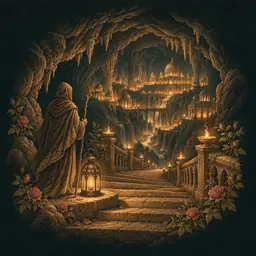

Agartha is a hidden kingdom said to lie beneath the ground of Asia, ruled by a King of the World. It first appears in French books of the 1870s and 1880s.
A lineage map for books and systems; it avoids presenting symbolic traditions as literal fact.
Understand the chapter you are in.
Your life’s turning points, measured from your birth.
Walk through Alex’s whole example first


Prefer to explore first?
 The Road of AgesThe turning points of your whole life, from your own chart
Walk my road
Where does the idea of Agartha come from?
Agartha has a short paper trail. In 1873 the French writer Louis Jacolliot, a former official in India, wrote of an ancient city called Asgartha. In 1886 the occultist Alexandre Saint-Yves d'Alveydre described Agarttha as a vast underground realm of millions, governed by a sovereign pontiff and holding the lost wisdom of the ages, and said he had visited it in spirit.
The Polish writer Ferdynand Ossendowski gave it its widest hearing in Beasts, Men and Gods (1922), reporting tales of an underground Agharti and a King of the World that he said he heard in Mongolia. René Guénon wrote a book on the theme in 1927. Later authors joined it to Shambhala.
On the tree of the hidden arts: Lost worlds.
What sets Agartha apart
Agartha is unusual in that its authors can be lined up by year. Each added something: Jacolliot the name, Saint-Yves the underground setting and the government of sages, Ossendowski the Mongolian colour and the King of the World, Guénon a metaphysical reading. Each also claimed more than his sources allowed. Saint-Yves said he travelled there out of the body, which by his own account puts the kingdom beyond any check.
- First form of the name: Asgartha, in Louis Jacolliot, 1873
- Underground realm: Saint-Yves d'Alveydre, written 1886, published 1910
- Popular spread: Ferdynand Ossendowski, Beasts, Men and Gods, 1922
- Metaphysical reading: René Guénon, The King of the World, 1927
- Earlier fiction of the kind: Bulwer-Lytton, The Coming Race, 1871
Often mistaken for something else: Shambhala is taught within Tibetan Buddhism and set above ground, in the north; Agartha is a modern European tale of a realm below.
The story behind Agartha
Saint-Yves had his book printed in 1886 and then withdrew it; it was published after his death, in 1910. Ossendowski was accused in his own day of borrowing from Saint-Yves, which he denied. Edward Bulwer-Lytton's novel The Coming Race (1871), about a people living under the ground, is older than any of these and is fiction by its own account. No Indian, Tibetan or Mongolian text older than the French books describes Agartha.
Why Agartha matters
Agartha shows a legend with named authors and exact dates being passed off as immemorial tradition within fifty years of its invention.
How to read Agartha
Readers set it beside Shambhala to see the difference between a teaching with centuries of texts behind it and a modern invention.
Agartha in practice: an example
A reader offered Agartha as an ancient Tibetan belief can ask for a Tibetan text that names it, and none is forthcoming.
Where readings of Agartha go wrong
No entrance, tunnel or city has been found, and nothing known of the ground beneath Asia leaves room for one.
Sources and editorial method
This entry summarizes the tradition in the Almanac's own words; where no source is listed, it is an editorial summary rather than a primary text, and symbolic readings are named as the tradition's, not as fact.
- Source
- The Great Almanac Dictionary
- Category
- Mystical Systems
- Aliases
- agartha meaning, agharta, agarttha, underground kingdom agartha, king of the world
- Last updated
- 2026-09-26
See Agartha in your personal almanac
A definition tells you what it is; your own birth chart tells you what it means for you. The Oracle casts your real chart and answers for your love, your work, and your year ahead, in conversation. It opens with the 7-day Oracle trial.
Speak with the OracleRelated terms
More in Mystical Systems
From the reference page to your own chart
Every word here
is in your own chart.
- Your life’s turning points, measured from your birth
- A practical next step to consider
- It opens with 7 days free: the AI Oracle on thirty hidden arts, and your daily horoscope
$0 today, then $19/month after 7 days. Cancel anytime.
Common questions
Where does the idea of Agartha come from?
From nineteenth-century French writers. Louis Jacolliot wrote of Asgartha in 1873 and Saint-Yves d'Alveydre of Agarttha in 1886. Ferdynand Ossendowski made it widely known in 1922 with a travel book set in Mongolia.
Is Agartha the same as Shambhala?
No. Shambhala belongs to the Kalachakra teaching of Tibetan Buddhism and is about a thousand years old. Agartha is a European creation of the 1870s and 1880s. Occult writers of the twentieth century merged the two.
Is there any evidence for Agartha?
None. No text older than the nineteenth century mentions it, and no underground kingdom has been found. Its sources are a few named books, which can be read as the works of their authors.


