

Mystical systems
Hyperborea
Direct answer
Hyperborea is the land beyond the north wind in Greek myth, whose people live long and happily and are dear to Apollo. Modern occultists reused the name for a supposed polar homeland.
$0 today, then $19/month after 7 days. Cancel anytime.
At a glance
- Also called
- land beyond the north wind
- Found in
- Mystical Systems
- Related
- Root Races, Atlantis, Shambhala, Theosophy
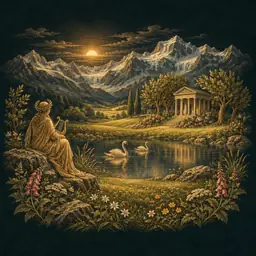

Hyperborea is the land beyond the north wind in Greek myth, whose people live long and happily and are dear to Apollo. Modern occultists reused the name for a supposed polar homeland.
A lineage map for books and systems; it avoids presenting symbolic traditions as literal fact.
Understand the chapter you are in.
Your life’s turning points, measured from your birth.
Walk through Alex’s whole example first


Prefer to explore first?
 The Road of AgesThe turning points of your whole life, from your own chart
Walk my road
What was Hyperborea in Greek myth?
The Greeks imagined the Hyperboreans as a people living beyond Boreas, the north wind, in a country without sickness, toil or war. Apollo was said to spend the winter among them, and offerings wrapped in straw were believed to reach his shrine at Delos from their land, passed from people to people. Poets used Hyperborea as a picture of perfect happiness that no traveller could reach by ship or on foot.
From the late nineteenth century the name was given a new and darker use. Theosophy made it the continent of a second root race, and German and Austrian occultists turned it into the northern home of an Aryan race. That reading ranked peoples, and it fed Nazi doctrine.
On the tree of the hidden arts: Lost worlds.
What sets Hyperborea apart
Hyperborea is defined by being out of reach. Pindar says that neither ship nor foot can find the road to it, and that is the point of the image: a happiness set beyond the edge of travel. The Greeks tied it to Apollo and to real cult practice at Delos, where offerings were said to arrive from the far north. The twentieth-century version reverses the meaning, turning a land nobody comes from into a homeland of ancestors.
- Meaning of the name: beyond Boreas, the north wind
- Greek sources: Pindar's tenth Pythian ode; Herodotus, book four
- God honoured: Apollo, said to winter there
- Cult link: offerings said to travel from the north to Delos
- Modern misuse: an Aryan polar homeland in German and Austrian occultism
Often mistaken for something else: Thule was a place name in ancient geography, an island far to the north; Hyperborea was a people and a land of myth.
The story behind Hyperborea
Hyperboreans appear in early Greek epic, in Pindar's odes and in Herodotus, who doubts that they exist while reporting the offerings at Delos. Later Greek geographers argued over where to put them. Helena Blavatsky used the name in 1888. In the first decades of the twentieth century writers linked to Ariosophy and the Thule Society joined Hyperborea to Thule, an island at the edge of the north in ancient geography, as the origin of a master race.
Why Hyperborea matters
The word carries two histories, a Greek myth of happiness and a modern racial fantasy, and telling them apart is the point of looking it up.
How to read Hyperborea
Readers check which Hyperborea a book means: the poets' unreachable land, or the polar homeland invented around 1900.
Hyperborea in practice: an example
Reading Pindar's lines on the Hyperboreans, a reader meets a land of music and feasting, with no word of race or conquest.
Where readings of Hyperborea go wrong
The racial use of the name belonged to occult circles on the fringe of the Nazi movement; the house rejects it and gives it only as history.
Sources and editorial method
This entry summarizes the tradition in the Almanac's own words; where no source is listed, it is an editorial summary rather than a primary text, and symbolic readings are named as the tradition's, not as fact.
- Source
- The Great Almanac Dictionary
- Category
- Mystical Systems
- Aliases
- hyperboreans, hyperborea myth, land beyond the north wind, hyperborea meaning
- Last updated
- 2026-09-26
See Hyperborea in your personal almanac
A definition tells you what it is; your own birth chart tells you what it means for you. The Oracle casts your real chart and answers for your love, your work, and your year ahead, in conversation. It opens with the 7-day Oracle trial.
Speak with the OracleRelated terms
More in Mystical Systems
From the reference page to your own chart
Every word here
is in your own chart.
- Your life’s turning points, measured from your birth
- A practical next step to consider
- It opens with 7 days free: the AI Oracle on thirty hidden arts, and your daily horoscope
$0 today, then $19/month after 7 days. Cancel anytime.
Common questions
What was Hyperborea in Greek myth?
A blessed country beyond the north wind, whose people lived long lives in peace and plenty and honoured Apollo. Greek poets treated it as a place that could not be reached by any ordinary journey.
Was Hyperborea a real place?
No location has ever been established. Ancient writers themselves were unsure, and Herodotus doubted it. It is best read as a myth of a perfect land, like the Isles of the Blessed.
How was Hyperborea used by occultists?
Theosophy made it the home of an early root race, and German and Austrian writers of the early twentieth century made it the birthplace of an Aryan race. That ranking of peoples fed Nazi ideology and has no basis in the Greek sources.


