

Mystical systems
Anunnaki
Direct answer
Anunnaki: The Anunnaki are a group of gods in the texts of ancient Mesopotamia. In 1976 Zecharia Sitchin claimed they were visitors from another planet, a reading Assyriologists reject.
$0 today, then $19/month after 7 days. Cancel anytime.
At a glance
- Found in
- Mystical Systems
- Related
- Nibiru, Ancient Astronauts, Pseudoarchaeology
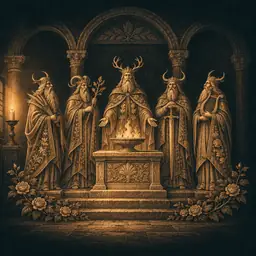
The Anunnaki are a group of gods in the texts of ancient Mesopotamia. In 1976 Zecharia Sitchin claimed they were visitors from another planet, a reading Assyriologists reject.
A lineage map for books and systems; it avoids presenting symbolic traditions as literal fact.
Understand the chapter you are in.
Your life’s turning points, measured from your birth.
Walk through Alex’s whole example first


Prefer to explore first?
 The Road of AgesThe turning points of your whole life, from your own chart
Walk my road
Who were the Anunnaki in Mesopotamian religion?
In Sumerian the name is Anunna, often explained as offspring of An, the sky god, or as those of princely seed. The texts use it for the great gods as a body: they sit in assembly, decree fates and receive offerings. In later Babylonian writing the Anunnaki are often the gods of the underworld, set beside the Igigi, the gods of heaven. The epic of Atrahasis tells how the junior gods tired of digging canals, and humankind was made from clay to do the work.
Sitchin read that story as a record of visitors who bred humans as miners. Scholars who read cuneiform say his translations follow neither the grammar nor the vocabulary of the texts.
On the tree of the hidden arts: Lost worlds.
What sets Anunnaki apart
The Anunnaki are known from thousands of clay tablets written by the people who worshipped them, which is why the modern claim can be checked so directly. In those tablets they behave as a divine council: they cast lots for the regions of the cosmos, judge the dead, and set the lesser gods to labour. The word shifts sense over two thousand years, from all the great gods to the gods below, a change that no modern retelling keeps track of.
- Sumerian form: Anunna; Anunnaki is the Akkadian spelling
- Usual explanation: offspring of An, or those of princely seed
- Counterpart: the Igigi, the gods of heaven in Babylonian texts
- Key myths: Atrahasis and the Enuma Elish
- Modern claim: visitors from elsewhere, per Sitchin in 1976; rejected by Assyriologists
Often mistaken for something else: The Nephilim are figures of the Hebrew Bible and the Book of Enoch; the Anunnaki are Mesopotamian gods, and joining the two is a modern step.
The story behind Anunnaki
The Anunna are named in Sumerian texts of the third millennium BCE, and the Akkadian form Anunnaki continues through the Babylonian creation epic, the Enuma Elish. Cuneiform was deciphered in the middle of the nineteenth century, and the main myths were in print by the early twentieth. Sitchin's The Twelfth Planet (1976) and its sequels built a history of visitors on them. Standard translations are freely available for comparison.
Why Anunnaki matters
The word is ancient and the claim attached to it is recent, so it is a good place to learn to keep a source and its modern use apart.
How to read Anunnaki
Readers look the name up in a scholarly translation first, then compare what the tablets say with what a modern book says they say.
Anunnaki in practice: an example
A reader can open a published translation of Atrahasis and see the Anunnaki debating in council, as gods do in every old epic.
Where readings of Anunnaki go wrong
These were gods worshipped by real peoples for three thousand years; treating them as visitors misreads both the texts and the worshippers.
Sources and editorial method
This entry summarizes the tradition in the Almanac's own words; where no source is listed, it is an editorial summary rather than a primary text, and symbolic readings are named as the tradition's, not as fact.
- Source
- The Great Almanac Dictionary
- Category
- Mystical Systems
- Aliases
- anunnaki meaning, anunnaki gods, anunna, sitchin anunnaki, who were the anunnaki
- Last updated
- 2026-09-26
See Anunnaki in your personal almanac
A definition tells you what it is; your own birth chart tells you what it means for you. The Oracle casts your real chart and answers for your love, your work, and your year ahead, in conversation. It opens with the 7-day Oracle trial.
Speak with the OracleRelated terms
More in Mystical Systems
From the reference page to your own chart
Every word here
is in your own chart.
- Your life’s turning points, measured from your birth
- A practical next step to consider
- It opens with 7 days free: the AI Oracle on thirty hidden arts, and your daily horoscope
$0 today, then $19/month after 7 days. Cancel anytime.
Common questions
Who were the Anunnaki in Mesopotamian religion?
A collective name for the great gods. In Sumerian texts they meet in assembly and decree destinies; in later Babylonian texts the name is used chiefly for the gods of the underworld, alongside the Igigi of heaven.
Did the Anunnaki come from another planet?
Nothing in the cuneiform texts says so. The claim was made by Zecharia Sitchin in 1976, and specialists in Sumerian and Akkadian reject his translations as unsupported by the languages.
What does the word Anunnaki mean?
It is usually explained as those of princely seed, or as the offspring of An, the god of the sky. The Sumerian form is Anunna; Anunnaki is the later Akkadian spelling.


