

Mystical systems
Nibiru
Direct answer
Nibiru is a Babylonian name linked with the god Marduk and with a marker in the sky. Since 1976 it has also been the name of a claimed wandering planet, for which no evidence exists.
$0 today, then $19/month after 7 days. Cancel anytime.
At a glance
- Also called
- neberu
- Found in
- Mystical Systems
- Related
- Anunnaki, Ancient Astronauts, Pseudoarchaeology
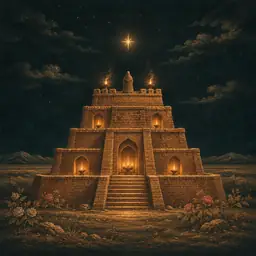

Nibiru is a Babylonian name linked with the god Marduk and with a marker in the sky. Since 1976 it has also been the name of a claimed wandering planet, for which no evidence exists.
A lineage map for books and systems; it avoids presenting symbolic traditions as literal fact.
Understand the chapter you are in.
Your life’s turning points, measured from your birth.
Walk through Alex’s whole example first


Prefer to explore first?
 The Road of AgesThe turning points of your whole life, from your own chart
Walk my road
What is Nibiru in Babylonian texts?
In Akkadian the word neberu means a crossing or a ferry. The Babylonian creation epic gives Nibiru as a name of the star of Marduk, which holds the other stars to their courses, and astronomical tablets use it for a point in the sky, most often identified with the planet Jupiter and sometimes with Mercury.
Zecharia Sitchin took the name in 1976 for a large planet that he said passes close every 3,600 years and is home to the Anunnaki. From 1995 a separate claim spread online that Nibiru would arrive on a set date, first 2003 and then 2012. Astronomers pointed out that such a body would have been plain to see long before, and the dates passed.
On the tree of the hidden arts: Lost worlds.
What sets Nibiru apart
Nibiru has two histories that share nothing but a spelling. The Babylonian word comes from a verb for crossing, and scribes used it for a marker in the sky by which the year could be divided. The modern Nibiru is a body with an orbit of 3,600 years, a figure that matches the Mesopotamian counting unit called the sar and was taken from it. The doomsday version added dates, and has been wrong on each of them.
- Akkadian meaning: crossing, or ferry
- In the Enuma Elish: the star of Marduk, which orders the courses of the stars
- Usual identification: the planet Jupiter, at times Mercury
- Modern planet claim: first made in The Twelfth Planet, 1976
- Failed arrival dates: 2003 and December 2012
Often mistaken for something else: Planet X was a name astronomers once gave to a body they were searching for beyond Neptune; Nibiru is a Babylonian term borrowed for a planet nobody has observed.
The story behind Nibiru
Nibiru appears in the Enuma Elish, composed in Babylonia in the later second millennium BCE, and in the star lists called MUL.APIN. Assyriologists have discussed which body it names since the early twentieth century. Sitchin's The Twelfth Planet (1976) gave it its modern sense. The prediction of an arrival was first posted in 1995, set for 2003, and was later moved to December 2012, alongside claims about the Maya calendar.
Why Nibiru matters
Nibiru joins an ancient word to a modern scare, and shows how a borrowed name lends false age to a new claim.
How to read Nibiru
Readers look at the Babylonian sense first, a name of the star of Marduk, and then at when and by whom the planet story was added.
Nibiru in practice: an example
A reader worried by a video about Nibiru can note that the date it gave has already passed, more than once.
Where readings of Nibiru go wrong
Predictions of a planet Nibiru arriving have failed each time; no observatory has seen such a body, and none is being hidden.
Sources and editorial method
This entry summarizes the tradition in the Almanac's own words; where no source is listed, it is an editorial summary rather than a primary text, and symbolic readings are named as the tradition's, not as fact.
- Source
- The Great Almanac Dictionary
- Category
- Mystical Systems
- Aliases
- nibiru meaning, planet nibiru, neberu, planet x nibiru, nibiru babylonian
- Last updated
- 2026-09-26
See Nibiru in your personal almanac
A definition tells you what it is; your own birth chart tells you what it means for you. The Oracle casts your real chart and answers for your love, your work, and your year ahead, in conversation. It opens with the 7-day Oracle trial.
Speak with the OracleRelated terms
More in Mystical Systems
- Ramadan
- Star of Bethlehem
- Tower of Babel
- Alchemy Citrinitas
- Birthstone
- Ein Sof
- Hasidic Mysticism
- Lent
From the reference page to your own chart
Every word here
is in your own chart.
- Your life’s turning points, measured from your birth
- A practical next step to consider
- It opens with 7 days free: the AI Oracle on thirty hidden arts, and your daily horoscope
$0 today, then $19/month after 7 days. Cancel anytime.
Common questions
What is Nibiru in Babylonian texts?
A name connected with the god Marduk. In the creation epic it is his star, which keeps the other stars to their courses, and in astronomical tablets it marks a point in the sky usually identified with Jupiter.
Is there a planet called Nibiru?
No such planet has been observed. A body large enough to matter and near enough to arrive within years would be among the brightest things in the night sky and visible to anyone, and it is not there.
Where did the Nibiru doomsday idea come from?
Zecharia Sitchin introduced a planet Nibiru in 1976. In 1995 a website predicted that it would arrive in 2003; when it did not, the date was moved to 2012. Neither prediction came true.


