
Atlantis
Plato’s story of about 360 BCE, and how it became a lost continent.
Where does the story of Atlantis come from, and has anything of it been found?
Atlantis, Lemuria, hidden kingdoms and visitors from the sky: each tale is traced to its first teller and set beside what has been dug up. No drowned continent has been found, and the monuments were raised by the peoples of their own lands.
What the sources say, and what the ground shows
Ask the OracleWhat is truly known of Atlantis and the lost worlds, and what is only told?
The lost worlds are stories with known first tellers. Atlantis comes from two dialogues of Plato, written about 360 BCE. Lemuria began in 1864 as a zoologist's guess about lemurs, and the land of Mu in the misreading of a Maya book. The idea of ancient astronauts dates from books of the 1960s and 1970s. Each tale has grown far beyond its source, and each can be followed back to the page where it starts.
Beside the tales stands what has been dug up. No drowned continent has been found, and the monuments said to need a lost race or visitors were built by the peoples of their own lands, whose quarries, tools and workers' towns survive. The house tells each story as a story, names what is true and remarkable, such as Doggerland and the Antikythera mechanism, and rejects the theories that rank peoples or take their works from them.
As the lore of the lost worlds, read beside what the ground shows teaches it.
A lost world is a tale with a shape that recurs. Long ago, it says, before any people we know of, there lived a great people, rich, skilled and wise. Their land was swallowed by the sea in a day and a night, or burned, or else they withdrew behind mountains or beneath the ground; their survivors or their memory stand behind the peoples who came after, and something of them may still be found. The pieces are old. The Greek poets sing of a golden race before ours, Hindu tradition tells of an age of truth, the first of four, before the present dark age, and many peoples tell of a flood that ended a former world.
This art reads every such tale twice: first as a story, for what it says and who first told it; then beside the ground, for what has been dug up where the tale is set. The two readings answer different questions, and the art keeps them apart.
The tales fall into a few families. There are the drowned continents: Atlantis beyond the Pillars of Heracles, Lemuria across the Indian Ocean, and Mu, set at last in the Pacific. There are the drowned coasts of legend: the Breton city of Ys, the Cornish Lyonesse, the Lowland Hundred under Cardigan Bay and the Tamil Kumari Kandam. There are the hidden kingdoms: Shambhala ringed by snow mountains, Agartha under the earth, Hyperborea beyond the north wind, and El Dorado, the gilded man who became a city of gold. There are the visitors from the sky, said to have built the monuments and made humankind. And beside them all stand the lost worlds that are real: the plains the sea drowned when the ice melted, and the marvels the ground has truly given up.
The art's first rule is that every tale has a first page. Find it, and read it. Then put one question to every later claim: where does this come from? Followed patiently, the question shows how a lost world grows. Each retelling adds what the source never had, and the newer the book, the more detailed the land: the crystals of Atlantis, its flying machines and its survivors in Egypt are not in Plato, and each can be traced to a named book of the last hundred and fifty years.
The first page also shows what kind of tale it is, and each kind is read in its own way. A myth is a people's sacred story, and Hyperborea is one, sung by the Greek poets in honour of Apollo. A legend is a tale told as history about a real place, as Ys and Lyonesse are told of real coasts. A tale may also be told to serve an argument, as Atlantis serves Plato's. Some belong to a living faith, as Shambhala belongs to the Kalachakra teaching of Tibetan Buddhism. Lore is what later writers built on all of these, and most of what is said of the lost worlds today is lore.
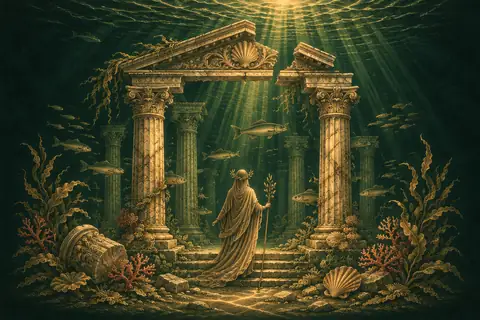
The drowned continents all grow from a few pages of Plato. In the Timaeus and the Critias an aged priest at Sais in Egypt tells Solon that the world has been destroyed many times by fire and by water, so that each people forgets its past and begins again like children, while Egypt alone keeps the old records. Nine thousand years before Solon, the priest says, there was an island beyond the Pillars of Heracles, larger than Libya and Asia together, whose ten kings of the line of Poseidon ruled from a city built in rings of land and water. Its power gathered against the lands within the Pillars and was beaten by an early Athens. Then, in a single day and night of earthquakes and floods, the island sank into the sea.
The kings, Plato tells, kept the god's laws while his nature lasted in them, and fell into greed when it faded. The story is offered as Socrates' best city seen in action, at war, and the Critias breaks off as Zeus gathers the gods to chasten the island's kings. Everything else said of Atlantis is later than these pages. The branch on Atlantis tells Plato's story in full, from the priest of Sais to the oath of the bull.
The great claim of the later lore is that a lost land was the mother of civilisation: that its survivors carried writing, building and the worship of the Sun to Egypt, India and the Americas, so that every likeness between distant peoples, a pyramid here and a pyramid there, is the memory of one source. The Atlantis of the modern legend is such a mother, and so are the Mu of James Churchward and the continents of Theosophy. It is a claim about evidence, and the ground answers it.
Each people's works grew from their own beginnings, step by step, where they stand. Egypt's pyramids grew from flat-topped tombs, through the stepped pyramid of Djoser, to the smooth-sided tombs of Giza; the pyramids of Mexico are something else, stepped platforms raised much later, with temples on their summits and stairs to climb them. Farming began separately in several lands, with wheat and barley in the Near East, rice and millet in China, maize in Mexico and potatoes in the Andes, and the wild plants those crops were bred from grow in the same lands still.
Some of the lore is a theory against peoples, and the art teaches it as the claim it is. Theosophy's scheme of root races sets humankind on a ladder of races, casts living peoples as dying remnants of lower ones, and puts those it calls Aryan at the head of the present age. Occult writers made Hyperborea the northern home of an Aryan master race, a doctrine the Nazi state turned to persecution and murder. Churchward set a fair-skinned race over darker peoples in his Mu. And the same thought runs through every claim that a people could not have made its own works: the mounds of North America given to a vanished race, Great Zimbabwe to Phoenicians or the Queen of Sheba, and the monuments of Egypt, the Americas and the Pacific to visitors from the sky.
Every one of these claims is false. All living people belong to one species, which arose in Africa and spread across the earth, and the differences among peoples are small and run in gradual shades, not in ranked races. Aryan was the name that early speakers of the languages of Iran and India gave themselves, and it names no race. The mounds were raised by the ancestors of Native Americans and Great Zimbabwe by the ancestors of the Shona, and every monument credited to others has its quarries, its tools and its workers' camps, left by the people of its own land. The branches on Lemuria and Mu, the hidden kingdoms, the ancient astronauts and the builders give each claim and its answer.
The second reading sets the tale beside what has been dug up. The ground is read in layers laid down one over another, so that where nothing has disturbed them the lower is the older, and a find tells most when it is read in its place, with whatever lies beside it. Charcoal, bone and seed carry a clock of their own, the slow decay of radioactive carbon in anything that once lived, by which a hearth or a burial can be dated. A sea floor can be mapped, and the floors of the Atlantic, the Indian Ocean and the Pacific show no continent that went down while people lived.
Beside any monument said to be beyond its makers, the art looks for four things: the quarry, with blocks cut and abandoned; the tools, worn by use; the road or slipway by which the weight was moved; and the camp where the workers ate, slept and were buried. At Giza all four have been found, down to the bakeries and the workers' tombs. And to any claim of builders from elsewhere the art puts a plain question: if they built it, where are their tools, their rubbish and their workshops?
Some lost lands are real. At the height of the last ice age so much water lay frozen in ice that the sea stood about 120 metres lower than now, and wide plains lay dry: Doggerland joined Britain to the rest of Europe, Beringia joined Siberia to Alaska, and Sundaland joined the great islands of South-East Asia to the mainland. People lived on all of them, and as the ice melted the sea took them back over thousands of years, a little in each lifetime.
The art teaches the difference between such a drowning, recorded in mud, pollen and bone, and a land gone in a night, which is the mark of a story. Some legends of drowned coasts sit over real drownings, as Lyonesse sits over the Isles of Scilly, which were once one larger island. The branch on the lands the sea took tells the real drowned lands and the legends their coasts still tell.
With a hidden kingdom the first question is whose it is, and the answer decides how it is read. Shambhala belongs to the Kalachakra teaching of Tibetan Buddhism, which holds it both as a kingdom ringed by snow mountains and as a state reached in practice, and it is learned from that faith's own teachers and texts. Agartha belongs to a handful of French writers and is read as their books. Hyperborea belongs to the Greek poets, who sing of a happy people beyond the north wind, dear to Apollo. El Dorado was first a man, a Muisca heir gilded for a rite at a mountain lake, whom Spanish hopes turned into a city of gold.
The ground has given up real marvels, stranger for being true: the Antikythera mechanism, a box of bronze gears that showed the Sun, the Moon, the seasons of eclipses and the cycle of the games, and Göbekli Tepe, rings of carved stone pillars raised by people who did not yet farm. A real marvel is known by what happens when it is studied: it gathers detail, measurements, readings and working reconstructions. A false one stays a single striking picture with a line of print beneath it. The wonder is kept either way.
Begin with the source. The Atlantis pages of the Timaeus and the Critias can be read in an evening: note what Plato says, then take one thing said of Atlantis today and ask where it comes from. Next choose a monument said to need a lost race, look for its quarry, tools, road and camp in the published site report or the museum's record, and see what was found. Last, put the question the art ends on: who is being told that they could not have done their own work?
The branches can be read in that order, the tales first and then the ground. Atlantis gives Plato's story whole; Lemuria and Mu, Shambhala and the hidden kingdoms, and Ancient astronauts give the later lore and its answers. How the monuments were built, The lands the sea took and Real ancient marvels give what the ground has shown.
Atlantis is first told by Plato about 360 BC, as part of an argument, and no drowned continent has been found. The monuments were built by the peoples of their own lands. Theories of lost master races take those works away from their makers, and the house does not repeat them as true.
Each one is a question you can ask.
Plato’s story of about 360 BCE, and how it became a lost continent.
Where does the story of Atlantis come from, and has anything of it been found?
A zoologist’s guess of 1864 and a misread Maya book, and what was built on them.
Where do the stories of Lemuria and the land of Mu come from?
Shambhala, Agartha, Hyperborea and El Dorado: whose stories they are.
What are Shambhala, Agartha and Hyperborea, and whose stories are they?
The books of 1968 and 1976 that gave the monuments to visitors, examined.
Where does the idea of ancient astronauts come from, and what do archaeologists answer?
Quarries, ramps, sledges and workers’ towns: what the diggers found.
Did a lost civilisation build the great monuments, or the peoples of their own lands?
Doggerland and the coasts that the rising seas really did cover.
Which lost lands did the sea really take when the ice melted, such as Doggerland?
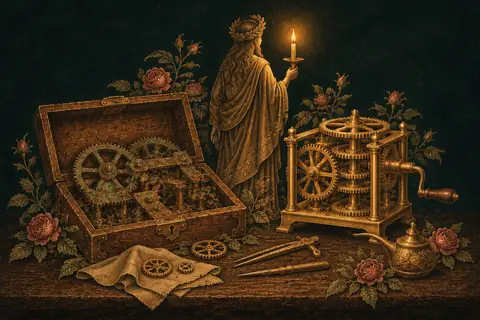
The Antikythera mechanism and other finds that need no lost race.
What is the Antikythera mechanism, and what does it show of ancient skill?
Each opens its page in the dictionary.
 Atlantis
 Timaeus and Critias
 Lemuria
 The Land of Mu
 Hyperborea
 Shambhala
 Agartha
 El Dorado
 Ancient Astronauts
 Anunnaki
 Nibiru
 Doggerland
 Antikythera Mechanism
 Root Races
 Pseudoarchaeology
Athenian philosopher, pupil of Socrates and teacher of Aristotle, who founded the Academy about 387 BC and wrote in dialogues. The Timaeus describes the cosmos as a living being with a soul, ordered by number; the Republic gives the cave and the three parts of the soul; the Symposium gives the tale of humans split in two who seek their other half. Later Platonists, Plotinus above all, built on him the philosophy the Hermetic and astrological traditions lean on.
Russian-born writer who founded the Theosophical Society in New York in 1875 with Henry Steel Olcott and William Quan Judge. Isis Unveiled (1877) and The Secret Doctrine (1888) brought Hindu and Buddhist ideas, karma and reincarnation among them, into Western esotericism.
American known as “the sleeping prophet”, who gave thousands of readings while in trance on health, past lives and the future; about fourteen thousand were written down. He founded the Association for Research and Enlightenment at Virginia Beach in 1931.
Zecharia SitchinGodfrey HigginsAlice BaileyFrancis BaconAthanasius KircherEdward Bulwer-LyttonRené Guénon
Past lives and karmaAstral projectionDeath and what followsSacred geometryThe sixth sense
Make today specific
The same sky reaches everyone differently. Your birth details turn a general forecast into one theme, and one thing worth doing about it.
One instrument, one answer. Explore the preview; membership opens every tool.
Read more

