
What are Shambhala, Agartha and Hyperborea, and whose stories are they?
What it is
Some lost worlds are not sunk but hidden. Shambhala is a kingdom described in the Kalachakra teaching of Tibetan Buddhism, ruled by a line of kings who guard that teaching; the tradition holds it both as a place and as a state reached in practice. Agartha is a kingdom under the ground, found in French books of the 1870s and 1880s. Hyperborea is the Greeks' happy land beyond the north wind. El Dorado began as a man, the gilded one, a chief of the Muisca people of what is now Colombia who was covered in gold dust for a rite at a lake. Later comers to the family are the Hollow Earth, the idea of a habitable space under the ground, and the Lost City of Z, which Percy Fawcett sought in Brazil until he vanished in 1925.
The teaching
As the lore of each hidden kingdom, from the Kalachakra to the Muisca's lake teaches it.
Shambhala, the kingdom of the lotus
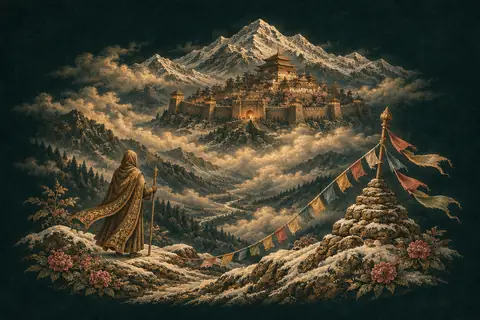
In the Kalachakra teaching, the Wheel of Time, Shambhala is a kingdom far to the north of India, ringed by snow mountains that fold round it like the petals of an eight-petalled lotus. Each petal holds a land of many cities, and at the centre stands the capital, Kalapa, with the palace of its king, who sits on a lion throne. Its people live long and in plenty, and the Buddha's teaching is kept there whole.
The tradition tells that the Buddha, at the great stupa of Dhanyakataka, taught the Wheel of Time at the request of Suchandra, king of Shambhala, who carried it home and wrote it down as the root tantra. He and the six kings after him, the seven Dharma kings, taught it in Shambhala. The eighth, Manjushri Yashas, gave the initiation to all the people of the kingdom and joined them into one family of the Vajra, and became the first of the twenty-five Kalki kings; he wrote the shorter Kalachakra Tantra, and his son Pundarika wrote its great commentary, the Stainless Light. Each Kalki reigns a hundred years.
The wheel of time, outer, inner and other
The teaching that Shambhala keeps has three parts that mirror one another. The outer wheel of time is the cosmos: the turning of the planets and the stars, the calendar, the cycles of history. The inner wheel is the body: its subtle channels, the winds that move in them and the drops they carry, which turn in the same rhythms as the sky. The other wheel is the practice that brings the two to rest: the initiation, the meditation on Kalachakra and his consort at the heart of a great mandala, and the yogas in which the winds of the body are drawn into the central channel and time itself is overcome. These yogas are given only after initiation and under a qualified teacher, never taken up from a book.
The last king and the road north
The texts foretell that in a dark time, when the teaching is nearly lost and a power hostile to it rules the lands, the twenty-fifth Kalki, Raudra Chakrin, the Wrathful Wheel-holder, will ride out of Shambhala with his armies and overthrow it in a great battle, and a golden age of the teaching will follow. Many Tibetan teachers read the battle as an inner one too, the mind's war with its own ignorance and hatred, and say that the gate to Shambhala is opened by practice as much as by travel.
The Third Panchen Lama wrote a Guide to Shambhala, describing the way north across deserts, rivers and mountains, past spirits and ordeals that only a traveller made strong in meditation can pass, a map that can be read as one of the land and of the mind. Today the Dalai Lama and other teachers give the Kalachakra initiation to great crowds, and the tradition holds that receiving it forms a bond with Shambhala and with the coming of its last king.
Agartha under the earth
Agartha is the kingdom of a handful of French writers. Louis Jacolliot first named an Asgartha, a city of the Sun in ancient India. Saint-Yves d'Alveydre, taught Sanskrit by a man called Hardji Scharipf who claimed to belong to the Great Agarthian School, made it a living realm beneath the ground somewhere in Asia. In his Mission of India in Europe it is a hidden land of millions, ruled by a Sovereign Pontiff with two assistants, the Mahatma and the Mahanga, and keeping powers and learning far beyond ours. It withdrew below the earth when the dark age, the Kali Yuga, began, and when the world above is ready, governed by the harmony of powers he called synarchy, Agartha will show itself and share its treasures.
The King of the World
A Polish traveller, Ferdynand Ossendowski, heard the tale again in Mongolia. In his Beasts, Men and Gods, lamas tell him of Agharti, a kingdom of many millions under the earth, whose ruler, the King of the World, knows all the forces of nature and reads the souls of all people; when he prays, the whole land falls silent, and men and beasts stand still. René Guénon then read the King of the World as a symbol: the image of the one spiritual centre of tradition, hidden since the start of the dark age, of which the Grail and the priest-king Melchizedek are other names.
Hyperborea of the poets
Hyperborea is the Greeks' land beyond Boreas, the north wind. Pindar sings that neither by ship nor on foot can one find the wondrous road to the gatherings of the Hyperboreans. Perseus once feasted with them: they sacrifice hecatombs of asses to Apollo, bind their hair with golden laurel and dance to the lyre and the pipe, and sickness and old age, toil and war never touch them. From the springs of the Ister, in their country, Heracles brought the wild olive whose leaves crown the victors at Olympia. Apollo himself went to them for the winter, and the Delphians sang paeans to call him back, and he came, the poet Alcaeus told, in a chariot drawn by swans.
Herodotus heard at Delos that the Hyperboreans sent offerings to Apollo wrapped in wheat straw, passed from people to people down to the island, and that long before they had sent two maidens, Hyperoche and Laodice, who never went home; the girls and boys of Delos still cut their hair before marriage and laid it on the maidens' tomb. He adds dryly that if there are people beyond the north wind, there must be people beyond the south wind too. Diodorus, following an older writer, places them on an island in the ocean beyond the land of the Celts, as large as Sicily, where Leto was born, with a sacred precinct and a famous round temple of Apollo, whom they honour above all gods.
The northern homeland, and why it is false
Writers of the last two centuries made Hyperborea something else: the lost Arctic home of a white master race, the Aryans, from which the noble peoples of Europe and India were said to descend. Occult societies in Germany and Austria joined it to Thule and made it part of the doctrine that the Nazi state turned to the persecution and murder of Jews, Roma and others. The claim is false at every step. Aryan was the name that early speakers of the languages of Iran and India gave themselves, and it names no race; peoples who share a family of languages do not share one stock; and the genes of Europeans show them to be a mixture of old hunters, farmers who came from Anatolia and herders from the steppe, not a pure people from the north.
El Dorado, the gilded man
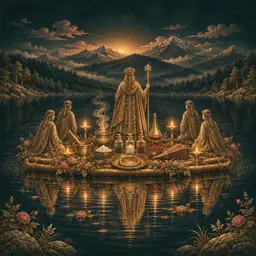
El Dorado was first a man. At Lake Guatavita, a round lake in the mountains of the Muisca, the heir to the chiefdom, after a long fast in a cave, came at his accession to the shore, where fires burned all round the water. He was stripped, anointed with a sticky resin and dusted with gold until he shone, and set standing on a raft of rushes with heaps of gold and emeralds at his feet and four chief lords beside him, naked too and crowned. To the sound of horns and shouting the raft went out to the middle of the lake; a banner was raised and silence fell, and the gilded man cast his gold into the water as an offering to the lake, and the lords cast theirs. Then the music began again, and he was welcomed on the shore as lord. The rite had ceased before the Spaniards came, and their hopes made of the gilded man a city of gold.
The lakes of the Muisca
For the Muisca the lakes were doors to the sacred. Bachué, the mother of humankind, rose from Lake Iguaque with a little boy in her arms; when he grew up she married him, their children peopled the earth, and in old age the two went back into the lake as serpents. Bochica, the bearded teacher who came from the east, taught the people to spin and weave and to live justly, and when a flood drowned the plain of Bogotá he struck the rocks with his staff and opened the falls of Tequendama to let the water out. Into the holy lakes the Muisca cast tunjos, small flat figures of gold showing people, animals and rites, and the golden raft with its chief and attendants is one of them.
How it is practised
With a hidden kingdom the first step is to ask whose it is. Shambhala belongs to a living faith, and the respectful way to learn of it is from Tibetan Buddhist teachers and translations, where it is a teaching about practice and time and not a spot on a traveller's map. Agartha belongs to a handful of named authors, who can be read as authors. Hyperborea can be read in the Greek poets. For El Dorado, the gold work of the Muisca in the museum at Bogotá shows what the rite was.
Where it comes from
The Kalachakra texts reached Tibet in the eleventh century, and Shambhala has been part of Tibetan teaching since. Western readers met it through Theosophy, and James Hilton's novel Lost Horizon of 1933 is widely thought to have drawn on it for Shangri-La. Agartha was spread by Louis Jacolliot and Saint-Yves d'Alveydre, and a Polish traveller's book of 1922 carried it to a wide public. Hyperborea is in Pindar and Herodotus; in the early twentieth century German and Austrian occultists made it, with the Ultima Thule of the Latin poets, the home of an Aryan race, a ranking of peoples that fed Nazi doctrine. Spanish expeditions hunted El Dorado from the 1530s.
What is known, and what is not
The Kalachakra teaching and its Shambhala are documented in Sanskrit and Tibetan texts; whether the kingdom is a physical place is a matter of faith on which Tibetan teachers themselves differ. No source for Agartha is older than the nineteenth century, and no cave kingdom has been found. Hyperborea is myth. A golden raft made by the Muisca, found in 1969, shows the lake rite behind El Dorado; the city of gold was never there to find. Of the Hollow Earth, no expedition, borehole or measurement has found such a space.
Its words
 Shambhala
- The kingdom of the Kalachakra teaching of Tibetan Buddhism, whose kings guard that teaching. The tradition holds it as a place and as a state reached in practice.
 Agartha
- A kingdom said to lie under the ground, first described by French writers of the 1870s and 1880s. No older source for it is known.
 Hyperborea
- In Greek myth the blessed land beyond the north wind. German occultists of the early twentieth century made it an Aryan homeland, a ranking of peoples the house rejects.
 El Dorado
- Spanish for the gilded one: a Muisca chief covered in gold dust for a rite at a lake, turned by European hopes into a city of gold that was never found.
- Thule
- The farthest northern land of Greek and Roman writers, reported by the navigator Pytheas about 325 BCE and never placed for certain. Later it became a byword for the far edge of the known.
- Shangri-La
- The hidden valley and lamasery of the novel Lost Horizon, which James Hilton published in 1933. It is fiction, and the name now means any far-off haven.
- Hollow Earth
- The idea of a great habitable space beneath the ground, put forward by Edmond Halley in 1692 and kept alive by novels and legend. No such space has been found.
- Lost City of Z
- The ancient stone city that the explorer Percy Fawcett believed lay in the forest of Brazil. He vanished looking for it in 1925, and it was never found.
Ask the Oracle further
What does Tibetan Buddhism itself teach about Shambhala?Where did the story of El Dorado begin, and what was truly found?
Before you practise
Atlantis is first told by Plato about 360 BC, as part of an argument, and no drowned continent has been found. The monuments were built by the peoples of their own lands. Theories of lost master races take those works away from their makers, and the house does not repeat them as true.
Its other branches
AtlantisLemuria and MuAncient astronautsHow the monuments were builtThe lands the sea tookReal ancient marvelsThe whole artSearch the tree

