
Atlantis
Plato’s story of about 360 BCE, and how it became a lost continent.
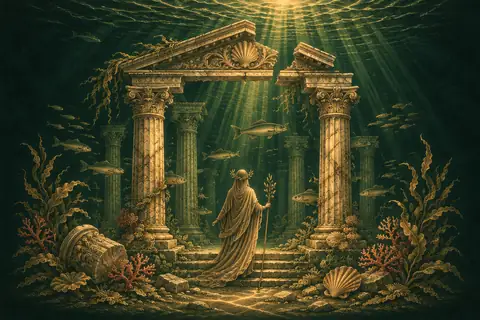
Where does the story of Atlantis come from, and has anything of it been found?
What it is
Atlantis is a story told by Plato. In his dialogues an Egyptian priest is said to have told the Athenian lawgiver Solon of a great island power beyond the Pillars of Heracles, which nine thousand years earlier made war on the lands of the Mediterranean, was beaten by an early Athens, and sank in a day and a night. Plato uses the tale to show his ideal city at war with a rich and proud rival. No writer before him mentions Atlantis.
The teaching
As Plato, in the Timaeus and the Critias teaches it.
How the story comes to be told
Plato gives the story to Critias, who heard it as a boy of ten from his grandfather, then nearly ninety, at the festival of the Apaturia. The old man had it from Solon, the wisest of the seven sages and a friend of the family, who brought it home from Egypt meaning to make a poem of it. Critias tells it the day after Socrates has described the best city, whose guardians hold all things in common. Socrates longs to see that city in motion, as one who has seen fine animals in a painting longs to see them alive and in action, and the story is offered as that city at war.
The priest of Sais
At Sais in the Nile delta, whose goddess Neith the Greeks call Athena, Solon tried to draw out the priests by telling the oldest Greek stories he knew. An aged priest answered him: “O Solon, Solon, you Hellenes are never anything but children, and there is not an old man among you.” Mankind, he said, has been destroyed many times, by fire and by water. The tale of Phaethon, who drove the Sun's chariot and burned the earth, is the memory of a real swerving of the bodies in the sky; and floods sweep away the cities and leave only unlettered herdsmen in the hills, so that every people forgets and begins again like children. Only in Egypt, kept by the Nile from both fire and flood, are the records of the old times written in the temples.
Athens of nine thousand years ago
Nine thousand years before Solon, the priest went on, the goddess founded Athens, a thousand years before she founded Sais. Attica was then far richer: its hills were deep in soil and forest, and its rain was held in the earth and let out in springs; what remains now, after many floods have washed the soil into the sea, is, in Critias' words, “the bones of the wasted body”. On the broad hill of the Acropolis, around the temples of Athena and Hephaestus, lived the warriors, owning nothing of their own and holding all in common, about twenty thousand men and women, the guardians of the citizens and the leaders of the Greeks.
Poseidon and Cleito
When the gods divided the earth among them, Poseidon received Atlantis, an island in the ocean before the Pillars of Heracles, larger than Libya, which is Africa, and Asia together, from which one could pass by other islands to the continent that surrounds the true ocean. Near a fair plain by the sea rose a low hill, the home of Evenor, one of the earth-born men, his wife Leucippe and their daughter Cleito. When her parents died Poseidon loved her, and to guard her he broke the ground round the hill into rings, two of land and three of water, turned as on a lathe, so that no one could reach it, for there were no ships yet. He brought up two springs on the island at the centre, one warm and one cold, and made the soil bring forth every kind of food.
The ten kings
Cleito bore Poseidon five pairs of twin sons, and he divided the island among them into ten parts. The eldest, Atlas, was king over all, and after him the island and the Atlantic ocean were named; his twin, Eumelus in Greek and Gadeirus in his own tongue, received the far end of the island toward the Pillars, facing the land now called Gades. Then came Ampheres and Evaemon, Mneseus and Autochthon, Elasippus and Mestor, Azaes and Diaprepes. The names are Greek, Critias explains, because Solon found that the Egyptians had turned them into their own language, and he turned them back into his. Their descendants ruled many islands of the open sea and, within the Pillars, Libya as far as Egypt and Europe as far as Tyrrhenia.
The riches of the island
No kings before or since had such wealth. Their mines gave every metal, and above all orichalcum, which is now only a name but was then dug in many parts of the island and was more precious than anything but gold. There was timber for every craft and pasture for every beast, with herds of elephants among them; every fragrant root, herb, wood and flower grew there; and the island bore grain, fruit and nuts of every kind in endless plenty.
The city of rings
The kings bridged the rings of water and cut a canal from the sea to the outermost ring, three hundred feet wide, a hundred deep and fifty stadia long, and roofed channels through the rings of land let a trireme pass from one harbour to the next. The outer ring of water was three stadia broad, and so was the ring of land within it; the next pair were two stadia each, the ring of water round the central island one stadium, and the island itself five stadia across. The stone was quarried from beneath the island and the rings, white, black and red, and as they quarried they hollowed out docks roofed with the living rock. The wall round the outer ring was coated with brass, the next with tin, and the wall of the citadel “flashed with the red light of orichalcum”.
The temple of Poseidon
At the centre stood the shrine of Cleito and Poseidon, where the ten princes were born, closed to all and ringed with a wall of gold; there each year the people of the ten kingdoms brought the first fruits. Beside it was Poseidon's own temple, a stadium long and half a stadium wide, of a strange barbaric look: its outside covered with silver and its pinnacles with gold, its roof within of ivory worked with gold, silver and orichalcum, and its walls, pillars and floors lined with orichalcum. Inside stood the god in gold, driving a chariot of six winged horses, so tall that his head touched the roof, with a hundred Nereids round him riding on dolphins, and outside stood golden statues of the kings and their wives.
The plain and the army
Around the city lay a great plain, smooth and oblong, three thousand stadia one way and two thousand the other, facing south and sheltered from the north by mountains. A ditch a hundred feet deep, a stadium wide and ten thousand stadia long ran all round it, gathering the mountain streams, and straight canals crossed the plain to bring down timber and harvests, so that the land gave two crops a year, one from the winter rains and one from the canals. The plain was divided into sixty thousand lots, each ten stadia square, and each lot sent a leader to war; together they furnished ten thousand chariots and the crews of twelve hundred ships.
The laws and the oath of the bull
The ten kings ruled each his own kingdom, but all were bound by the laws of Poseidon, inscribed by the first kings on a pillar of orichalcum in the god's temple. Every fifth and every sixth year in turn, honouring the odd number and the even alike, they met there. Left alone in the temple, where bulls roamed free, they prayed, then hunted a bull without weapons, with staves and nooses, and cut its throat over the top of the pillar so that the blood ran down over the sacred writing. They cast a clot of the blood for each of them into a bowl of wine, drew from it in golden cups, poured on the fire, and swore to judge by the laws on the pillar. When darkness came and the fire had cooled, they put on robes of the most beautiful azure, sat on the ground by the embers and gave judgement through the night; at daybreak they wrote their judgements on a golden tablet and dedicated it, with their robes, to the god.
The chief laws were that they should never take up arms against one another, that all should come to the rescue if any tried to overthrow a royal house, that they should consult together on war, giving the first place to the line of Atlas, and that no king could put a kinsman to death without the consent of most of the ten.
The fall
For many generations, while the god's nature lasted in them, they obeyed the laws, held virtue above all and thought gold a burden. But when “the divine portion began to fade away”, too often diluted with the mortal, they grew unable to bear their fortune: to those with eyes to see they became debased, while to those without they seemed most glorious and blessed at the very time they were full of greed and unjust power. Then they gathered all their might to subdue at one blow Egypt, Athens and every land within the Pillars.
Athens led the Greeks against them, and when the others fell away stood alone, came through the extreme of danger, defeated the invaders, saved those not yet enslaved and freed the rest. Then came violent earthquakes and floods, and in “a single day and night of misfortune” the warriors of Athens sank into the earth, and Atlantis in like manner vanished into the depths of the sea; and so the sea there is impassable still, blocked by a shoal of mud where the island went down.
The Critias tells the doom from heaven's side and breaks off. Zeus, the god of gods who rules by law, saw an honourable race in a woeful state and wished to chasten them, that they might improve. He gathered all the gods into his holiest dwelling, at the centre of the world, and when he had called them together, he spoke as follows; and there the dialogue ends, unfinished.
How it is practised
The check for Atlantis is to read the source, the Timaeus and Critias. The passages are short, and a reader can go through them in an evening and note what Plato does say: the date, the size, the war with Athens, the single day of ruin. Then each later claim is set beside the text with one question, where does this come from? Most of what is said of Atlantis today, its crystals, its flying machines, its survivors in Egypt, is not in Plato and can be traced to a named book of the last hundred and fifty years.
Where it comes from
Ancient readers were divided: Aristotle is reported to have thought Plato invented it, and others took it as history. It stayed a learned curiosity until 1882, when the American politician Ignatius Donnelly published Atlantis: The Antediluvian World and argued that Egypt, Mexico and Europe all inherited their arts from the sunken island. Helena Blavatsky gave it a place in Theosophy's scheme of root races in 1888, a ranking of peoples the house rejects, and Edgar Cayce spoke of it in trance from the 1920s. Since then it has been placed in Santorini, Spain, the Sahara, Antarctica and dozens of other spots.
What is known, and what is not
That Plato wrote the story is certain; that it records a real place is not supported. No drowned continent lies in the Atlantic, whose floor has been mapped, and nothing has been dug up of a sea power of 9600 BCE. The eruption of Thera about 1600 BCE, which buried a town on Santorini, may have lent the tale some colour, and scholars argue over that. Most classicists read Atlantis as a fable made for the argument it serves. The Bimini Road, a line of slabs off the Bahamas claimed for Atlantis in 1968, proved on coring to be natural beachrock.
Its words
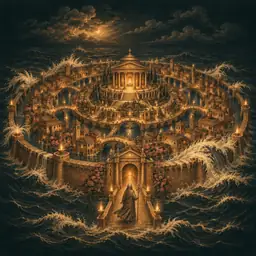 Atlantis
- The island power of Plato's Timaeus and Critias, said to have sunk in a day and a night. No source before Plato knows it, and no trace of it has been found.
 Timaeus and Critias
- The two dialogues of Plato, written about 360 BCE, that hold the whole of the ancient story of Atlantis. The second breaks off unfinished.
 Root Races
- Theosophy's scheme of seven successive races of humankind, set out by Helena Blavatsky in 1888. It ranks peoples, it fed racial doctrine, and the house rejects it.
- Bimini Road
- A row of large limestone slabs in shallow water off the Bahamas, reported in 1968 and claimed for Atlantis. Geologists who cored it found natural beachrock.
Ask the Oracle further
What does Plato actually say about Atlantis in the Timaeus and Critias?How did Ignatius Donnelly turn Atlantis into a lost continent in 1882?
Before you practise
Atlantis is first told by Plato about 360 BC, as part of an argument, and no drowned continent has been found. The monuments were built by the peoples of their own lands. Theories of lost master races take those works away from their makers, and the house does not repeat them as true.
Its other branches
Lemuria and MuShambhala and the hidden kingdomsAncient astronautsHow the monuments were builtThe lands the sea tookReal ancient marvelsThe whole artSearch the tree

