
How the monuments were built
Quarries, ramps, sledges and workers’ towns: what the diggers found.
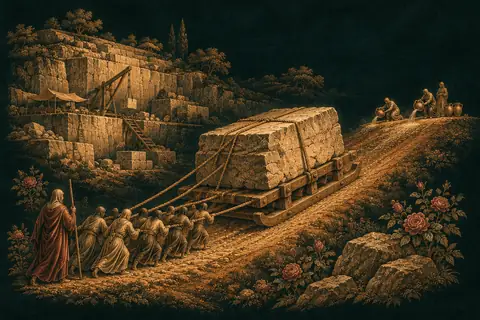
Did a lost civilisation build the great monuments, or the peoples of their own lands?
What it is
The great monuments were built by the peoples of their own lands, and the proof is in the ground beside them. At Giza the town of the pyramid builders has been excavated, with its bakeries, fish bones and the tombs of overseers and workmen. On Easter Island nearly nine hundred statues can be followed back to the quarry at Rano Raraku, where hundreds remain, many unfinished. At Stonehenge the sources of the stones are known. Wherever a lost civilisation has been proposed, the workshops of the real one have turned up. Deciding the answer first and skipping the dig is what archaeologists call pseudoarchaeology.
The teaching
As the record of the quarries and camps, with Mark Lehner's The Complete Pyramids teaches it.
Cutting the stone at Giza
The limestone for the core of the Great Pyramid was cut on the plateau itself, a short haul south of the pyramid, where the quarry floors still show the grid of blocks taken out. The quarrymen cut narrow channels round each block with copper chisels and stone tools, then split it from the bed with levers along its natural layers. The fine white limestone for the casing came by boat from the quarries of Tura across the river, and the granite for the king's chamber from Aswan, far to the south, where granite was not cut but pounded out with balls of dolerite, a harder stone.
At Aswan the method can still be seen half done. The unfinished obelisk lies in its quarry, longer than any obelisk ever raised, with the trenches pounded round it on every side and the crack that made the masons give it up running across its face.
By river to the plateau
Stone moved by water wherever it could. The logbook of Merer, an inspector who led a crew of about forty men, records their round of work in Khufu's last years: loading blocks of fine limestone at the Tura quarries, sailing them across the river, and bringing them by canal into a basin at the foot of the plateau that the logbook calls the Lake of Khufu, under the orders of the king's half-brother Ankhhaf. Each round trip took a few days, and in the season of the flood, when the Nile spread over the fields, the boats could come close to the works.
Sledges on wet sand
On land, heavy stones went on wooden sledges. A painting in the tomb of a governor named Djehutihotep shows how: a colossal statue of him, lashed upright on a sledge, is hauled by four long lines of men on ropes, while one man standing on the front of the sledge pours water on the sand before its runners and another beats time. Wetting the sand firms it so that the sledge slides more easily, and the roads the builders laid, of packed earth and timber, served the same end.
Ramps and the rising pyramid
To lift blocks up the rising pyramid the builders raised ramps of rubble, mud and limestone chips against it, and the remains of such ramps survive at Giza and at other pyramids and quarries. At the alabaster quarry of Hatnub a steep ramp of Khufu's time runs between two staircases lined with post holes, where posts held the ropes so that men on the stairs could haul a sledge straight up the slope. Near the top, blocks were levered up course by course, and as the ramps came away the casing was dressed smooth from the top down.
The crews
The builders were Egyptians, organised like the crew of a ship. A work gang was split into two halves and these into smaller divisions, and the gangs took proud names that they painted on the blocks, such as Friends of Khufu and Drunkards of Menkaure. Their bread was baked in bell-shaped pots, and the bones of cattle, sheep, goats and fish in their rubbish show that they were well fed. Their skeletons show broken bones that were set and healed, and they were buried near the works with bread and beer for the next life, in tombs beside those of their overseers.
The statues that walked
On Rapa Nui, Easter Island, the moai were carved from the soft volcanic tuff of the crater Rano Raraku with hand picks of hard basalt, the toki, which lie in the quarry still in their thousands. The carvers shaped each statue lying on its back in the rock face, front and sides first, leaving it joined by a keel along its spine that was cut through last; then the statue was slid down the slope and stood up in a pit, where its back was finished. Hundreds of statues remain in and around the quarry, at every stage of the work.
The islanders' own tradition says the moai walked to their places, moved by mana, the sacred power of the chiefs. Along the old roads from the quarry lie statues fallen on the way, and their shape suits that telling: their bases are broad and D-shaped and they lean forward, so that with ropes pulled from either side and one behind to steady it, a small team can rock such a statue from side to side and it waddles forward upright. At the coast the moai were raised on ahu, stone platforms over the graves of the ancestors, with their backs to the sea and their faces to the villages; some were crowned with topknots of red scoria from the quarry of Puna Pau, and eyes of white coral were set in their sockets to bring them to life.
The stones of Stonehenge
The bluestones of Stonehenge were taken from outcrops in the Preseli hills where the rock stands in natural pillars. At the quarries of Carn Goedog and Craig Rhos-y-felin the builders loosened the pillars along their joints with wedges, lowered them onto platforms of stone and earth, and dragged them away on sledges; the stone wedges and the hearths of the quarrymen were found at the foot of the outcrops. The sarsens were shaped beside the monument by pounding with sarsen hammerstones, and each was raised by sliding its base into a hole with one sloping side and hauling it upright with ropes and timber, while the lintels were most likely lifted on rising platforms of timber and levered into place.
The giant blocks of Baalbek
At Baalbek in Lebanon the platform of the Roman temple of Jupiter holds three limestone blocks, each about nineteen metres long and some eight hundred tonnes, the famous Trilithon, among the largest stones ever moved by human hands. The quarry that gave them lies a short walk away, and in it still lie blocks larger yet, one of about a thousand tonnes called the Stone of the Pregnant Woman and others beside it, cut free on several sides and left where they lay. Roman engineers could move such loads with timber cradles, levers and capstans worked by many hundreds of men.
Great Zimbabwe
Great Zimbabwe, in the south of the country that now bears its name, was the capital of a kingdom of the ancestors of the Shona, who grew rich on cattle and on the gold they traded to the Swahili coast for glass beads, cloth and porcelain from as far as China. Its builders laid walls of granite blocks, split from the bare domes of rock nearby, which peel naturally in layers, in neat courses without any mortar; the outer wall of the Great Enclosure runs for some two hundred and fifty metres and stands up to eleven metres high, with a solid conical tower inside. Carved soapstone birds stood on pillars there, and one is the emblem on the nation's flag.
White settlers in Rhodesia refused to believe that Africans had built it and credited it to Phoenicians, Arabs or the Queen of Sheba, and guides were pressed to repeat the story long after the digging had settled the matter. Excavation found nothing but African work at every level: the pottery, the iron and copper tools, the houses of daga clay and the burials belong to the people whose descendants live there still.
The mounds of Cahokia
At Cahokia, by the Mississippi near present St Louis, the Mississippian people built a city of more than a hundred earthen mounds around great plazas. The largest, Monks Mound, rises about thirty metres in four terraces and covers more ground at its base than the Great Pyramid; it was raised in stages by carrying earth in baskets, load upon load, and laying different soils in layers to keep it standing. On its summit stood the house of the chief, and to the west a circle of great posts marked the sunrise at the solstices and equinoxes.
How it is practised
Before accepting that a work is beyond its makers, a reader can look for four things in the excavation reports: the quarry, the tools, the road and the camp. A quarry shows blocks cut and abandoned. Tools show wear. A road or slipway shows how weight was moved, on sledges over wetted sand in Egypt, as a tomb painting of about 1900 BCE depicts. A camp shows who ate and slept there. Museums and published site reports are open to anyone, and reading one is the plainest answer to a mystery.
Where it comes from
For centuries visitors credited these works to others: medieval writers gave Stonehenge to Merlin, and settlers gave the earthen mounds of North America to a vanished race instead of to the ancestors of Native Americans, a belief that a Smithsonian survey laid to rest in 1894. Excavation changed the picture. Mark Lehner and Zahi Hawass uncovered the workers' town and cemeteries at Giza from about 1990, and in 2013 the logbook of an inspector named Merer, who shipped limestone for the Great Pyramid, was found at Wadi al-Jarf on the Red Sea. On Easter Island a team walked a replica statue upright with ropes in 2012.
What is known, and what is not
This is the best documented branch of the art. The Giza workers' town, the Merer papyri, the Egyptian quarries with their unfinished obelisk, and the statue roads of Easter Island are all published and can be visited or read. Some details are still argued, such as the exact form of the ramps used on the upper courses of the Great Pyramid. An open question about method is not a gap that needs a lost race: the builders, their food and their graves have been found.
Its words
 Pseudoarchaeology
- Writing about the past that borrows the look of archaeology and skips its tests, most often to argue that a people did not build their own monuments.
 Ancient Astronauts
- The claim that visitors from the sky shaped early civilisations. It dates from books of the 1960s and 1970s, and archaeologists reject it.
Ask the Oracle further
How were the statues of Easter Island moved without a lost civilisation?What did excavators find of the workers behind works credited to a lost race?
Before you practise
Atlantis is first told by Plato about 360 BC, as part of an argument, and no drowned continent has been found. The monuments were built by the peoples of their own lands. Theories of lost master races take those works away from their makers, and the house does not repeat them as true.
Its other branches
AtlantisLemuria and MuShambhala and the hidden kingdomsAncient astronautsThe lands the sea tookReal ancient marvelsThe whole artSearch the tree

