
Ancient astronauts
The books of 1968 and 1976 that gave the monuments to visitors, examined.
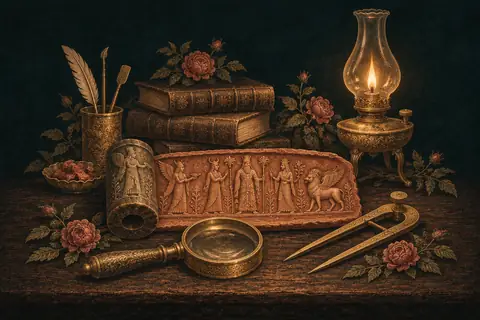
Where does the idea of ancient astronauts come from, and what do archaeologists answer?
What it is
The idea of ancient astronauts holds that visitors from the sky came in early times, and that the monuments, myths and gods of ancient peoples are memories of them. In its best known form it points to pyramids, great stone walls and old drawings and says that people of the time could not have made them. A second form, from Zecharia Sitchin, says that beings called the Anunnaki came from a planet named Nibiru and bred humankind as workers. Both are modern, and both are claims about evidence that can be checked.
The teaching
As the ancient-astronaut case, read beside the texts and stones it cites teaches it.
The claim
The ancient-astronaut case holds that in the remote past beings from another world came to the earth; that the people of the time, seeing their craft and their powers, took them for gods; and that the myths, the monuments and the pictures of the ancient peoples are memories and records of those visits. Its method is to set a strange object beside a question, could the people of that time have made this, and to answer that they could not.
Erich von Däniken reads the gods of every people so. The fire and smoke of a god's descent in scripture, the flying chariots of the Indian epics and the gods who came down from the sky to teach the arts are, in his reading, spacecraft and their crews, and the sons of God who took the daughters of men as wives in Genesis are visitors who improved the human stock. Each claim rests on a striking object, and each is best learned by setting the claim beside the object itself.
The lines of Nazca
The claim: on the desert plateau of Nazca in Peru, long straight lines and huge drawings of animals that can be seen whole only from the air look like an airfield, made for or by flyers. The object: the lines and figures were made by the Nazca people by lifting the dark, weathered stones of the desert surface and setting them aside, laying bare the paler ground beneath. Each great figure, the hummingbird, the monkey, the spider, is drawn as a single line that can be walked from start to end, and the same creatures are painted on Nazca pottery. A small team with stakes and cord can lay out such a figure in days, and the soft ground would not bear a landing aircraft.
The lid at Palenque
The claim: the carved stone lid of a tomb in the Temple of the Inscriptions at Palenque in Mexico shows an astronaut at the controls of a rocket, leaning forward with flames below. The object: the lid covers the tomb of K'inich Janaab' Pakal, a king of Palenque, and its inscriptions, now read, give his name, his ancestors and the day of his death. It shows the king at the moment of death, falling into the open jaws of the underworld or rising from them, before the World Tree, the great cross-shaped tree of Maya belief that joins the underworld, the earth and the sky, with the bird of the heavens perched on its top, as the same tree appears elsewhere in Maya art.
Ezekiel's wheels
The claim: the vision that opens the Book of Ezekiel describes a spacecraft landing. The object: the prophet sees, in the words of the King James Bible, “a whirlwind came out of the north, a great cloud, and a fire infolding itself”; within it four living creatures, each with four faces, of a man, a lion, an ox and an eagle; beside them wheels whose “appearance and their work was as it were a wheel in the middle of a wheel”, their rims full of eyes; and above them a throne like sapphire, on which sits the likeness of the glory of the Lord. It is a vision of God's throne-chariot coming to his people in exile, and Jewish mystics made it the centre of their contemplation, the work of the chariot.
The Piri Reis map
The claim: a map drawn by an Ottoman admiral shows the coast of Antarctica free of ice, as only someone flying above it could have seen. The object: Piri Reis drew the map at Gallipoli and wrote on it that he had compiled it from about twenty older charts, among them a map of Columbus. Its southern shore is the coast of South America, bent eastward to fit the edge of the gazelle-skin parchment, as mapmakers of the time often bent coasts they knew poorly; the real Antarctic coast has lain under thick ice for millions of years.
Sitchin's twelfth planet
Zecharia Sitchin built a second and larger story from the clay tablets of Sumer and Babylon. In his telling the solar system holds a twelfth member, Nibiru, a planet on a long orbit of thirty-six hundred years, which in the beginning struck a world called Tiamat and split it into the earth and the belt of broken rock between Mars and Jupiter. From Nibiru came the Anunnaki, who landed in Mesopotamia hundreds of thousands of years ago to mine gold, needed to save their planet's air. Weary of the labour, they made workers by mixing their own genes with those of an early human, and the first man, Adamu, was the result; the flood was a wave raised when Nibiru passed close.
What the tablets tell
The tablets themselves tell another story, worth knowing for its own sake. In the Babylonian poem of Atrahasis, when the gods were like men, they bore the work themselves: the junior gods, the Igigi, dug the rivers and canals for the senior gods, the Anunnaki, until after long ages they burned their tools and surrounded the house of Enlil in revolt. Enki proposed a remedy. One god was slain, and the mother goddess Nintu mixed his flesh and blood with clay and so made humankind to carry the gods' toil. When people multiplied and their noise kept Enlil from sleep he sent plague, drought and famine, and at last the flood, from which Enki saved Atrahasis by telling him to build a boat.
In the Babylonian Epic of Creation, Marduk splits the body of the monster Tiamat to make the sky and the earth, and humans are made from the blood of the rebel god Kingu to free the gods from labour. The gods are gods throughout: they eat the offerings, decree destinies and dwell in the temples, and no word in either poem tells of craft, genes or a planet.
Nibiru and the sar
Two words carry most of Sitchin's case. Nibiru, in Akkadian neberu, means a crossing or a ford, the place where one passes over, and it is one of the fifty names that Marduk receives at the close of the Epic of Creation. The thirty-six hundred years come from the sar, the Sumerian word for the number 3,600, sixty times sixty, in which the Sumerian King List counts the reigns of the kings before the flood: Alulim, the first king at Eridu, ruled 28,800 years, eight sars. The list is a measure of a legendary age, not the orbit of a planet.
How it is practised
Take one claim at a time and ask what would be there if it were true. If visitors built a wall, where are their tools, their rubbish and their workshops? Then look up what excavators found at that site: at nearly every one there are quarries with half-cut blocks, worn stone hammers, ramps and the houses of the crews. For the Anunnaki, read a standard translation of the Sumerian and Babylonian texts and see what the word means there. The question behind the method is plain: who is being told they could not have done their own work?
Where it comes from
Tales of sky visitors ran through magazines of the 1950s, and two French authors raised the idea in a bestseller of 1960. It reached the world with Chariots of the Gods?, published by the Swiss writer Erich von Däniken in 1968, which has sold in the millions. Zecharia Sitchin's The Twelfth Planet followed in 1976, built on his own reading of Sumerian tablets, and television took up the theme again from 2009. The astronomer Carl Sagan and many archaeologists answered at length from the 1970s, and the field's name for such writing is pseudoarchaeology.
What is known, and what is not
The books and their dates are documented, and so are the replies. No object of unearthly make has been found at any ancient site. In the cuneiform texts the Anunnaki are a group of gods, and Nibiru is a name tied to the god Marduk and to a point in the sky, usually taken as the planet Jupiter; Assyriologists reject Sitchin's readings. The theory draws its examples mostly from Egypt, the Americas and the Pacific, and it takes their works away from the peoples who made them.
Its words
 Ancient Astronauts
- The claim that visitors from the sky shaped early civilisations. It dates from books of the 1960s and 1970s, and archaeologists reject it.
 Anunnaki
- A group of gods in Sumerian and Babylonian texts. Zecharia Sitchin's claim of 1976 that they were visitors who bred humankind is rejected by Assyriologists.
 Nibiru
- In Babylonian texts a name tied to the god Marduk and to a point in the sky. The wandering planet of that name in modern books has no basis in the tablets.
 Pseudoarchaeology
- Writing about the past that borrows the look of archaeology and skips its tests, most often to argue that a people did not build their own monuments.
Ask the Oracle further
What do Assyriologists say about the Anunnaki and Nibiru claims?What is wrong with the ancient astronauts idea, besides the lack of evidence?
Before you practise
Atlantis is first told by Plato about 360 BC, as part of an argument, and no drowned continent has been found. The monuments were built by the peoples of their own lands. Theories of lost master races take those works away from their makers, and the house does not repeat them as true.
Its other branches
AtlantisLemuria and MuShambhala and the hidden kingdomsHow the monuments were builtThe lands the sea tookReal ancient marvelsThe whole artSearch the tree

