
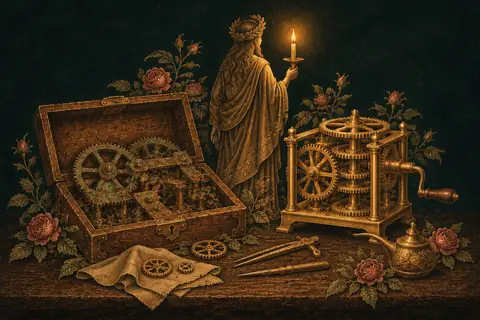
What is the Antikythera mechanism, and what does it show of ancient skill?
What it is
The ancient world left real marvels, and they are stranger for being true. The Antikythera mechanism is a box of at least thirty bronze gear wheels, made in the Greek world about the second century BCE, that showed the places of the Sun and Moon, the Moon's phase, the seasons of eclipses and the four-year cycle of the games. Göbekli Tepe in Turkey has carved stone pillars up to five metres tall, raised from about 9500 BCE by people who did not yet farm. Each was a shock to scholars, and each has been explained by study, not by a lost race.
The teaching
As Alexander Jones's A Portable Cosmos (2017), with the finds themselves teaches it.
The box of gears
The Antikythera mechanism was a wooden box about the size of a shoebox, with a crank on one side and dials on its two faces, holding at least thirty bronze gear wheels with hand-cut triangular teeth. Turning the crank drove the great four-spoked wheel within once round for every year, and through the trains of gears each pointer moved at its own rate, so that the user could wind the heavens forward or back to any date and read what the sky would show.
The front: Sun, Moon and planets
The front dial held two rings. The inner was the zodiac, its twelve signs divided into degrees; the outer was the Egyptian calendar of 365 days, twelve months of thirty days and five days added, which could be turned to keep step with the extra quarter day. Over them moved a pointer for the Sun and one for the Moon, and the Moon's pointer carried a small ball, half silver and half dark, that turned to show the Moon's phase. Its inscriptions name the five planets the Greeks knew, Mercury, Venus, Mars, Jupiter and Saturn, and their cycles.
The back: the calendar and the games
The back carried two great spiral dials, each read by a pointer whose tip ran along the spiral's groove. The upper spiral, of five turns, was divided into the 235 months of the nineteen-year cycle of Meton, after which the Moon's phases fall again on the same days of the year, and its months bear the names of a Corinthian calendar. Within it a small dial showed the four-year cycle of the great games of Greece and named the games of each year: the Olympic, the Pythian, the Isthmian and the Nemean, and lesser festivals such as the Naa of Dodona.
The back: the eclipses
The lower spiral, of four turns, was divided into the 223 months of the saros, the cycle after which eclipses come back in the same order. In the months when an eclipse could fall, a small glyph was engraved, marked for an eclipse of the Sun or of the Moon with the hour of the day or night; and a small dial within showed the exeligmos, three saros cycles, after which the eclipses return at nearly the same hour, telling the user how many hours to add.
The Moon's uneven pace
The cleverest part follows the Moon itself. The Moon moves faster across the sky at some times and slower at others, as the astronomer Hipparchus described. The mechanism copies this with two gears on slightly offset axles, one carrying a pin that runs in a slot on the other, so that the second wheel turns now a little faster and now a little slower; and the plate that carries the pair turns slowly round, as the place of the Moon's fastest motion moves round the sky over some nine years.
Its words, and its kin in the books
The mechanism speaks for itself. Thousands of letters engraved on its plates survive: a calendar of the risings and settings of the stars set against the zodiac, the names of the dials, and on the back cover a text that explains what the user is looking at, like a handbook. Ancient writers describe instruments of its family. Cicero tells that the Roman general Marcellus carried off from Syracuse a model of the heavens made by Archimedes, which showed the motions of the Sun, the Moon and the five planets, and even the eclipses, and that in his own day his friend Posidonius had made one that showed the same.
Göbekli Tepe: the rings of pillars
On a hill near Şanlıurfa in Turkey, people who lived by hunting and gathering raised great round and oval enclosures of stone walls and benches, with T-shaped limestone pillars set into the walls and two taller ones, up to five and a half metres, standing at the centre. The pillars were quarried from the limestone of the hill itself, where an unfinished one, longer than any yet raised, still lies in the rock.
The pillars are people. The central pair in the best known enclosure have arms carved down their sides, hands with long fingers meeting over the belly, belts, and loincloths of fox pelts hanging in front: the T is a head and body, stylised, faceless and larger than life. Around them the other pillars swarm with animals carved in relief, foxes, boars, snakes, aurochs, wild asses, cranes and scorpions, and on one a vulture spreads its wing beside a round disc above a headless man.
Its sister sites on the nearby hills, Karahan Tepe among them, have pillars and rooms cut into the bedrock, one with a human head carved out of its wall; and from the old city of Şanlıurfa below comes the Urfa man, a life-size limestone statue of a man with eyes of black obsidian, from the same age of hunters.
The tunnel of Eupalinos
On the Greek island of Samos, Herodotus writes, the people made a tunnel through a mountain to bring water to their city, the work of Eupalinos of Megara: more than a kilometre long and about two metres high and wide, with a deeper channel cut along it for the water pipes. The marvel is how it was dug. Two teams started from the two sides of the mountain and worked toward each other through solid rock, guided by geometry and by levels and sightings taken over the mountain, and near the middle, to be sure of meeting, both teams turned aside, so that their headings crossed and joined.
Glass that changes and iron that keeps
The Lycurgus Cup, a Roman cup of carved glass, shows the Thracian king Lycurgus caught in the vines of the nymph Ambrosia for his attack on her, a follower of Dionysus. In ordinary light it looks jade green; lit from within it glows red. The change comes from particles of gold and silver in the glass, far too small to see.
In the courtyard of the Qutb Minar in Delhi stands an iron pillar more than seven metres tall and some six tonnes in weight, raised with an inscription for a king called Chandra, that has stood in the open for some sixteen hundred years with almost no rust. Its iron is rich in phosphorus, and the metal has grown a thin, tight skin that shields it from the air and the rain.
How it is practised
A real marvel can be told from a false one by what happens when experts get hold of it. A real one gathers detail: the Antikythera mechanism now has published gear counts, a known calendar and working reconstructions that anyone can watch run. A false one stays a single striking picture with a line of print under it. A reader can pick any wonder from a book or a film, look for the excavation report or the museum record, and see which kind it is. The wonder is kept either way.
Where it comes from
The mechanism came up from a wreck of the first century BCE in 1901 and sat in the museum at Athens as a puzzle. Derek de Solla Price studied it with radiographs and published Gears from the Greeks in 1974; from 2005 a research team used X-ray scans to read thousands of characters engraved on its plates and to rebuild its gearing. Göbekli Tepe was noted in a survey of 1963 and excavated by Klaus Schmidt from 1995. Other claimed marvels have fared less well: the jars called the Baghdad battery show no sign of use as cells, and the Nazca lines of Peru were made by clearing dark stones from pale ground.
What is known, and what is not
The mechanism's date, gearing and functions are established by repeated scans and by what is engraved on its plates, though the display of the planets on its front is a reconstruction from fragments. No other geared device of its complexity survives from before the Middle Ages, which makes it a rarity and not an impossibility: ancient authors mention such instruments. Göbekli Tepe's dates rest on many radiocarbon measurements. What its builders believed is unknown.
Its words
 Antikythera Mechanism
- A geared bronze calculator of the Sun, Moon and calendar, made in the Greek world about the second century BCE and raised from a shipwreck in 1901.
 Pseudoarchaeology
- Writing about the past that borrows the look of archaeology and skips its tests, most often to argue that a people did not build their own monuments.
Ask the Oracle further
How do we know what the Antikythera mechanism was for?Which claimed wonders, like the Baghdad battery or the Nazca lines, hold up?
Before you practise
Atlantis is first told by Plato about 360 BC, as part of an argument, and no drowned continent has been found. The monuments were built by the peoples of their own lands. Theories of lost master races take those works away from their makers, and the house does not repeat them as true.
Its other branches
AtlantisLemuria and MuShambhala and the hidden kingdomsAncient astronautsHow the monuments were builtThe lands the sea tookThe whole artSearch the tree

