

Mystical systems
Göbekli Tepe
Direct answer
Göbekli Tepe is a hill in south-eastern Turkey where people raised rings of carved stone pillars from about 9500 BCE, before farming, pottery or metal.
$0 today, then $19/month after 7 days. Cancel anytime.
At a glance
- Also called
- gobekli tepe, potbelly hill, oldest temple in the world, gobekli tepe pillars
- Found in
- Mystical Systems
- Related
- Megalith, Stonehenge, Temple
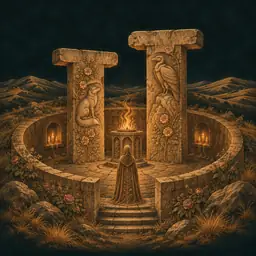

Göbekli Tepe is a hill in south-eastern Turkey where people raised rings of carved stone pillars from about 9500 BCE, before farming, pottery or metal.
A lineage map for books and systems; it avoids presenting symbolic traditions as literal fact.
Understand the chapter you are in.
Your life’s turning points, measured from your birth.
Walk through Alex’s whole example first


Prefer to explore first?
 The Road of AgesThe turning points of your whole life, from your own chart
Walk my road
Who built Göbekli Tepe?
Göbekli Tepe, Turkish for potbelly hill, stands near the city of Şanlıurfa. Its builders cut limestone pillars shaped like a capital T, some more than five metres tall and several tonnes in weight, and set them in round and oval enclosures with two of the tallest at the centre. Many are carved with foxes, boars, snakes, cranes, vultures and scorpions. Some have arms, hands and belts in low relief, so the pillars themselves seem to be figures.
The oldest enclosures date from about 9500 BCE and the site was in use for some fifteen hundred years. That is about seven thousand years before the great stones of Stonehenge.
On the tree of the hidden arts: Sacred places.
What sets Göbekli Tepe apart
Its date is the whole surprise. The pillars were cut, carved and raised by people who had no pottery, no metal, no draught animals and, as far as is known, no farmed crops. The carvings are mostly of wild and dangerous creatures, though boar, aurochs and cranes, which the builders also ate, are among them. The tallest pillars stand in pairs at the middle of each ring, facing one another, with hands carved meeting over the belly, so that each ring looks like a gathering of stone figures round two greater ones.
- Name: Turkish: potbelly hill
- Oldest enclosures: about 9500 BCE
- Tallest pillars: about 5.5 metres
- Excavation: begun in 1995 by Klaus Schmidt
- World Heritage: listed by UNESCO in 2018
Often mistaken for something else: Stonehenge was raised by farmers about 2500 BCE; Göbekli Tepe by hunters and gatherers some seven thousand years before.
The story behind Göbekli Tepe
A survey of 1963 took the hill for a medieval graveyard. The German archaeologist Klaus Schmidt recognised what it was in 1994 and excavated there from 1995 until his death in 2014. He held that it was a sanctuary where hunters gathered and that the need to feed the gatherings helped bring about farming. Excavators since have found houses, cisterns and thousands of grinding stones, and now think people also lived there. Similar pillars have been found at other hills in the region, among them Karahan Tepe.
Why Göbekli Tepe matters
Göbekli Tepe overturned the order archaeologists had assumed, in which farming and villages came first and great building came after.
How to read Göbekli Tepe
Historians cite it when asking what first drew people together in large numbers: food, belief, or both at once.
Göbekli Tepe in practice: an example
A reader told that monuments need cities and kings can point to pillars raised by people who had neither.
Where readings of Göbekli Tepe go wrong
Göbekli Tepe’s makers left no writing, so every account of what they believed, including the word temple, is an inference from the stones.
Sources and editorial method
This entry summarizes the tradition in the Almanac's own words; where no source is listed, it is an editorial summary rather than a primary text, and symbolic readings are named as the tradition's, not as fact.
- Source
- The Great Almanac Dictionary
- Category
- Mystical Systems
- Aliases
- gobekli tepe, göbekli tepe turkey, potbelly hill, oldest temple in the world, gobekli tepe pillars
- Last updated
- 2026-09-26
See Göbekli Tepe in your personal almanac
A definition tells you what it is; your own birth chart tells you what it means for you. The Oracle casts your real chart and answers for your love, your work, and your year ahead, in conversation. It opens with the 7-day Oracle trial.
Speak with the OracleRelated terms
More in Mystical Systems
From the reference page to your own chart
Every word here
is in your own chart.
- Your life’s turning points, measured from your birth
- A practical next step to consider
- It opens with 7 days free: the AI Oracle on thirty hidden arts, and your daily horoscope
$0 today, then $19/month after 7 days. Cancel anytime.
Common questions
Who built Göbekli Tepe?
People of the region who lived by hunting and by gathering wild grain, about 11,500 years ago. Their tools, their food remains and their quarries have been found on and around the hill.
Is Göbekli Tepe the oldest temple in the world?
It holds the oldest monumental buildings known. Whether they were temples is not settled: later digging found signs of ordinary dwelling there too.
Why was Göbekli Tepe buried?
Its first excavator thought the enclosures were filled in on purpose. More recent work suggests that slides of soil and rubble from the slopes above filled them over time.


