

Mystical systems
Shambhala
Direct answer
Shambhala is a kingdom described in the Kalachakra teaching of Tibetan Buddhism, ruled by kings who preserve that teaching. The tradition holds it as both a place and an inner state.
$0 today, then $19/month after 7 days. Cancel anytime.
At a glance
- Also called
- shambala, shangri-la
- Found in
- Mystical Systems
- Related
- Agartha, Hyperborea, Theosophy, El Dorado
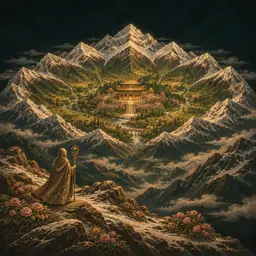

Shambhala is a kingdom described in the Kalachakra teaching of Tibetan Buddhism, ruled by kings who preserve that teaching. The tradition holds it as both a place and an inner state.
A lineage map for books and systems; it avoids presenting symbolic traditions as literal fact.
Understand the chapter you are in.
Your life’s turning points, measured from your birth.
Walk through Alex’s whole example first


Prefer to explore first?
 The Road of AgesThe turning points of your whole life, from your own chart
Walk my road
What is Shambhala in Tibetan Buddhism?
In the Kalachakra tradition Shambhala is a land ringed by snow mountains, shaped like an eight-petalled lotus, with the capital Kalapa at its centre. Its first religious king, Suchandra, is said to have received the Kalachakra teaching from the Buddha and carried it home, and a line of kings has guarded it since. The texts foretell that a later king, Raudra Chakrin, comes forth when the teaching is in danger.
Tibetan teachers explain Shambhala on more than one level: as a country in the north, as a pure realm visible to those with the right practice, and as the awakened state itself. Western books have tended to keep only the map and to lose the teaching.
On the tree of the hidden arts: Lost worlds.
What sets Shambhala apart
Shambhala differs from every other land on this shelf in belonging to a living religion with a long literature of its own. It is bound up with one teaching, the Kalachakra or wheel of time, and with an initiation that Tibetan lamas, the Dalai Lama among them, still give to large gatherings. The texts name its kings in order and give each a length of reign, and they lay the kingdom out with the regularity of a mandala.
- Tradition: the Kalachakra teaching of Tibetan Buddhism
- Texts reach Tibet: in the eleventh century CE
- Capital: Kalapa, at the centre of a lotus-shaped land
- First religious king: Suchandra, said to have received the teaching from the Buddha
- Western borrowing: Shangri-La, in James Hilton's Lost Horizon, 1933
Often mistaken for something else: Agartha is an underground realm invented by European authors in the nineteenth century; Shambhala is a kingdom of Tibetan Buddhist teaching some nine centuries older.
The story behind Shambhala
The Kalachakra texts appeared in India around the early eleventh century and reached Tibet soon after, where guidebooks to Shambhala were later written, among them one by the Panchen Lama Lobsang Palden Yeshe in 1775. Helena Blavatsky and Nicholas Roerich brought the name to Western readers, Roerich leading an expedition through Central Asia in the 1920s. James Hilton's novel Lost Horizon (1933) is widely thought to have drawn on it for Shangri-La.
Why Shambhala matters
Shambhala is the one hidden kingdom here that belongs to a living faith, so it calls for the tradition's own account before any outsider's.
How to read Shambhala
Readers treat it as a reminder to ask whose a story is: Shambhala is told by Tibetan Buddhist teachers, and their telling comes first.
Shambhala in practice: an example
A reader who knows Shangri-La from a film can look up the Kalachakra and find that the original is a teaching about time and practice.
Where readings of Shambhala go wrong
Shambhala is a teaching of a living religion, not a destination; expeditions and guides that promise to reach it sell something else.
Sources and editorial method
This entry summarizes the tradition in the Almanac's own words; where no source is listed, it is an editorial summary rather than a primary text, and symbolic readings are named as the tradition's, not as fact.
- Source
- The Great Almanac Dictionary
- Category
- Mystical Systems
- Aliases
- shambhala meaning, shambhala kingdom, kalachakra shambhala, shambala, shangri-la
- Last updated
- 2026-09-26
See Shambhala in your personal almanac
A definition tells you what it is; your own birth chart tells you what it means for you. The Oracle casts your real chart and answers for your love, your work, and your year ahead, in conversation. It opens with the 7-day Oracle trial.
Speak with the OracleRelated terms
More in Mystical Systems
From the reference page to your own chart
Every word here
is in your own chart.
- Your life’s turning points, measured from your birth
- A practical next step to consider
- It opens with 7 days free: the AI Oracle on thirty hidden arts, and your daily horoscope
$0 today, then $19/month after 7 days. Cancel anytime.
Common questions
What is Shambhala in Tibetan Buddhism?
A kingdom named in the Kalachakra teaching, whose kings are said to preserve that teaching. Teachers describe it as a land in the north, as a pure realm seen through practice, and as a state of awakening.
Is Shambhala a real place?
Tibetan teachers differ. Some hold that it is a physical land hidden from ordinary sight, others that it is reached only through practice. No expedition has located it, and the tradition does not rest on its being found.
Is Shangri-La the same as Shambhala?
Shangri-La is a fictional valley in James Hilton's novel Lost Horizon, published in 1933. Hilton drew on Western accounts of Shambhala, but his peaceful lamasery is his own invention.


