
What it is held to be
The tradition’s claim, set beside what researchers have found.
What is astral projection held to be, and what has science found about out-of-body experience?
The old teaching that a second body can travel while the first one sleeps. The experience is real and common at the edge of sleep; science has not shown that anything leaves the body.
What it is, and the gentle way to try
Ask the OracleWhat is astral projection, and is it safe for me to try?
Astral projection is the teaching that a person has a second, finer body that can leave the physical one and travel while it lies asleep or still. The idea took its modern form among the Theosophists of the late nineteenth century, who drew on Platonist and Indian sources, and popular books spread it in the twentieth. Behind the doctrine lies a real and fairly common event, the out-of-body experience, in which a person seems to see the world, and often their own body, from outside.
The house keeps the two apart. The experience is real: roughly one person in ten reports at least one, most often at the edge of sleep. The explanation is disputed, and no experiment has shown that anything leaves the body. So these pages set out what the tradition claims, what researchers have found, and a gentle way of exploring the edge of sleep that puts rest first and forces nothing.
As the tradition of the second body, from the Platonists to Robert Monroe teaches it.
The teaching begins with what a person is. Beside the body of flesh, it holds, there is a second body of finer stuff and the same shape, which fits within the first while a person is awake, moves with it, and carries their awareness and feeling. Each age of the tradition has its own name for it. The late Platonists call it the vehicle of the soul, luminous and star-like. Paracelsus speaks of a sidereal body, a body of starry stuff within the physical one, and the word astral, which means starry, keeps that old memory. The Theosophists call it the astral body, Sylvan Muldoon the phantom, and Robert Monroe, choosing a plainer name, the Second Body.
The names do not all mean quite the same thing. Some travellers find themselves with a body out there, with hands to look at and a floor to stand on; others have only a point of view, seeing from somewhere near the ceiling. In the older Theosophy the astral body is the double, and in the later it is the body of feeling and desire, the double being renamed etheric. The branches on what the art is held to be and on the planes sort these out. What every form of the teaching shares is the claim on which the whole art rests: that the self is not bound fast to the flesh, and can for a time stand apart from it.
The second idea is that the parting is not rare. Muldoon teaches that when the two bodies are exactly aligned they are in coincidence, which is the waking state, and that in every ordinary sleep the phantom slips a little out of coincidence and hovers just above the sleeper. Leadbeater teaches much the same: in deep sleep the astral body withdraws from the physical, and in most people it drifts near the bed, nearly as drowsy as the body it has left. What a projector adds is only awareness. Projection, in this teaching, is the nightly loosening carried further while the mind stays awake to know it.
So the art's whole method lies in one phrase: mind awake, body asleep. The body is allowed to fall asleep as it does every night, while a thread of attention is kept, lightly, through the change. Everything the manuals teach, the relaxing, the watching, the resolve and the calm meeting of strange sensations, serves that single state.
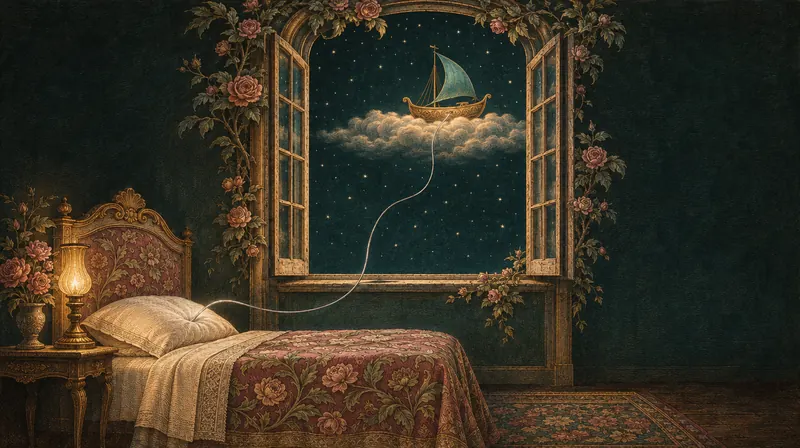
Between the two bodies, many travellers say, runs a cord, thick and strong close to the sleeper and thinning to a thread with distance, which the tradition calls the silver cord and holds to part only at death, so that a traveller is always drawn back. Some see it on every journey and others never once.
As there are finer bodies, so there are finer worlds. Theosophy teaches seven planes, which differ not in place but in fineness, each interpenetrating the denser, so that all are present here and now. Next above the physical is the astral plane, the world of feeling and desire, whose matter answers to emotion as physical matter answers to touch; above it lies the mental plane, the world of thought, and higher planes beyond that. The astral body is the vehicle of the astral plane, and in sleep and after death it is said to move there.
Monroe, writing from his own journeys, drew a simpler map in three locales: this world, visited unseen; a world without matter where thought is the substance of things; and a third, solid world much like ours but not ours. The two maps agree on the teaching that matters most to a beginner. In the finer world, both teach, what a person feels takes shape about them, so that a traveller meets whatever answers their own state of mind. The planes, with their levels and their inhabitants, are taught on their own branch.
The way between the worlds, in the manuals, runs through the borderland between waking and sleep: the hypnagogic state on the way down, the hypnopompic on the way up, where most out-of-body experiences begin. There the body lets go before the mind does. Patterns of light drift behind the closed eyes, voices and sounds arrive from nowhere, the outline of the body blurs, and it may seem to float, sink, sway or swell. Deeper in come the signs the projectors make most of: a rushing roar, the vibrations, which feel like a current pouring through the body, and a stillness in which the body cannot move, which Muldoon calls astral catalepsy.
Here the two chief sources of this art read the same events in two ways, and a student should know both. The projectors read each sign as a stage of the second body loosening from the first. Sleep medicine reads them as the brain falling asleep, and the stillness as the body's ordinary stillness in dream sleep, arriving while the mind is still awake. Either way the signs are harmless and they pass. The branches on the edge of sleep and on sleep paralysis teach them one by one, with what to do as each arrives.
In the finer body, the teachers say, thought is motion. To think of a place or a person is to be drawn toward them, sometimes slowly and sometimes in a rush; walls and doors give little hindrance; and to think of the body is to be back in it. The ways out are made of thought too: Monroe teaches thinking oneself lighter until one floats up, or turning as if rolling over in bed until one rolls free, while the physical body does not move at all. Fear, above all, ends a journey, and a return too sudden jolts the body awake, which Muldoon calls repercussion.
This is why the practice trains the state of the mind and not any effort. Straining wakes the body, grasping at an image wakes the mind, and fear brings the traveller home. What carries a person across is calm, and an interest that watches without reaching. The projectors also teach three ways in, from waking, from a dream known as a dream, and unbidden in illness or shock, and the branch on what the art is held to be teaches each, with the stages of leaving and Monroe's three locales.
The gentle practice is made of four simple things. The first is relaxation: the body let go part by part, from the feet to the face, until it is heavy, warm and still, with the breath left to itself. The second is attention: a thread of quiet awareness kept through the drowsiness, interested in whatever comes and holding on to none of it. The third is the resolve, a plain sentence of intention set before lying down, as Monroe set himself to perceive and remember all that he met. The fourth is the record, written as soon as it is comfortable to write.
The record is where a student's honesty is trained. It keeps apart what happened and what was concluded: a feeling of floating is a fact of the night, while a visit to a distant room is a conclusion still to be checked. It notes the date and hour, how rested the body was, how far the stages went, and whether anything was seen that could be checked afterwards. Monroe's book grew from such a diary, and the gentle way to try, on its own branch, gives his method step by step.
The first step is not to go anywhere. At an ordinary bedtime, or in a short rest by day, the student lies comfortably, lets the body grow heavy, and watches the borderland arrive: the drifting lights, the snatches of speech, the sense of floating. If sleep comes, it comes, and the night was a night of sleep. A line in the notebook on waking is enough. Over some weeks the record shows the student the shape of their own falling asleep, which is the ground every later practice stands on.
If the stillness comes, the student remembers what it is: the body asleep and the mind awake, and it always passes. Slow breathing stays under one's own control, and moving one finger or toe, or blinking hard, ends it. Only when such meetings have grown calm does the student turn to the resolve and to Monroe's ways of rising out. Many who practise never have the experience of leaving at all, and lose nothing by it: the borderland is worth knowing for its own sake.
The art's limits come before everything else in it. Sleep is never cut short for it: no alarm in the small hours, no night broken to catch the borderland, and nothing taken to force it, neither thirst nor fasting nor any substance, so the harsher methods of the older manuals are left out. Anyone who has had psychosis, mania, dissociation or seizures leaves this practice alone. Anyone at all stops if it brings a fear that follows them into the day, or a lasting sense that the world or their own body is unreal, and a doctor can help if that stays.
The branches stand in a natural order. What it is held to be gives the projectors' own account: the stages of leaving, the cord, Monroe's three locales and the three ways in. The edge of sleep teaches the borderland sign by sign, and is the place to begin practice. Sleep paralysis teaches the stillness met on the way and how to let it pass. The gentle way to try sets out Monroe's method, from the setting and the resolve to rolling out and coming back. The branch on the planes and the cord gives the Theosophists' map of the finer worlds and bodies, and the story of the silver cord.
Out-of-body experiences are real experiences; science has not shown that anything leaves the body. Sleep paralysis on the way is harmless and passes in a minute or two. Never go without sleep or take anything to force it. If you have had psychosis, mania, dissociation or seizures, leave this practice alone, and stop if it brings fear or a lasting sense of unreality.
Each one is a question you can ask.
The tradition’s claim, set beside what researchers have found.
What is astral projection held to be, and what has science found about out-of-body experience?
The state between waking and sleep where most of these experiences begin.
What happens at the edge of sleep that feels like leaving the body in astral projection?
The body asleep, the mind lightly awake, and a notebook afterwards.
What is the gentle, safe way to try astral projection?
Harmless and brief: what it is, and how to let it pass.
What is sleep paralysis during astral projection, and what do I do when it happens?
The Theosophists’ map of the astral plane and its silver cord.
What did the Theosophists teach about the astral plane and the silver cord in astral projection?
Each opens its page in the dictionary.
Russian-born writer who founded the Theosophical Society in New York in 1875 with Henry Steel Olcott and William Quan Judge. Isis Unveiled (1877) and The Secret Doctrine (1888) brought Hindu and Buddhist ideas, karma and reincarnation among them, into Western esotericism.
Austrian philosopher who led the German section of the Theosophical Society from 1902, broke with it, and founded the Anthroposophical Society in 1912 and 1913. Waldorf schools (1919) and biodynamic farming (1924) come from him. Some of his statements about race are rejected today, including by anthroposophists.
Athenian philosopher, pupil of Socrates and teacher of Aristotle, who founded the Academy about 387 BC and wrote in dialogues. The Timaeus describes the cosmos as a living being with a soul, ordered by number; the Republic gives the cave and the three parts of the soul; the Symposium gives the tale of humans split in two who seek their other half. Later Platonists, Plotinus above all, built on him the philosophy the Hermetic and astrological traditions lean on.
Past lives and karmaLost worldsDeath and what followsSacred geometry
Make today specific
The same sky reaches everyone differently. Your birth details turn a general forecast into one theme, and one thing worth doing about it.
One instrument, one answer. Explore the preview; membership opens every tool.
Read more

