
What it is held to be
The tradition’s claim, set beside what researchers have found.
What is astral projection held to be, and what has science found about out-of-body experience?
What it is
Astral projection is held to be the conscious separation of a second body from the physical one. The traveller is said to rise out, see the room and the sleeping body, and move through walls or over great distances. That is the claim of the tradition. Beneath it is the out-of-body experience, which is not a claim but a report: people do have the vivid sense of being outside themselves. It comes most often near sleep, and also in accidents, under anaesthetic and in moments of extreme stress.
The teaching
As the projectors' tradition, from Sylvan Muldoon to Robert Monroe teaches it.
The second body
The teaching begins with a claim about what a person is. Beside the body of flesh there is a second body, finer and lighter but of the same shape, which fits within the first while we are awake. Theosophy calls it the astral body, and so does Sylvan Muldoon, who also calls it simply the phantom. Robert Monroe chose a plainer name, the Second Body. It is held to see, hear and move on its own account, and to carry the person's awareness with it when it goes.
When the two bodies are exactly aligned, Muldoon says they are in coincidence, and that is the waking state. He taught that in every ordinary sleep the phantom slips a little out of coincidence and hovers just above the sleeper, and that sleep restores the body partly through this. Projection, in his teaching, is the same movement carried further while awareness stays on: the phantom leaves the bed, and the person knows it.
How the double leaves
Muldoon gives the leaving in stages, from his own experience. First the body grows stiff and cannot move, a state he calls astral catalepsy. Then the phantom rises, lying flat and rigid, a few feet above the bed, as though floating on its back. Some way up it is turned from lying to standing and set upright on the floor of the room, where the traveller finds that they can look about.
Monroe teaches two ways out. In the first the traveller thinks of growing lighter and lighter until they float upward, which he calls lifting out. In the second they turn as if rolling over in bed, head and shoulders first, until they roll clean out of the body and drift free. Both begin from a deep relaxation in which the body is still and the mind awake, and both are done in thought alone: the physical body does not move.
The cord
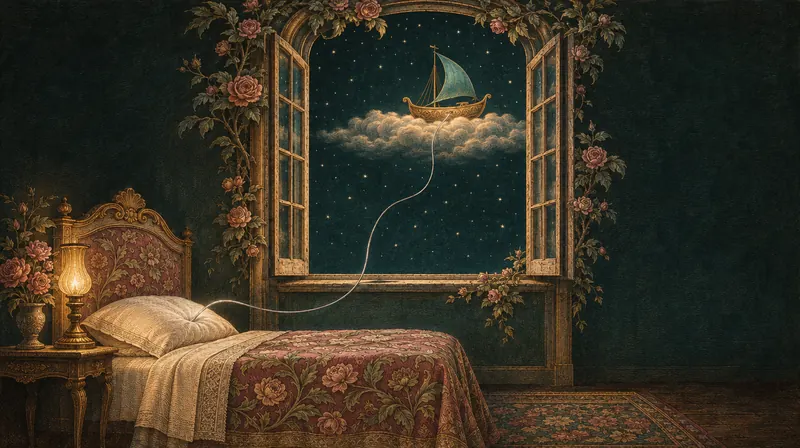
Many travellers report a cord between the two bodies. Muldoon saw it on his first projection as an elastic cable running from the forehead of his sleeping body to the back of the head of his phantom. Close to the body, within what he called the cord's range of activity, it is thick and pulls strongly; farther off it thins to a thread, and it stretches as far as the traveller goes. The tradition holds that it parts only at death, so that a traveller is always drawn back. Not everyone sees it: some speak of the cord on every journey, others never once.
What the traveller meets
The traveller is said to see the room, and often their own body lying on the bed, which most find the strangest sight of all. The second body moves by thought: to think of a place or a person is to be drawn toward them, sometimes slowly, sometimes in a rush. Walls and doors give little or no hindrance. The traveller may hear as well as see, and may meet others, the living or figures they take to be something else.
Celia Green, who gathered hundreds of first-hand accounts, distinguished two forms of the experience. In the first, which she called parasomatic, the person seems to have a body out there, with arms and legs and a place to stand. In the second, asomatic, there is no body at all, only a point of view, seeing from somewhere near the ceiling. Accounts of both are found, and the teaching of a second body draws on the first.
Monroe's three locales
Monroe sorted the places he went into three. Locale I is the here and now: this world, its rooms and streets and the people one knows, visited unseen. It is the only locale where what is seen could be checked, and Monroe tried to check such visits afterwards with the people he had seen.
Locale II is a world without matter as we know it, where thought is the substance of things. What one deeply desires or fears takes shape there, and like is drawn to like, so that a traveller arrives among whatever answers their own deepest feelings; Monroe met fear there more than anything else. Locale III, the rarest, seemed to him a solid world much like ours but not ours, with its own people and its own history, where he sometimes found himself inside another man's life.
Three ways in
The teaching distinguishes three ways in. Conscious projection begins from waking: the traveller lies still, lets the body sleep while the mind stays awake, and leaves knowingly. Projection from a dream begins inside sleep: the dreamer realises that they are dreaming and, from that knowing, steps out; Oliver Fox, who began this way, called such a dream a dream of knowledge. Unbidden projection comes without any wish, at the edge of sleep, in illness, in shock or in danger, and it is how most people who have had the experience first met it.
Muldoon held that the power behind every projection is the subconscious will, the part of the mind that acts in sleep on what was strongly wanted by day. His harsher ways of stirring it, such as going to bed thirsty so that the sleeping mind would rise to fetch water, the house leaves out: they cost the body for the sake of an experience, and the art's rule is that sleep and comfort come first.
The return
Every teacher agrees that the way back is easy, often too easy. A sudden fear, a noise in the house, a thought of the body, and the traveller is back in bed, sometimes with a jolt. Muldoon called the jolt repercussion: when the phantom drops back into coincidence too fast, the body jerks, sometimes with a sharp, brief pain, and then it passes. Monroe found that fear above all cut a journey short.
On waking, the projector's first task is the record: the date and hour, how long they had slept, what they saw and what they took it to mean, set down before the day blurs it. Monroe's book grew from such notes, kept from his first experience onward.
Fear and its limits
The teachers warn first of fear. The vibrations, the stiffness of the body, a sense of presence in the room: each can frighten, and each is harmless and passes. The way through fear is not to push on but to rest, or to come back; nothing in the teaching asks anyone to go further than feels safe.
The house adds the art's own limits. Sleep is never cut short for this, and nothing is taken to force it. Anyone who has had psychosis, mania, dissociation or seizures leaves the practice alone. If it brings fear, or a sense of unreality that lingers into the day, the right step is to stop.
How it is practised
The first step in understanding it is to sort any account into what was experienced and what was concluded. A reader with an experience of their own can write down exactly what happened, at what hour and after how much sleep, before deciding what it was. Useful questions are whether the room looked as it really was, and whether anything was learned that could be checked. Most people find it happens to them once or twice, unbidden, and is remembered as striking and harmless.
Where it comes from
Accounts of the soul leaving the body are found in Plato's story of Er and in many shamanic traditions, and saints' lives tell of bilocation, a holy person seen in two places at once. The modern doctrine was shaped by the Theosophical Society, founded in 1875, and made popular in 1929 by Sylvan Muldoon's The Projection of the Astral Body. Robert Monroe's Journeys Out of the Body of 1971 made the neutral term familiar. Research followed: Celia Green collected cases in the 1960s, and from 2002 neuroscientists began to produce the experience in the laboratory.
What is known, and what is not
The experience is well established: surveys find that roughly one person in ten has had one. In 2002 Olaf Blanke reported that stimulating a region near the junction of the temporal and parietal lobes produced it in a patient, and in 2007 two laboratories induced a similar illusion in healthy volunteers. Tests in which a traveller tries to read a hidden target have not given reliable results. Neurologists class the experience with autoscopy, the seeing of one's own body or double from outside. The evidence fits a change in the brain's sense of where the body is, and does not show that anything leaves.
Its words
- Astral Projection
- The practice, or the claimed fact, of a second body leaving the physical one to travel while it sleeps or rests.
- Out-of-Body Experience
- The experience of seeming to be outside one's body, often seeing it from above. Common, real as experience, and studied in laboratories.
- Bilocation
- The report that one person was seen in two places in the same hour, told mostly in the lives of Catholic saints.
- Autoscopy
- The neurologists' word for seeing one's own body or its double in the space outside oneself, a family that includes the out-of-body experience.
Ask the Oracle further
Has anyone on an astral projection ever proved they saw something they could not have known?Why do out-of-body experiences happen in accidents and under anaesthetic?
Before you practise
Out-of-body experiences are real experiences; science has not shown that anything leaves the body. Sleep paralysis on the way is harmless and passes in a minute or two. Never go without sleep or take anything to force it. If you have had psychosis, mania, dissociation or seizures, leave this practice alone, and stop if it brings fear or a lasting sense of unreality.
Its other branches
The edge of sleepThe gentle way to trySleep paralysisThe planes and the cordThe whole artSearch the tree

