

The inner life
Autoscopy
Direct answer
Autoscopy is the experience of seeing an image of one's own body in the space outside oneself, a term from neurology that covers a family of related experiences.
$0 today, then $19/month after 7 days. Cancel anytime.
At a glance
- Also called
- autoscopic hallucination, seeing your own body, autoscopic phenomena
- Found in
- Consciousness & Spiritual Psychology
- Related
- Out-of-Body Experience, Astral Projection, Doppelgänger, Sleep Paralysis
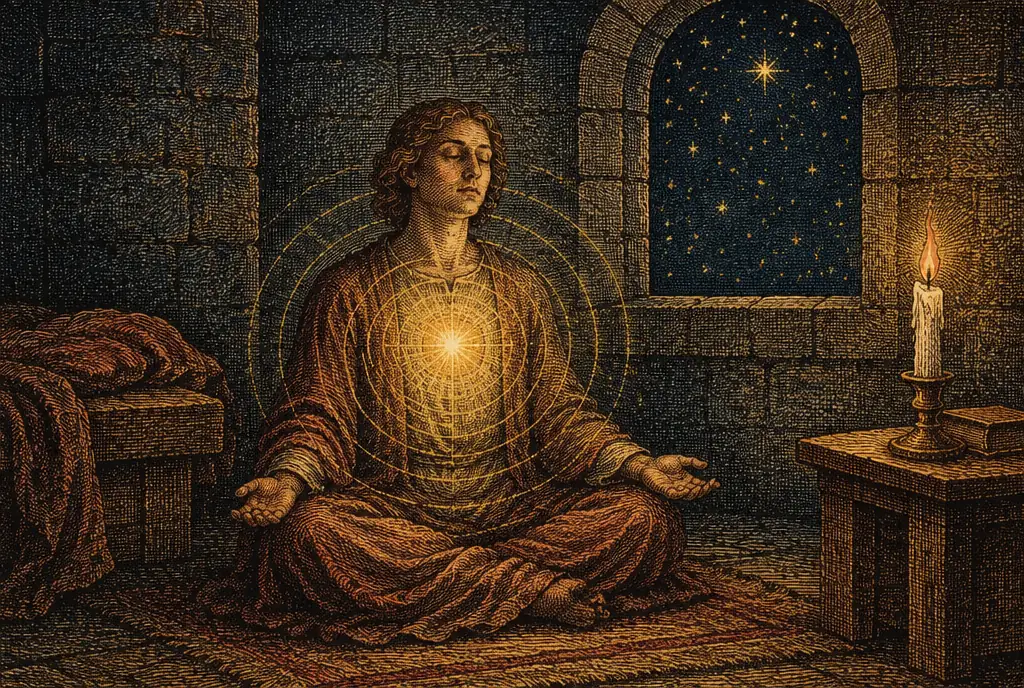
Autoscopy is the experience of seeing an image of one's own body in the space outside oneself, a term from neurology that covers a family of related experiences.
A plain educational schematic; it does not diagnose a condition or replace professional care.
Understand the chapter you are in.
Your life’s turning points, measured from your birth.
Walk through Alex’s whole example first


Prefer to explore first?
 The Road of AgesThe turning points of your whole life, from your own chart
Walk my road
What is autoscopy?
Autoscopy comes from Greek words for self and looking. Neurologists use it for experiences in which a person sees their own body as if from outside. Three forms are usually distinguished. In an autoscopic hallucination the person stays in their body and sees a mirror image of themselves in front of them. In heautoscopy they see a double and are unsure which of the two they are, sometimes feeling themselves in both. In an out-of-body experience they seem to look back at their own body from a point above it.
All three are understood as failures to combine the signals that normally give a single sense of where the body is: sight, touch, balance and the feel of the limbs. They occur in healthy people, particularly near sleep, and more often with migraine, epilepsy and some injuries to the brain.
On the tree of the hidden arts: Astral projection.
What sets Autoscopy apart
The types are told apart by one question: where does the person feel they are? In an autoscopic hallucination, in the body, looking at an image. In an out-of-body experience, outside it, looking at the body. In heautoscopy the answer wavers, and the person may feel the double's sensations as their own. The image is often mirror reversed, colourless and seen for seconds only, and it tends to copy the person's movements.
- Word: Greek autos, self, and skopein, to look at
- Three forms: autoscopic hallucination, heautoscopy, out-of-body experience
- Brain region: the temporo-parietal junction, more often on the right for OBEs
- Key experiment: Blanke and colleagues, Nature, 2002: stimulation of the angular gyrus
- Often reported with: migraine, epilepsy, and the edges of sleep
Often mistaken for something else: A doppelgänger in folklore is a double seen by other people as an omen; autoscopy is the private experience of seeing oneself, studied as a matter of perception.
The story behind Autoscopy
Reports of seeing one's double entered the medical literature in the nineteenth century. In 2002 Olaf Blanke and colleagues in Switzerland reported in Nature that electrical stimulation of the right angular gyrus of a patient being assessed for epilepsy surgery repeatedly produced an out-of-body experience. A 2004 paper by Blanke's group in the journal Brain set out the three types and tied them to the junction of the temporal and parietal lobes.
Why Autoscopy matters
Autoscopy gives the out-of-body experience a place in a mapped family of body illusions, which is the main scientific account of projection.
How to read Autoscopy
Clinicians use the term when taking a history; writers on projection use it to compare their reports with what laboratories can induce.
Autoscopy in practice: an example
A person with migraine might, during an attack, see a faint figure of themselves standing a few steps away, copying their posture.
Where readings of Autoscopy go wrong
A first or repeated episode while awake is a reason to see a doctor, since it can accompany migraine or seizures.
Sources and editorial method
This entry summarizes the tradition in the Almanac's own words; where no source is listed, it is an editorial summary rather than a primary text, and symbolic readings are named as the tradition's, not as fact.
- Source
- The Great Almanac Dictionary
- Category
- Consciousness & Spiritual Psychology
- Aliases
- autoscopy meaning, autoscopic hallucination, heautoscopy, seeing your own body, autoscopic phenomena
- Last updated
- 2026-09-26
See Autoscopy in your personal almanac
A definition tells you what it is; your own birth chart tells you what it means for you. The Oracle casts your real chart and answers for your love, your work, and your year ahead, in conversation. It opens with the 7-day Oracle trial.
Speak with the OracleRelated terms
More in Consciousness & Spiritual Psychology
- Concert pitch
- Empath
- Hypnagogia
- Manifestation
- Precognition
- Second Sight
- Spiritual Discernment
- Vibration
From the reference page to your own chart
Every word here
is in your own chart.
- Your life’s turning points, measured from your birth
- A practical next step to consider
- It opens with 7 days free: the AI Oracle on thirty hidden arts, and your daily horoscope
$0 today, then $19/month after 7 days. Cancel anytime.
Common questions
What is autoscopy?
It is the experience of seeing one's own body, or a double of it, outside oneself. The term covers autoscopic hallucinations, heautoscopy and, in most classifications, out-of-body experiences.
What causes autoscopy?
It is linked to disturbed processing where the temporal and parietal lobes meet, a region that combines vision, touch and balance. It is reported with migraine, epilepsy and drowsiness, and sometimes with no known cause.
Is an out-of-body experience a form of autoscopy?
Most neurologists class it as one of the autoscopic phenomena. It differs from the others in that the person feels located outside the body, looking back at it.


