
The planes and the cord
The Theosophists’ map of the astral plane and its silver cord.
What did the Theosophists teach about the astral plane and the silver cord in astral projection?
What it is
Theosophy teaches that the world has seven planes, of which the physical is the densest, and that a person has a body for each of the lower ones. Nearest the flesh is the etheric body, said to carry vitality and never to travel. The astral plane is the next above the physical, a realm of feeling and desire where thoughts take visible form. The astral body is the vehicle said to move there in sleep and after death. A silver cord is said to join it to the sleeping body, stretching without limit and parting only at death, so that a traveller is always drawn back.
The teaching
As the Theosophy of Annie Besant and C. W. Leadbeater teaches it.
Seven planes
Theosophy teaches that the universe is built of seven planes, or worlds, which differ not in place but in fineness. Each is made of its own grade of matter, the finer interpenetrating the coarser, so that all seven are present here and now. Each plane has seven subplanes of its own. Named from the lowest upward they are the physical, the astral, the mental, the buddhic, the atmic, the anupadaka and the adi. In Besant's grouping the lower three are the field of ordinary human life and growth, the next two belong to the later stages of the spiritual path, and the highest two to the divine life itself.
The physical plane and its ether
The physical plane is the densest. Its seven subplanes are the solid, the liquid and the gaseous, and above them four grades of ether, finer than any gas. Of those grades is made the etheric double, an exact counterpart of the dense body that interpenetrates it, carries the vital energy called prana, and serves as the mould on which the dense body is built. Invisible to ordinary sight, it still belongs to the physical plane.
The astral plane
The astral plane is the world of feeling and desire, called in Sanskrit kama. Its matter answers to emotion as physical matter answers to touch, so that every passion and wish takes form and colour there. It is the plane the astral body moves in during sleep, the plane of most of the apparitions and spirits the books describe, and the region through which the dead pass in the first part of the life after death, which Theosophy calls kamaloka, the place of desire.
The mental plane
The mental plane is the world of thought, manas. Its four lower subplanes are the levels of form, rupa, where concrete thoughts take shape; its three upper subplanes are formless, arupa, the levels of abstract thought. On the higher levels dwells the causal body, the vehicle of the reincarnating self, which lasts from life to life and holds what each life has gathered. The heaven world that Theosophy calls devachan lies on the mental plane.
The four higher planes
The buddhic plane is the world of intuition and spiritual union, where the sense of being separate from others begins to fall away and another's life is known from within as one's own. Theosophy teaches that most people barely touch it yet.
The atmic plane, which Leadbeater often calls the nirvanic, is the world of the spirit, atma, the pure will and being of the self. Its waking belongs, with the buddhic, to the advanced stages of the path.
The anupadaka plane, whose name means parentless, is the home of the monad, the divine spark at the root of each person; Besant describes it as a plane on which no vehicle has yet been formed.
The adi plane, whose name means first, is the foundation of the whole system, the plane of the divine life from which all the others proceed.
Two meanings of astral
A reader of the older books must watch one word. Helena Blavatsky taught seven principles in each person: the dense body, sthula sharira; life, prana; the double, linga sharira; the body of desire, kama rupa; mind, manas; the spiritual soul, buddhi; and spirit, atma. In her usage, and in early Theosophy generally, the astral body was the linga sharira, the double. Leadbeater and Besant later renamed that double the etheric double, counting it as physical, and gave the name astral body to the body of desire. Astral in Blavatsky and astral in Leadbeater therefore name two different things.
The astral body
In the later teaching the astral body is the vehicle of feeling. To clairvoyant sight a person is surrounded by an oval mass of luminous mist, the auric egg, within which the physical body sits; the brightest part of it, flashing and changing with every passing desire, is the astral body proper. Besant and Leadbeater's Thought-Forms gives its colours meanings: crimson and rose for affection, yellow for intellect, blue for devotion, red for anger and a livid grey for fear, among many more. In an undeveloped person the astral body is vague and shapeless when it leaves the physical; as a person grows in mind and spirit it becomes clearer in outline and more like the physical form.
The same book teaches that thoughts charged with feeling make forms of their own in astral and mental matter, and gives three rules for them: the quality of a thought decides its colour, its nature decides its shape, and its definiteness decides the clearness of its outline. A strong thought directed at someone is said to travel to them as such a form and to act on them according to its kind.
The seven levels of the astral plane
Leadbeater numbers the astral plane's seven subplanes from the highest, the first, down to the lowest, the seventh, and finds that they fall into three groups. The seventh stands alone. Its background is the physical world, but seen dark and distorted, with all that is light and good invisible, and he describes moving through it as like pushing through a black and viscous fluid. Those held there live in a darkness that radiates from within themselves, a hell of their own making.
The sixth, fifth and fourth also have the physical world for their background. Life on the sixth is ordinary earthly life without the body and its needs; on the fifth and fourth it grows less material and more withdrawn from earthly interests.
The third, second and first are farther from the earth. Those who live there lose sight of it, are often wrapped in their own concerns, and build their surroundings by thought, houses, schools and cities, forests, lakes and gardens, real enough to be seen by others. Leadbeater held this to be the summerland of which the Spiritualists' séances spoke.
Those who dwell there
In Leadbeater's catalogue the inhabitants of the astral plane fall into three great classes. The human are of two kinds: the living, who are there in sleep or trance, from adepts and their pupils to the ordinary sleeper drifting near the bed, and the dead, from those soon to be reborn to the empty shells the dead leave behind. The non-human include the elemental essence, the astral bodies of animals, the nature spirits that folklore calls fairies, and the orders of angels he calls devas. The artificial are thought-forms that have taken on a life of their own, made unconsciously by strong feeling or deliberately by trained will.
Sleep and the astral body
In deep sleep, Leadbeater teaches, the higher principles in their astral vehicle almost always withdraw from the physical body. In most people this astral body hovers near the bed, nearly as asleep as the body it has left. In some it floats dreamily on the currents of the plane and meets others, and what it meets returns in the morning as a confused and often grotesque dream. In those who have trained, it is awake, clearly shaped and able to travel by intention, and Theosophy teaches that such sleepers can serve others on the plane as helpers.
After death
At death the dense body is left, and soon the etheric double with it, and the person lives on in the astral body in kamaloka, passing through its levels as the desires that bind them there wear out. When the last are spent the astral body is dropped in its turn, leaving a fading shell, and the person rises to the heaven world of the mental plane, devachan, to rest and take in the fruits of the life just ended before the next birth.
The silver cord
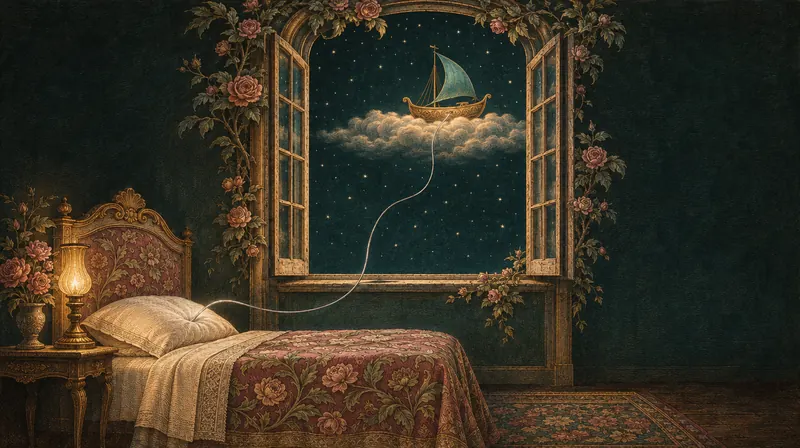
The silver cord that joins the travelling body to the sleeping one takes its name from a verse near the end of Ecclesiastes, where the Preacher bids the young remember their Creator before age and death come: “Or ever the silver cord be loosed, or the golden bowl be broken, or the pitcher be broken at the fountain, or the wheel broken at the cistern.” There the loosing of the cord is death itself. The projectors took the image for the link between the bodies, which in their teaching is the one thing that must not part: while it holds, the traveller lives and can always return.
How it is practised
The planes are best studied as a map and compared with others like it. A reader can set the Theosophical seven beside the Platonists' vehicles of the soul, the sheaths, or koshas, of the Indian Upanishads and the causal body of Vedanta, and note what each tradition says the layers are for. A second exercise is to read one first-hand account, Muldoon's or Monroe's, and mark which details the author experienced and which come from the map. The cord, for instance, is seen by some travellers and never by others.
Where it comes from
The word astral, starry, was used by Paracelsus for a subtle body, and the French magician Éliphas Lévi wrote of an astral light in the 1850s. Helena Blavatsky and her successors turned these into a system. Annie Besant and C. W. Leadbeater described the planes and bodies in detail in the 1890s, and Leadbeater's The Astral Plane appeared in 1895. The same writers spoke of the Akashic Records, a memory of all events said to be open to clairvoyants. The phrase silver cord is from the twelfth chapter of Ecclesiastes, where its loosing is an image of death. Its use for a connecting thread was spread by Muldoon in 1929.
What is known, and what is not
The system of planes and bodies is documented in the Theosophical books, whose authors said they saw these things by clairvoyance. No independent method has confirmed any of it. The silver cord of Ecclesiastes is a poetic figure with no hint of travel, and in collected accounts only a small minority of people who have out-of-body experiences report any cord. The map has shaped what later travellers expect to see, which makes their agreement weak evidence for it.
Its words
- Astral Plane
- In Theosophy, the level of existence next above the physical, the world the astral body is said to move in.
- Astral Body
- The finer second body that Theosophy and older teachings say carries feeling and desire and can separate from the flesh.
- Silver Cord
- The thread said to join the travelling body to the sleeping one. The phrase is from Ecclesiastes; the doctrine is modern.
- Theosophy
- The movement founded in 1875 by Helena Blavatsky and others, which gave the West its vocabulary of planes and subtle bodies.
- Etheric Body
- In Theosophy the double nearest the flesh, said to carry vitality through the physical body and, unlike the astral body, never to travel.
- Akashic Records
- A supposed memory of every event and thought, said by Theosophists to be readable by clairvoyants. Nothing read from it has been confirmed.
- Causal Body
- In Vedanta the subtlest of three bodies, the seed of the other two; Theosophy made it the lasting vehicle of the soul across lives.
Ask the Oracle further
Where does the silver cord come from: Ecclesiastes, Theosophy or the travellers themselves?How do the seven planes of Theosophy compare with the astral body in older traditions?
Before you practise
Out-of-body experiences are real experiences; science has not shown that anything leaves the body. Sleep paralysis on the way is harmless and passes in a minute or two. Never go without sleep or take anything to force it. If you have had psychosis, mania, dissociation or seizures, leave this practice alone, and stop if it brings fear or a lasting sense of unreality.
Its other branches
What it is held to beThe edge of sleepThe gentle way to trySleep paralysisThe whole artSearch the tree

