
Edward Bulwer-Lytton
1803 to 1873
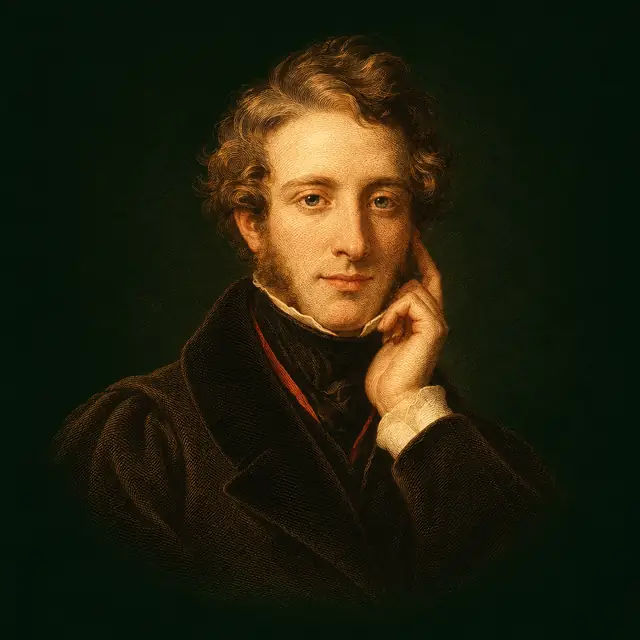
Who was Edward Bulwer-Lytton, and what is truly known of them?
What is known
English novelist and politician, a Member of Parliament, Secretary of State for the Colonies in 1858 and 1859, and from 1866 Baron Lytton. Among many novels three fed the occult revival: Zanoni (1842), about an immortal adept; A Strange Story (1862); and The Coming Race (1871), in which a people living under the ground command a force he named vril. He read widely in magic and astrology, tried crystal-gazing and geomancy for himself, and received Éliphas Lévi at his house at Knebworth in 1861.
The teaching
Taught from his novels, above all Zanoni (1842) and The Coming Race (1871).
Zanoni: the singer of Naples
Zanoni is told from a manuscript in cipher, left to its narrator by an old man he had met in a London bookshop among the books of the Rosicrucians. Its story begins in Naples in the years before the French Revolution. Gaetano Pisani, a violinist whose wild music no one understands, has a daughter, Viola, who sings in his opera at the San Carlo and wins the city. Into Naples comes Zanoni, a stranger of great beauty and wealth of whom strange things are told: that he does not age, that he has been seen in other centuries, that he knows what is to come.
Clarence Glyndon, a young English painter, loves Viola but cannot bring himself to marry a singer. Zanoni, who has begun to love her too, guards her from a prince who would carry her off, and lays a choice before Glyndon: marry her and live a good and ordinary life, or seek the knowledge that Zanoni's kind possess, which asks him to master every passion and every fear. Glyndon chooses knowledge.
Zanoni: the two immortals
Zanoni and Mejnour are the last of an ancient brotherhood who have mastered the elixir of life and the command of spirits. Mejnour is pure intellect: he has put away every passion and lives in calm, cold contemplation, studying the world without loving it. Zanoni lives by beauty and feeling, and has kept his heart. As his love for Viola grows his power wanes, and Adon-Ai, the radiant being of light who has guided him, comes to him less and less, for a mind bound by human love and human fear can no longer rise to it.
Zanoni: the Dweller of the Threshold
Glyndon goes as Mejnour's pupil to a lonely castle in the mountains, where he is set a discipline of fasting, solitude and study. Left alone, he is forbidden one chamber and the vessels in it; he enters it, opens the vessels and takes the elixir, and sees the Dweller of the Threshold, a veiled and shapeless horror with burning eyes, the guardian that meets whoever crosses into the world of spirit with a heart still full of the passions of the world of sense. From then on it haunts him. He flees to his own country and then to Paris, tries to drown it in pleasure and in the politics of the Revolution, and finds it beside him again and again.
Zanoni: the sacrifice
Zanoni marries Viola, and a child is born to them. But Viola, frightened by Glyndon's warnings that her husband deals with spirits, comes to fear his arts for herself and the child, and flees with the child to Paris, into the Terror. She is arrested and condemned. Zanoni follows her and gives up his long life to save hers: he goes to the guillotine in her place on the last day of Robespierre's power, and within hours Robespierre falls and the prisons open. Viola is found in her cell, dead in peace as though she had followed him, and the child lives. At the last Adon-Ai comes again and receives Zanoni's soul.
The Coming Race
In The Coming Race an American goes down a mine shaft into a world beneath the earth, lit and warmed by its own power, and is taken in by its people, the Vril-ya. They command vril, a force that runs through all nature, which they direct by will through a slender staff: with it they heal, light their world, drive their machines and their wings, and destroy, so completely that a child with a staff could lay a city waste. Because every one of them holds that power, war among them has ended, crime is unknown and government has almost withered away; there is no poverty, and their women, taller and stronger than their men, do the courting.
Their peace is also a stillness: they have no great art and no passion, and the narrator, though loved by Zee, the daughter of his host, finds their perfection oppressive. When their law condemns him, Zee carries him up the shaft on her wings and goes back below. He ends by warning that her race will one day rise and take the upper world. Their philosophers, in a joke at Darwin's expense, teach that their kind is descended from the frog.
A Strange Story
A Strange Story sets a doctor who believes only in matter against a world he cannot explain. Allen Fenwick, a physician of a quiet English town, meets Margrave, a youth of dazzling charm and no conscience, who is the old magician Louis Grayle renewed, and who seeks the elixir that would keep him young for ever. Through mesmerism and the shining double of the soul, which the book calls the Scin-Laeca, Fenwick is drawn into his schemes, until in the Australian bush he must help Margrave brew the elixir in a magic circle. The work fails, Margrave dies, and Fenwick's materialism dies with him: he comes to believe in the soul and in God.
What the tales teach
Bulwer's tales teach through their seekers. Knowledge sought without the purity it demands opens the door to terror: the Dweller is what a soul meets when it reaches for the powers of spirit with the passions of the flesh still in it. Long life and power are barren without love, and love is worth more than either: Mejnour keeps his immortality and lives in ice, while Zanoni gives his up and is received into the light. A power that ends war may end striving and art with it. And matter is not the whole of what is: the physician who would not believe is made to.
His readers took the Dweller further. The Theosophists read Zanoni almost as a teaching, and Rudolf Steiner made the meeting with the Guardian of the Threshold a stage on his path of knowledge: the moment when a seeker sees the shape of his own unpurified nature and must take up the work of changing it. Helena Blavatsky wrote of vril as a real force once known to lost races; it is the novelist's invention.
Orders and memberships
None is documented. About 1871 the Societas Rosicruciana in Anglia named him its Grand Patron without asking him, and he wrote to object. The hints in Zanoni that its author was an initiate are a novelist’s.
The legend
That he was a Rosicrucian adept, and that vril is a real force guarded by a secret “Vril Society”. Vril is his invention for a novel. The powerful Berlin society of that name is first described in a French book of 1960, and no record from the time shows it.
Their works
- ZanoniNovel, 1842
The novel of an immortal adept of an ancient brotherhood who gives up his long life for love, set in the time of the French Revolution. Its hints of a real order behind it are a novelist’s, but it fed the Victorian occult revival and was read by Theosophists as almost a teaching.
Ask the Oracle about it - The Coming RaceNovel, 1871
A tale of a people living under the ground who command a force he named vril. It gave its name to the beef extract Bovril. Vril is his invention for a novel, and the Vril Society of later legend has no record from the time.
Ask the Oracle about it - A Strange StoryNovel, 1862
A novel of a doctor drawn against his reason into a world of mesmerism, magic and the elixir of life. It was written as a challenge to the materialism of the age.
Ask the Oracle about it - The Haunted and the HauntersStory, 1859
A ghost story printed in Blackwood’s Magazine, also known as The House and the Brain, in which the haunting of a London house is traced to a long-lived magician’s will. It is among the most praised ghost stories of its century.
Ask the Oracle about it - ZicciNovel, 1838
An earlier and shorter telling of the tale that became Zanoni, first printed in a magazine. He put it aside and rewrote it four years later. Set beside Zanoni, it shows how the occult frame of the later novel grew in the rewriting.
Ask the Oracle about it
How the house tells a life
This life is told from the record, with what is documented, what is legend and what was forged kept apart. A membership in an order is stated only where documents show it. A person’s chart explains none of their deeds.
The arts it feeds
Lives near it in time
Lives and legends
Count CagliostroAdam WeishauptNapoleon BonaparteMarie Anne LenormandFrancis BarrettMarie LaveauAllan KardecAlbert PikeÉliphas LéviPaschal Beverly RandolphAndrew Jackson DavisHelena BlavatskyThe whole tree

