
Marie Anne Lenormand
1772 to 1843
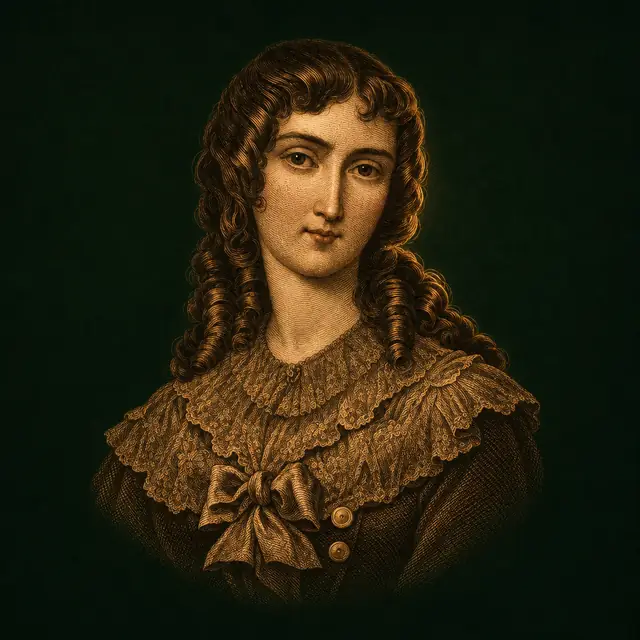
Who was Marie Anne Lenormand, and what is truly known of them?
What is known
French fortune-teller, born at Alençon and schooled in a convent. She came to Paris as a young woman during the Revolution, and from the later 1790s she received clients in the rue de Tournon, behind the front of a bookshop, for more than forty years. She read cards, coffee grounds and palms. The police arrested her more than once, in Paris in 1809 and in Belgium in 1821, and she turned each arrest into a book. Her Souvenirs prophétiques of 1814 and her “secret memoirs” of the Empress Joséphine of 1820 are the source for her claim to have advised Joséphine, Robespierre and Tsar Alexander. She died in Paris in 1843.
The teaching
Taught from her own books of 1814 to 1820, with the pack of cards later sold under her name.
The sibyl's three arts
Mademoiselle Lenormand practised the fortune-telling arts of her Paris, and those who came to her asked above all for three: the cards, the grounds of coffee and the lines of the hand. Her books present each reading as a glimpse of fate granted to one who knew how to look, and herself as the sibyl who read it.
The cards
The cards of her day were read in the manner Etteilla had printed: a pack shuffled and cut by the one who asks and laid out in rows, each card with one meaning upright and another reversed, and each read together with its neighbours. Each suit has its province, love and happiness, money and business, news, and trouble and grief; the court cards are the people in the questioner's life, and the questioner's own card is the centre round which the reading turns.
Coffee grounds
Coffee grounds are read by the shapes they leave. The cup is drunk, the grounds are swirled with what remains and turned out onto a white plate, and the reader looks at the figures they leave behind as one looks at clouds: a line for a road or a journey, a ring for a marriage, a cross for a trial, a bird for news, small scattered dots for money. The reading goes from figure to figure, as a story is told from picture to picture.
The palm
In the hand the three great lines are read first: the line of life, curving round the root of the thumb; the line of the head, running across the palm; and the line of the heart, above it, beneath the fingers. The raised places of the palm, the mounts, are named for the planets: Venus at the root of the thumb, Jupiter under the forefinger, Saturn under the middle finger, the Sun under the ring finger, Mercury under the little finger, and the Moon at the edge of the palm opposite the thumb, with Mars in the middle of the palm. A full mount gives its planet's nature, so that a strong mount of Jupiter shows ambition and pride, and a strong mount of Venus warmth and love.
The pack under her name
The pack sold as the Petit Lenormand has thirty-six cards, each a small picture: the Rider, the Clover, the Ship, the House, the Tree, the Clouds, the Snake, the Coffin, the Bouquet, the Scythe, the Whip, the Birds, the Child, the Fox, the Bear, the Stars, the Stork, the Dog, the Tower, the Garden, the Mountain, the Crossroads, the Mice, the Heart, the Ring, the Book, the Letter, the Gentleman, the Lady, the Lily, the Sun, the Moon, the Key, the Fish, the Anchor and the Cross.
Its readers give each card a plain meaning: the Rider news on its way, the Ship a journey, the Clouds confusion, the Snake a rival or a deceit, the Coffin an ending, the Scythe a sudden cut, the Fox cunning, the Dog a faithful friend, the Mountain an obstacle, the Mice a loss, the Ring a promise, the Key a solution, the Anchor what holds firm, and the Cross a burden borne. The cards are read in pairs and in lines, as words make sentences, and in the great tableau all thirty-six are laid out at once, the Gentleman or the Lady standing for the one who asks and the cards nearest them for what is closest. The pack is not hers: it copies a German game printed about 1799, and her name was put on it after her death.
Orders and memberships
None. She worked alone, trained no school and belonged to no society; the “sibyl of the Faubourg Saint-Germain” was her own trade name.
The legend
That she foretold the fall of Robespierre, the divorce of Joséphine and the end of Napoleon. The only witness is herself, writing after the events. Joséphine did consult fortune-tellers, and Lenormand was well known in Paris; how close the two were cannot be shown.
What was forged, or is false
The Lenormand cards. The pack of thirty-six sold as the Petit Lenormand copies a German parlour game, the Game of Hope, printed at Nuremberg about 1799, and her name was put on it by publishers after her death. No pack that she designed is known.
Their works
- Souvenirs prophétiquesBook, 1814
Her Prophetic Memories of a Sibyl, telling of her arrest in Paris in 1809 and of the fortunes she said she had read. It is the main source for her claims to have foretold the fates of the great, and the only witness to them is herself.
Ask the Oracle about it - Historical and Secret Memoirs of the Empress JoséphineBook, 1820
Her book on Joséphine, written after the Empress’s death, presenting herself as her confidante and adviser. Joséphine did consult fortune-tellers, but how close the two were cannot be shown from any other record.
Her own account, written after the events, and not borne out by other witnesses.
Ask the Oracle about it - The Sibyl at the Congress of Aix-la-ChapelleBook, 1819
An account of her journey to the congress of the powers in 1818, where she said she sought to read for Tsar Alexander. Like her other books it turns her own adventures into a show of her fame.
Ask the Oracle about it - The Petit LenormandDeck, after 1843
The pack of thirty-six cards sold under her name, used for reading fortunes to this day. It copies a German parlour game, the Game of Hope, printed at Nuremberg about 1799, and publishers put her name on it after her death.
Not hers: no pack that she designed is known.
Ask the Oracle about it
How the house tells a life
This life is told from the record, with what is documented, what is legend and what was forged kept apart. A membership in an order is stated only where documents show it. A person’s chart explains none of their deeds.
The arts it feeds
Lives near it in time
Lives and legends
Martinez de PasquallyFranz Anton MesmerEtteillaCount CagliostroAdam WeishauptNapoleon BonaparteFrancis BarrettMarie LaveauEdward Bulwer-LyttonAllan KardecAlbert PikeÉliphas LéviThe whole tree

