
Franz Anton Mesmer
1734 to 1815
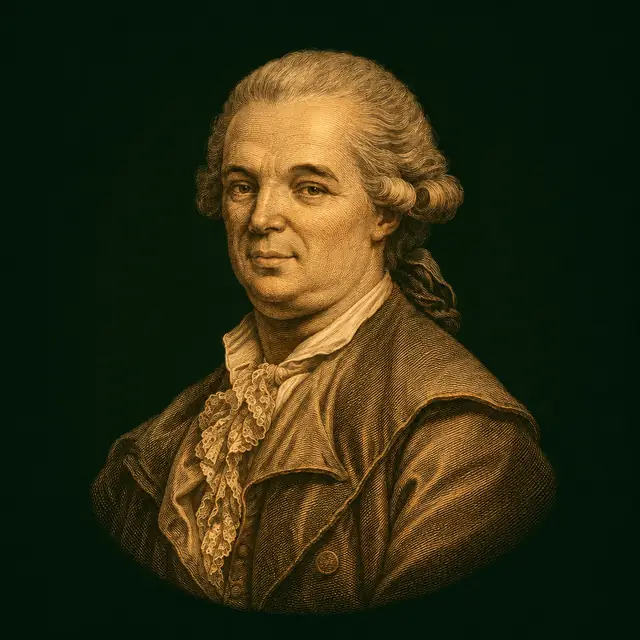
Who was Franz Anton Mesmer, and what is truly known of them?
What is known
German physician, born at Iznang on Lake Constance. His Vienna thesis of 1766 was on the influence of the planets on the body. From 1774 he treated patients with magnets and then with his hands alone, and taught that an unseen fluid, which he called animal magnetism, flows through all things and can be directed by the healer. He left Vienna after the disputed case of the blind pianist Maria Theresia Paradis and reached Paris in 1778, where patients sat round a tub fitted with iron rods. In 1784 two royal commissions, one with Franklin and Lavoisier on it, found no evidence of any fluid and put the effects down to imagination. He left France and died at Meersburg in 1815.
The teaching
Taught from his own writings, above all the Memoir of 1779 with its twenty-seven propositions.
A fluid through all things
Mesmer teaches that the heavenly bodies, the earth and living bodies act on one another, and that the means of their action is a fluid spread through the universe, so continuous that it leaves no void, finer than anything known, and able to receive, carry and pass on every kind of motion. This action follows mechanical laws not yet known, and it works by alternate effects, an ebb and a flow, more general or more particular according to its causes, as the heavens raise the tides of the sea. By it the heavenly bodies, the earth and its parts stand in a constant traffic of influence, and on it the properties of matter and of living bodies depend.
Animal magnetism
The living body feels the ebb and flow of this agent, which enters the substance of the nerves and acts on them directly. In the human body it shows properties like those of the magnet: there are poles in it, different and opposite, which can be passed on, changed, destroyed and strengthened. Because the body's power to receive the influence of the heavens and of the bodies around it resembles the magnet's, Mesmer calls it animal magnetism. It is not the magnet's own force: a lodestone can take up animal magnetism like any other body without its pull on iron changing in the least, which shows that the two principles differ.
How the force behaves
Animal magnetism can be passed to other bodies, living and lifeless, though not all take it equally. It can be strengthened and spread by them; it acts at a distance without any body between; it is increased and reflected by mirrors as light is; and it is carried and increased by sound. It can be stored, concentrated and carried from place to place. A few rare people have the opposite virtue, so that their presence destroys its effects in others, and that opposite virtue behaves in the same ways.
Health as harmony
On this ground Mesmer builds a teaching of health. Health is the free and harmonious flow of the fluid through the body, in tune with the universe; sickness is an obstruction of that flow, a place where it is stopped. The healer restores the harmony, and the sign that the obstruction is breaking is the crisis: convulsions, sweats, tears, laughter or sleep, which he takes for nature's own effort to clear the way, to be provoked and guided until it passes.
He claims that his principle heals disorders of the nerves directly and others by way of them, that it lets the physician judge the source and course of an illness and guide its crisis, and that with it the art of healing would reach its perfection. These are his claims. The royal commissions of 1784 found no fluid and put the effects down to imagination, and nothing here is a treatment: anyone who is ill should see a doctor.
Rapport and the passes
The healer first puts himself in rapport with the patient. He sits facing the patient, knees touching knees, holds the thumbs and looks into the eyes; then he draws his hands from the shoulders down the arms, and lays them on the region below the ribs, where he finds the seat of many nervous troubles. The passes follow: the hands, or a single finger, or a rod of iron, moved slowly down the body at a little distance from it, along the course the fluid is meant to take. Touch, gaze and pass serve one end, to carry the fluid from the healer's poles into the patient's.
The tub
To treat many at once he built the baquet, a covered tub of oak. Inside, bottles of magnetised water lie in rows among powdered glass and iron filings, and from holes in the lid bent rods of iron reach out, each to be laid on an ailing part of a patient's body. The patients sit round it in rows, joined by a cord passed about them and by holding one another's thumbs, so that the fluid runs through the whole chain, while music plays, often on the glass harmonica. Those who fall into crisis are taken to a padded room set apart for them.
The inner sense
In his later writings Mesmer explains the strange sleep that his pupils saw in some patients. In that sleep, he teaches, the outward senses rest and an inner sense wakes, in direct touch with the universal fluid, so that the sleeper may perceive what the eyes cannot, things far off or still to come, and the state of the body. He explains all of it by the fluid and its motions, never by spirits.
Orders and memberships
In 1783 he and his backers founded the Society of Universal Harmony in Paris, a paying society with branches in the provinces whose members swore to keep the doctrine secret. He is often called a Freemason; the house has no lodge record that settles it.
The legend
That he discovered hypnosis. He believed to the end in a physical fluid; the sleep-like trance was first described in 1784 by his pupil the Marquis de Puységur, and the word hypnotism was brought into use by the surgeon James Braid in the 1840s. That an early opera of Mozart’s was first staged in his garden rests on one late report.
Their works
- On the Influence of the PlanetsTreatise, 1766
His medical thesis at Vienna, arguing that the planets act on the human body through a fine universal fluid, much as they move the tides. It holds the seed of his later animal magnetism.
Parts of it closely follow the English physician Richard Mead.
Ask the Oracle about it - Memoir on the Discovery of Animal MagnetismBook, printed 1779
His first statement for the public of Paris, ending in twenty seven propositions on an unseen fluid flowing through all things that a healer can direct. It set off the craze of the tub and the iron rods.
Ask the Oracle about it - Report of the CommissionersReport, 1784
The report of the royal commission with Franklin, Bailly and Lavoisier, which tested his method and found no evidence of any fluid, putting the effects down to imagination. A secret report to the king warned of the risk to women patients.
Ask the Oracle about it - MesmerismusBook, printed 1814
His last and fullest account of his system, edited by the Berlin physician Karl Christian Wolfart from his manuscripts the year before his death. It came out when German doctors and poets were taking a fresh interest in magnetism and trance.
Ask the Oracle about it
How the house tells a life
This life is told from the record, with what is documented, what is legend and what was forged kept apart. A membership in an order is stated only where documents show it. A person’s chart explains none of their deeds.
The arts it feeds
Chakras and the breathThe sixth sensePhysics and the mystics
Lives near it in time
Lives and legends
Elias AshmoleIsaac NewtonThe Count of Saint-GermainCourt de GébelinGiacomo CasanovaMartinez de PasquallyEtteillaCount CagliostroAdam WeishauptNapoleon BonaparteMarie Anne LenormandFrancis BarrettThe whole tree

