
Isaac Newton
1642 to 1727
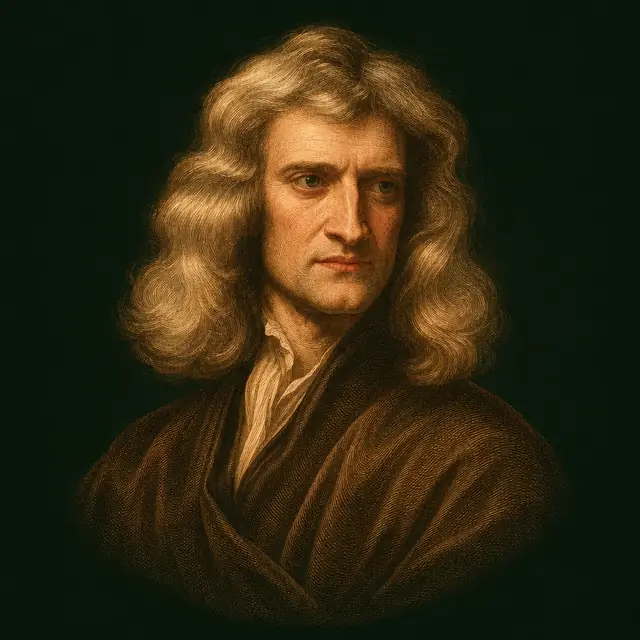
Who was Isaac Newton, and what is truly known of them?
What is known
The mathematician and physicist of the Principia also wrote, in private, about a million words on alchemy and more on biblical prophecy and chronology. He copied out and translated the Emerald Tablet. The papers were sold in 1936; the economist John Maynard Keynes, who bought many, called him “the last of the magicians”.
The teaching
Taught from his own papers on alchemy and prophecy, with the Principia (1687) and the queries of the Opticks (1704).
The rules of reasoning
Newton opens the third book of the Principia with four rules for reasoning about nature. The first is this: “We are to admit no more causes of natural things than such as are both true and sufficient to explain their appearances.” The second: to the same natural effects, as far as possible, assign the same causes, as to the falling of stones in Europe and in America, or to the light of a kitchen fire and of the Sun. The third: the qualities found in all the bodies within reach of experiment are to be counted qualities of all bodies whatever. The fourth: what is gathered from the phenomena by induction is to be held true, or very nearly true, whatever hypothesis may be imagined against it, until other phenomena correct it or show its exceptions.
I frame no hypotheses
By these rules he finds one force at work in the fall of a stone, the course of the Moon and the tides of the sea: every body draws every other with a force that grows with their masses and weakens as the square of the distance between them grows. What that force is, he will not say. In the General Scholium he writes that he has not yet been able to discover the cause of these properties of gravity from the phenomena, “and I frame no hypotheses.” The law is known by its effects and is enough to account for the motions of the heavens and the sea; its cause is left open rather than filled with a guess.
The Lord of all
The same Scholium names the one behind the system: “This most beautiful System of the Sun, Planets, and Comets, could only proceed from the counsel and dominion of an intelligent and powerful Being.” He is not eternity or infinity but eternal and infinite, not duration or space but enduring and everywhere present, and by being always and everywhere He makes duration and space. He is known by His works and by His dominion, not by any likeness of a body, and a god without dominion, providence and final causes would be nothing but fate and nature. The Opticks adds that God perceives things in infinite space as it were in His sensory, seeing them through and through by their presence to Him.
Active principles
Matter alone is passive. In the last query of the Opticks Newton holds it probable that God in the beginning formed matter in “solid, massy, hard, impenetrable, moveable Particles,” and that these alone would never set themselves moving or keep the world from running down. Nature therefore needs active principles as well: the cause of gravity, the cause of fermentation, and the forces by which the smallest particles attract and repel one another and cohere. By them the world keeps its motion, its warmth and its life, and through them God's working in nature goes on.
Vegetation
In his alchemical papers the active principle has another name. Nature's actions, he writes, are either vegetable or purely mechanical. The mechanical are the gross changes of common chemistry, particles shifted and joined by their sizes and motions. The vegetable are the work of a subtle spirit diffused through matter, a ferment that makes things grow, by which metals ripen in the earth as plants grow in a field. The earth itself is like a great animal, or rather a vegetable, that breathes in the ether for its daily refreshment and breathes out gross vapours. Alchemy is the art of this second kind of action, and his furnace is where he watched for it.
The Emerald Tablet
Newton copied the Emerald Tablet and turned it into English, and he read it as a summary of the work: one thing, from which all things come by adaptation; its father the Sun and its mother the Moon, carried by the wind and nursed by the earth; separated gently, risen to heaven and come down again, its force made whole when it is turned into earth. His English is given line by line, with its meaning, on the branch of the Emerald Tablet.
The language of the prophets
Newton reads the prophets with a key. Their figurative language, he writes, is taken from “the analogy between the world natural, and an empire or kingdom considered as a world politic.” The heavens and what is in them signify thrones and dignities and those who hold them, and the earth the common people; the Sun is the race of kings, the Moon the body of the people, and the stars the lesser princes and great men. The darkening of the Sun and the falling of the stars are the end of a kingdom, an earthquake is the shaking of a kingdom, a beast is a kingdom and its horns are its kings, and a day is a year.
Read so, the four beasts of Daniel are the four kingdoms, Babylon, Persia, Greece and Rome, and the ten horns of the fourth are the kingdoms into which the western empire broke. Among them rises a little horn with eyes and a mouth speaking great things, which plucks up three of the ten: Newton takes it for the Church of Rome in its worldly power, and its time, times and half a time for twelve hundred and sixty years.
Prophecy is not for foretelling
He warns against using the prophecies to name dates. The folly of interpreters, he says, has been to foretell times and things by them, as if God meant to make them prophets, and so they have brought the prophecy itself into contempt. God gave the prophecies “not to gratify men's curiosities by enabling them to foreknow things,” but so that when they are fulfilled they may be read in the event, and His providence, not the cleverness of the interpreter, be shown to the world. They are understood as history unfolds, and better the nearer the end comes.
The chronology amended
His chronology teaches that the nations made themselves older than they were, out of vanity, and that their histories must be corrected by measure. Kings reign on average some eighteen to twenty years, not the thirty-three or forty years the Greeks allowed for each generation, so the lists of kings shrink when they are counted honestly. The heavens give a second check. The equinoxes move slowly backward through the stars, and from the places of the colures in the figure of the heavens said to have been drawn for the Argonauts, Newton dates their voyage centuries later than the Greeks had reckoned, and the early history of Greece and Egypt with it.
Orders and memberships
He belonged to no secret order. Lists that make him a Grand Master of a “Priory of Sion” come from documents forged in France in the 1960s.
The legend
That he predicted the end of the world in 2060. In a private note he reckoned it would not come before 2060, and wrote that he said so to stop people naming dates.
What was forged, or is false
The “Priory of Sion” papers that name him.
Their works
- PrincipiaBook, printed 1687
The Mathematical Principles of Natural Philosophy, setting out the laws of motion and universal gravitation. It is the work the world knows him by, and its force acting at a distance troubled readers as something close to an occult quality.
Ask the Oracle about it - OpticksBook, printed 1704
His book on light and colour, which ends with queries on the forces between particles and the ether, where his private thinking about active principles in nature comes nearest the surface.
Ask the Oracle about it - Commentary on the Emerald TabletTranslation, 17th century
A manuscript in which he copied out and translated the Emerald Tablet of Hermes and wrote notes on its meaning. It is one of the papers sold in 1936 and bought by Keynes.
Ask the Oracle about it - PraxisTreatise, about 1693
One of his alchemical manuscripts, drawing together what he had learned from his reading and his furnace, among about a million words on alchemy he never printed.
Ask the Oracle about it - Observations upon the Prophecies of DanielBook, printed 1733
His reading of the books of Daniel and the Revelation of St John as history foretold, printed after his death. His papers on the end of the world, with the date he would not allow to be earlier than 2060, belong to this study.
Ask the Oracle about it - The Chronology of Ancient Kingdoms AmendedBook, printed 1728
His attempt to fix the dates of the earliest kingdoms by astronomy and Scripture, shortening the history of Greece and Egypt by centuries. It was printed the year after his death.
Ask the Oracle about it
How the house tells a life
This life is told from the record, with what is documented, what is legend and what was forged kept apart. A membership in an order is stated only where documents show it. A person’s chart explains none of their deeds.
The arts it feeds
Lives near it in time
Lives and legends
Heinrich KhunrathMichael MaierRobert FluddJohann Valentin AndreaeWilliam LillyElias AshmoleThe Count of Saint-GermainCourt de GébelinGiacomo CasanovaMartinez de PasquallyFranz Anton MesmerEtteillaThe whole tree

