
Heinrich Khunrath
About 1560 to 1605
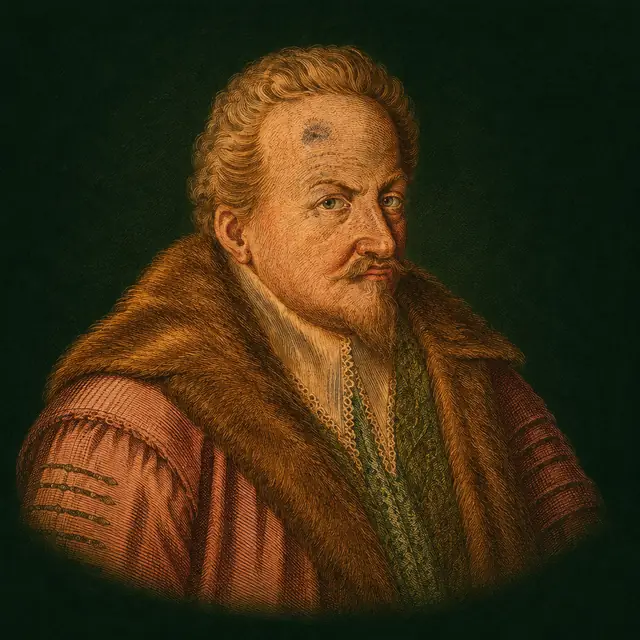
Who was Heinrich Khunrath, and what is truly known of them?
What is known
German physician and alchemist, born in Saxony about 1560. He took his doctorate in medicine at Basel in 1588 with theses on the signatures of natural things, practised at Hamburg, Magdeburg and Dresden, and in 1591 was physician to Vilém of Rožmberk in Bohemia. John Dee’s diary records a visit from him at Bremen in 1589. His one famous book is the Amphitheatre of Eternal Wisdom, first printed at Hamburg in 1595 with four round engraved plates and enlarged at Hanau in 1609, which joins alchemy, the Kabbalah and prayer. Its best known plate shows a room that is half chapel and half laboratory, with the alchemist kneeling before a tent of prayer. He died in 1605. The theologians of Paris condemned the book in 1625.
The teaching
Taught from his Amphitheatre of Eternal Wisdom (1595, enlarged 1609) and his treatise on the Hylealic Chaos (1597).
Oratory and laboratory
Khunrath's first teaching is that the work has two rooms. In the best known plate of his Amphitheatre the seeker kneels in a tent of prayer before an open book, and across the same hall stands a laboratory with its furnace, vessels and bellows; one side is named the oratory and the other the laboratory, and the two words are meant to be heard together. The work is prayer and labour, and either without the other fails. Prayer asks God for the wisdom that only He gives; labour tests it at the fire; what is received in the oratory is proved in the laboratory, and what is found in the laboratory is carried back to the oratory as thanks.
Between the two stands a table laid with musical instruments, and its inscription gives the reason: holy music drives away sadness and evil spirits, because the Spirit of the Lord sings gladly in a heart full of joy. The seeker is to work in gladness, not in gloom, and to keep the room of the work a place where God is praised.
One wisdom in three books
The Amphitheatre is a commentary on verses gathered from Proverbs and the Wisdom of Solomon, one for each day of the year, and its title calls its wisdom Christian and kabbalistic, divine and magical, physical and chemical, threefold and universal. The wisdom is one, but it is read in three books: the Bible, the great world of nature, and the little world of the human being. The theologian, the physician and the alchemist are to read the same truth in each, and each book is read by the light of the others, so that scripture opens nature and nature confirms scripture.
Eternal Wisdom is Christ
The wisdom the book seeks has a name. Eternal Wisdom is Christ, the Word by whom all things were made, and in the great round plate at the heart of the book He stands at the centre in a blaze of light, His arms spread wide, with the Hebrew name of Jesus over Him, written as the four letters of God's name with the letter shin set in their midst, and around Him rings of the divine names, the ten sefirot of the Kabbalah and the choirs of angels. To climb the steps of the book is to climb toward Him.
Khunrath sets the stone of the philosophers beside Christ as its likeness. What Christ is for the soul, the stone is for the matter of the world: the healer that makes the imperfect whole. The work in the furnace and the work of grace answer each other, and each helps the alchemist to understand the other.
The chaos of the wise
His treatise on the Hylealic Chaos teaches where the work begins. God made the world from a first matter, the deep of Genesis over which the Spirit of God moved, and that Spirit, ruach Elohim in the Hebrew, breathed into the chaos the seeds of all things. The chaos is not gone. It lies hidden in nature still, as one universal matter, which Khunrath calls the chaos of the wise and the catholic, that is the universal, magnesia, and in it the spirit of the world is held as in a salt.
The alchemist does not make this matter; he finds it. He frees the spirit from its gross body, purifies both, and joins them again, so that the work in his vessel repeats the making of the world in small. Everything that grows comes from this one matter, and the stone is that same matter brought to its perfection.
The signatures of things
In his theses on the signatures he teaches the physician's way of reading nature. God has marked every creature with a sign of its hidden virtue: the shape, colour, scent and habit of a plant, a stone or a beast are letters, and the physician who learns them as one learns an alphabet can read in them what each thing is for. The old examples are the walnut, whose kernel is shaped like the brain, and eyebright, whose flower looks like an eye. These are teachings of the old physic and not a guide to remedies: no plant is to be taken on the strength of its shape.
The rule of the seeker
Khunrath's rule for the one who would learn is the rule of his plate. Begin in prayer and stay in it; read scripture and nature together, slowly; work at the fire with patience, and trust nothing that has not been proved by reason and by experience both; seek wisdom first and the stone for its sake, never gold for its own. He is hard on the gold-seekers and sophists who rush to the furnace without prayer or understanding, and he holds that God gives the work to the humble and keeps it from the greedy.
Orders and memberships
No order is documented. The first Rosicrucian manifesto was printed nine years after his death; later writers call him a forerunner, and nothing ties him to a brotherhood.
The legend
That he was a Rosicrucian adept, and that he held the stone itself: his book speaks of having seen the green lion and the universal matter, and shows no more than its engravings.
Their works
- Amphitheatre of Eternal WisdomBook, printed 1595, enlarged 1609
His one famous book, joining alchemy, the Kabbalah and prayer in a commentary on verses of Solomon, with large round engraved plates. The best known shows the oratory and the laboratory side by side, the alchemist kneeling at prayer. The theologians of Paris condemned it in 1625.
Ask the Oracle about it - On the Hylealic ChaosTreatise, printed 1597
A treatise in German on the first matter of all things, the chaos from which the world was made, which the alchemist seeks to find again. It sets out the faith in a single universal matter that runs through his Amphitheatre.
Ask the Oracle about it - Theses on the signatures of natural thingsTheses, 1588
The theses he defended for his doctorate in medicine at Basel, on the signs by which plants, stones and creatures show their hidden virtues, the teaching of signatures that runs from Paracelsus to Böhme.
Ask the Oracle about it
How the house tells a life
This life is told from the record, with what is documented, what is legend and what was forged kept apart. A membership in an order is stated only where documents show it. A person’s chart explains none of their deeds.
The arts it feeds
Lives near it in time
Lives and legends
ParacelsusNostradamusJohn DeeIsaac LuriaRudolf IIEdward KelleyMichael MaierRobert FluddJohann Valentin AndreaeWilliam LillyElias AshmoleIsaac NewtonThe whole tree

