
Paracelsus
1493 or 1494 to 1541
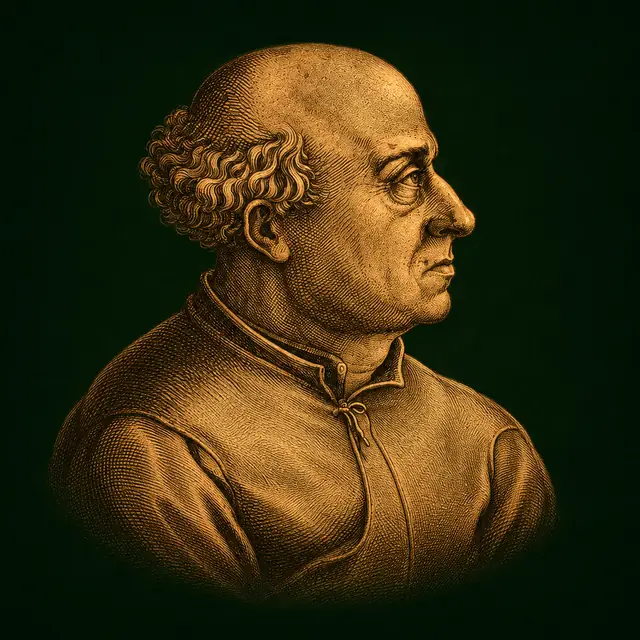
Who was Paracelsus, and what is truly known of them?
What is known
Swiss physician and alchemist, born Theophrastus von Hohenheim. He turned alchemy towards medicine, brought minerals and chemicals into the pharmacy, and taught that the dose makes the poison. A treatise printed after his death (1566) describes the four kinds of elemental beings: gnomes, undines, sylphs and salamanders.
The teaching
Taught from his own books, above all the Paragranum (1530), the Opus Paramirum (1531) and the Astronomia Magna.
The four pillars of medicine
Medicine, Paracelsus teaches in the Paragranum, stands on four pillars, and a physician who lacks any one of them is no physician. The first is philosophy, the knowledge of nature, of the earth and the water and of everything that grows and is made, for the physician grows out of nature and must learn from it, not from books alone. The second is astronomy, the knowledge of the heavens: the stars above, and the firmament within the human body that answers to them.
The third is alchemy, by which the physician prepares what nature has left unfinished, separating the pure from the impure and bringing each remedy to its full power. The fourth is the physician's own virtue, honesty, faithfulness and skill that stay with him until death, for a cheat or a boaster has no right to the sick. The deepest ground of medicine, he writes, is love.
The little world
A human being is the little world, holding in small everything the great world holds: the heavens with their stars, the earth, the waters and the air, the metals, the plants and the beasts. What the physician learns of the great world he finds again in the body, and what he has not learned outside he cannot understand within. So the cure of a disease is sought in the outer world, where its likeness grows, and a physician who knows only the body knows half of it.
Two lights and three bodies
There are two lights by which a person knows. The light of nature shows the things of nature, the arts and the sciences, the virtues of herbs and stones and the workings of the stars; the light of grace, the Holy Spirit, shows God and what belongs to eternal life. Both come from God, but the second stands above the first, and no learning in the light of nature may set itself against it.
In the Astronomia Magna the human being has a threefold make. The elemental body comes from the earth and returns to it. The sidereal body comes from the stars: it carries reason, skill and the arts, it teaches in sleep and in dreams, and it is what the hidden arts read, astrology, divination and natural magic among them. The soul comes from God and returns to God. Among the beings known in the light of nature are the peoples of the four elements, taught in full on the page of The elementals, under The spirit realm.
Five sources of sickness
Every disease, he teaches, comes from one of five sources, and the physician must know which. The first is the stars, which work on the body through the air it breathes. The second is poison, for every food and drink holds poison beside its nourishment, and the inner alchemist of the stomach must part the two. The third is the body's own nature, its make and its inner firmament. The fourth is the spirit, when one will acts on another and the spirit of one person harms the spirit of another. The fifth is God, who sends some sicknesses as a trial or a judgement, and these only God can lift.
To the five sources answer five kinds of physician: those who heal by the natures of things, setting contraries against contraries as the schools teach; those who heal by the specific virtues of remedies; those who heal by words and signs; those who heal by the power of the spirit; and those who heal by faith, as Christ and the apostles did.
Salt, sulphur, mercury and tartar
In the Opus Paramirum the four humours of the schools give way to his three principles, salt, sulphur and mercury, and a sickness is one of them out of its measure; the three are taught in full on the page of Salt, sulphur and mercury, under Alchemy. Among the diseases he names is the tartar. As wine leaves its tartar on the walls of the cask, so the body leaves a hard deposit from what it eats and drinks when it cannot part the pure from the impure, and from it come the stone, the gout and other hardenings.
Signatures and the dose
Nature marks every growth according to its virtue, he teaches, so that a skilled eye can read in the shape, the colour and the place of a plant what it is good for, as a face shows the character behind it. This is the art of signatures. Against the schools he prefers to treat like with like, and to seek for each disease the one remedy made for it, the arcanum, in minerals as well as in herbs.
Because the strongest remedies are poisons, he holds to his rule: all things are poison and nothing is without poison; only the dose makes a thing not a poison. The same rule is why no remedy of his is given here and none is to be copied. His medicines belong to the history of the art.
Nature heals the wound
In the Great Surgery he teaches that a wound is healed by nature and not by the surgeon. The body has within it a natural balsam that closes and mends what is cut, and the surgeon's work is to guard it: to keep the wound clean, to keep out whatever hinders it, and not to pour in oils or load it with salves and plasters that corrupt it. The surgeon is nature's servant and protector, never her master.
Reading nature from land to land
Learning, for Paracelsus, is gathered on the road. Scripture is studied letter by letter, he says, but nature from land to land: every country is a leaf of her book, and whoever would read it must walk its pages. By his own account he learned from barbers and bath keepers, from women and magicians, from alchemists and monks, from nobles and common folk as well as from doctors, and he taught his students to test every teaching by experience before they trusted it.
Orders and memberships
He belonged to no secret order. The Rosicrucian writings appeared some seventy years after his death and claimed him as a forerunner; he knew nothing of them.
The legend
That he made the philosopher’s stone or a living homunculus. The recipe for the homunculus stands in a work whose authorship is doubted.
Their works
- ParagranumBook, 1530
His defence of his own medicine against the doctors of Basel and Nuremberg, resting the physician’s art on four pillars: philosophy, astronomy, alchemy and the virtue of the healer himself. It is the plainest statement of why he turned alchemy towards medicine.
Ask the Oracle about it - Opus ParamirumBook, 1531
A work on the causes of disease, where he sets out his three principles of salt, sulphur and mercury in place of the four humours of the schools. The three principles shaped chemical medicine and alchemy for more than a century after him.
Ask the Oracle about it - The Great SurgeryBook, printed 1536
A book on wounds and ulcers printed at Ulm and Augsburg, one of the few of his works to appear while he lived, and the one that made his name as a healer. It urges the surgeon to let nature heal and to keep wounds clean rather than load them with salves.
Ask the Oracle about it - A Book on Nymphs, Sylphs, Pygmies and SalamandersTreatise, printed 1566
A treatise printed twenty five years after his death on the beings of the four elements: the water folk, the air folk, the earth folk and the fire folk, who live and die like us but have no soul. It is the source of the gnomes, undines and sylphs of later magic, poetry and fairy tale.
Ask the Oracle about it - Astronomia MagnaBook, written about 1537, printed 1571
Also called the Philosophia sagax, a large late work on the light of nature in man and the hidden arts that read it, from astrology and divination to magic, set beneath the light of grace. It is his fullest account of how the greater world and the lesser answer each other.
Ask the Oracle about it - De natura rerumTreatise, printed 1572
Nine books on the generation, growth and change of natural things, printed long after his death. It contains the famous recipe for growing a little man, the homunculus, in a sealed vessel, which later legend made one of his deeds.
Its authorship is doubted, and many scholars do not think it his.
Ask the Oracle about it
How the house tells a life
This life is told from the record, with what is documented, what is legend and what was forged kept apart. A membership in an order is stated only where documents show it. A person’s chart explains none of their deeds.
The arts it feeds
Lives near it in time
Lives and legends
Moses de LeónArnald of VillanovaJacques de MolayNicolas FlamelJohannes TrithemiusCornelius AgrippaNostradamusJohn DeeIsaac LuriaRudolf IIEdward KelleyHeinrich KhunrathThe whole tree

