

Mystical systems
Salamander
Direct answer
Salamander: The salamander of legend is a creature said to live unharmed in fire; Paracelsus made it the name of the fire elemental, one of his four peoples of the elements.
$0 today, then $19/month after 7 days. Cancel anytime.
At a glance
- Also called
- fire elemental
- Found in
- Mystical Systems
- Related
- Elementals, Undine, Sylph, Gnome
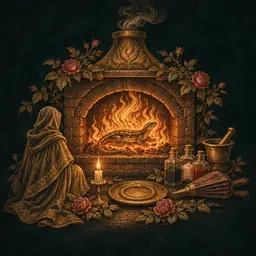

The salamander of legend is a creature said to live unharmed in fire; Paracelsus made it the name of the fire elemental, one of his four peoples of the elements.
A lineage map for books and systems; it avoids presenting symbolic traditions as literal fact.
Understand the chapter you are in.
Your life’s turning points, measured from your birth.
Walk through Alex’s whole example first


Prefer to explore first?
 The Road of AgesThe turning points of your whole life, from your own chart
Walk my road
Can a salamander live in fire?
The salamander is a real amphibian with an unreal reputation. Ancient writers said it was so cold that it could put out a fire by crawling through it. The belief probably began with salamanders creeping out of damp logs thrown on a hearth. Medieval bestiaries repeated it, and cloth of asbestos, which does not burn, was sold as salamander wool.
Paracelsus took the name for the people of fire in his scheme of four elementals. He says they are seldom seen and have little to do with humans, and he also calls them vulcani. In alchemy the salamander in the flames became an emblem of what survives the fire.
On the tree of the hidden arts: The spirit realm.
What sets Salamander apart
The salamander is the one elemental named after a real animal, and the animal's legend is older by two thousand years. The fire salamander of Europe hides in damp wood and gives off a milky fluid when alarmed, which is likely how the tale of a creature too cold to burn began. Paracelsus kept the name and dropped the lizard: his fire people are long, narrow and lean, and keep away from humans. Alchemists then kept the lizard and drew it sitting calmly in the furnace.
- Element: fire; Paracelsus also calls its people vulcani
- Ancient report: Aristotle and Pliny: it puts out fire by its cold
- Royal badge: Francis I of France, a salamander in flames
- Salamander wool: a medieval name for asbestos cloth
- Real animal: the fire salamander, Salamandra salamandra
Often mistaken for something else: The phoenix dies in fire and is reborn from it; the salamander of legend simply lives in the flames and is not consumed.
The story behind Salamander
Aristotle reports the claim that the salamander puts out fire, and Pliny the Elder passed it on in the first century CE. The legend ran through the bestiaries of the Middle Ages. Francis I of France, who came to the throne in 1515, took a salamander in flames as his badge. Paracelsus's treatise, printed in 1566, made it a spirit, and alchemical books of the seventeenth century drew it among their emblems.
Why Salamander matters
Salamander shows how a piece of mistaken natural history became in turn a royal badge, an alchemical emblem and a spirit of fire.
How to read Salamander
Readers meet it in heraldry, in alchemical pictures and in writing on the elements, where it stands for fire and for what endures heat.
Salamander in practice: an example
A visitor to the château of Chambord who sees a crowned lizard among flames carved again and again on the ceilings is looking at the salamander of Francis I.
Where readings of Salamander go wrong
The living animal cannot survive fire, and no creature should be put near one. The fire spirit is a figure of folklore and of one author's scheme.
Sources and editorial method
This entry summarizes the tradition in the Almanac's own words; where no source is listed, it is an editorial summary rather than a primary text, and symbolic readings are named as the tradition's, not as fact.
- Source
- The Great Almanac Dictionary
- Category
- Mystical Systems
- Aliases
- salamanders, fire elemental, fire salamander myth, salamander in alchemy, salamander meaning
- Last updated
- 2026-09-26
See Salamander in your personal almanac
A definition tells you what it is; your own birth chart tells you what it means for you. The Oracle casts your real chart and answers for your love, your work, and your year ahead, in conversation. It opens with the 7-day Oracle trial.
Speak with the OracleRelated terms
More in Mystical Systems
From the reference page to your own chart
Every word here
is in your own chart.
- Your life’s turning points, measured from your birth
- A practical next step to consider
- It opens with 7 days free: the AI Oracle on thirty hidden arts, and your daily horoscope
$0 today, then $19/month after 7 days. Cancel anytime.
Common questions
Can a salamander live in fire?
No. The belief is ancient and false. It may have begun with salamanders escaping from damp logs laid on a fire, which made them seem to come out of the flames.
What is a salamander as an elemental?
In the scheme of Paracelsus, salamanders are the people of fire, one of four kinds of being assigned to the four elements. He says they rarely meet humans.
What does the salamander mean in alchemy?
In alchemical emblems a salamander in flames stands for a substance or a quality that passes through fire and is not destroyed by it.


