

Mystical systems
Sylph
Direct answer
Sylph: A sylph is the air elemental in the scheme of Paracelsus: one of a people who live in the air as humans live on the ground.
$0 today, then $19/month after 7 days. Cancel anytime.
At a glance
- Also called
- air elemental, air spirit paracelsus
- Found in
- Mystical Systems
- Related
- Elementals, Undine, Gnome, Salamander
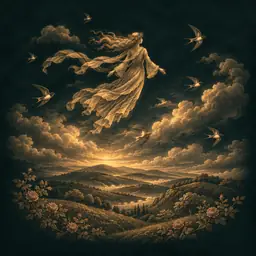

A sylph is the air elemental in the scheme of Paracelsus: one of a people who live in the air as humans live on the ground.
A lineage map for books and systems; it avoids presenting symbolic traditions as literal fact.
Understand the chapter you are in.
Your life’s turning points, measured from your birth.
Walk through Alex’s whole example first


Prefer to explore first?
 The Road of AgesThe turning points of your whole life, from your own chart
Walk my road
What is a sylph?
The word first appears in the writings of Paracelsus, who gave each of the four elements a people of its own. His sylphs, which he also calls sylvestres, the wood people, are not delicate: he describes them as taller, rougher and stronger than humans, and as closest to us of all the four because they breathe the same air.
The airy, graceful sylph is a later invention. In 1670 the French satire Le Comte de Gabalis made the sylphs beautiful and eager for human company, and Alexander Pope borrowed them in 1714 as the tiny guardians of a lady's hair and dress. From there the word came to mean a slender, light-footed woman.
On the tree of the hidden arts: The spirit realm.
What sets Sylph apart
The sylph has changed more than any of its companions. In Paracelsus the people of the air are the coarsest of the four, bigger and stronger than humans, and he pairs the name with sylvestres, wood people, so that they are half forest folk. A century later a French satire made them elegant, and Pope shrank them to guardians of ribbons and curls. By the nineteenth century the word meant a slight and graceful girl, the reverse of where it began.
- Element: air, the element humans share with them
- Word: first found in Paracelsus; its origin is uncertain
- His second name for them: sylvestres, the wood people
- Made fashionable by: Le Comte de Gabalis, a French satire of 1670
- In English verse: Alexander Pope, The Rape of the Lock, 1714
- On the stage: the ballet La Sylphide, Paris, 1832
Often mistaken for something else: An angel is a messenger of God in the faiths that speak of angels; a sylph is a mortal creature of the air in one physician's scheme, with no errand from anyone.
The story behind Sylph
Paracelsus's treatise on the four peoples was printed in 1566. Where he got the word is uncertain; it may blend the Latin sylvestris, of the woods, with the Greek nympha. The Abbé de Villars made sylphs fashionable in 1670, the enlarged version of Pope's The Rape of the Lock gave them their English form in 1714, and the ballet La Sylphide, first danced in Paris in 1832, fixed the winged figure in white on the stage.
Why Sylph matters
The sylph is a clear case of a word changing its meaning as it passes from natural philosophy to satire, poetry and the stage.
How to read Sylph
Readers meet the word in writing on the elements, where it stands for air, wind and breath, and in older poetry and ballet.
Sylph in practice: an example
A reviewer who calls a dancer sylph-like is using, at four removes, a word that a Swiss physician made up for the people of the air.
Where readings of Sylph go wrong
A sylph is a figure of one author's scheme and of later literature. No being of the air is claimed here, and nothing calls on one.
Sources and editorial method
This entry summarizes the tradition in the Almanac's own words; where no source is listed, it is an editorial summary rather than a primary text, and symbolic readings are named as the tradition's, not as fact.
- Source
- The Great Almanac Dictionary
- Category
- Mystical Systems
- Aliases
- sylphs, sylphid, air elemental, air spirit paracelsus, sylph meaning
- Last updated
- 2026-09-26
See Sylph in your personal almanac
A definition tells you what it is; your own birth chart tells you what it means for you. The Oracle casts your real chart and answers for your love, your work, and your year ahead, in conversation. It opens with the 7-day Oracle trial.
Speak with the OracleRelated terms
More in Mystical Systems
From the reference page to your own chart
Every word here
is in your own chart.
- Your life’s turning points, measured from your birth
- A practical next step to consider
- It opens with 7 days free: the AI Oracle on thirty hidden arts, and your daily horoscope
$0 today, then $19/month after 7 days. Cancel anytime.
Common questions
What is a sylph?
A sylph is an air spirit in the system of Paracelsus, one of four peoples he assigned to the elements. Later writers made the sylph small, winged and graceful.
Who invented the word sylph?
Paracelsus, in the sixteenth century. The word is first found in his writing and may combine the Latin sylvestris, of the woods, with nymph.
What do sylphs do in The Rape of the Lock?
In Alexander Pope's poem they are tiny airy guardians who watch over the heroine's hair, dress and jewels, a joke taken from Le Comte de Gabalis.


