
Nostradamus
1503 to 1566
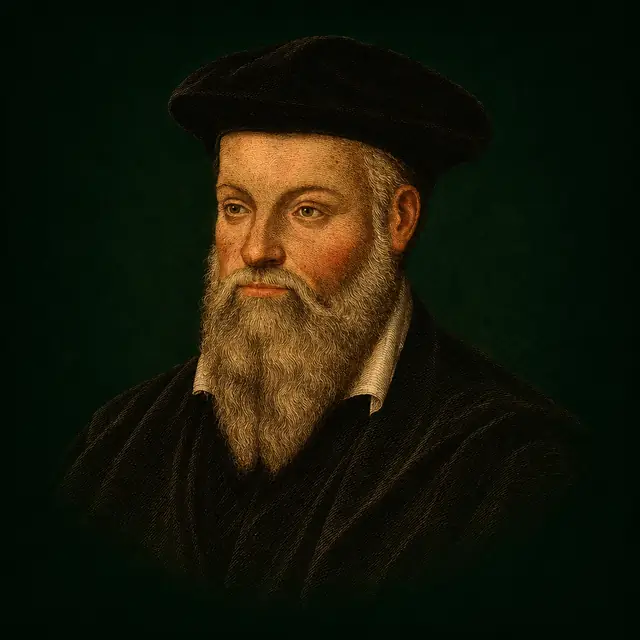
Who was Nostradamus, and what is truly known of them?
What is known
French apothecary and astrologer, Michel de Nostredame. His Prophéties, first printed in 1555, are rhymed quatrains, nearly all without dates, written in a deliberately dark style. Catherine de’ Medici favoured him at the French court.
The teaching
Taught from his own words, the Prophéties with their preface to his son César, his almanacs and his Treatise.
The night watch
The first two verses of the Prophéties tell how they were made. He sits alone at night in his secret study, resting on a seat of brass, and a slender flame rising out of the solitude makes him speak what is not vain to believe. With the wand in his hand, set in the midst of the branches, he wets the hem of his robe and his foot with water; a fear and a voice tremble through his sleeves; a divine splendour; the divine sits near.
The scene follows the account of the prophetess of Branchidae in Iamblichus's On the Mysteries, who prophesied holding a rod and wetting her feet or the hem of her robe in water, and the brass seat recalls the tripod of Delphi. He set his verses inside the oldest picture of prophecy he knew: the seer who makes himself still and waits for the god.
Inspiration and calculation
In the preface to his son he explains his gift. It is a natural instinct given by God, joined to long calculation by the stars: inspiration shows what is to come, and the astrology of the heavens sets it in its time. God alone knows the times fully, and the prophet sees only what the divine light shows him. He wrote in dark and cloudy sentences on purpose, he says, so as not to offend the present age or those in power, and books of hidden arts that had come into his hands he burned after reading them, so that they would do no harm. His verses, he says, run to the year 3797.
The almanacs
His almanacs forecast each year from its sky: the Sun's entry into the signs, the eclipses and the new and full Moons, read for the weather, the harvests, sickness and the affairs of princes. Each month had its short verse, a presage, and the year its own, in the same dark style as the Prophéties.
The apothecary's book
His treatise of cosmetics and preserves shows the craft of the apothecary. Its first part teaches face powders, scented waters and oils, soaps and perfumes. It also gives the pastille of red roses gathered before dawn, with cypress, iris, cloves and sweet woods, which he says he used against the plague in Provence, to be held in the mouth; it belongs to the medicine of his age, and nothing in it protects against any disease.
The second part teaches the keeping of fruits in sugar and honey, quinces, cherries, citrus peels and the rest, among them a quince jelly he praises as fit to be set before a king. Its recipes are exact about fruit, sugar and fire, and they are the plainest of all his teaching.
How the verses are made
The verses are built to be dark. They are almost never dated; they name places, rivers, beasts and kings in riddles, anagrams and Latin turns; and they pass from one age to another without warning, so that every age can find itself in them and every age has read them after the event. No quatrain has been shown to foretell an event before it happened.
Orders and memberships
He belonged to no secret order.
The legend
That he foretold particular modern events. No quatrain has been shown to predict an event before it happened; each is fitted to events afterwards.
What was forged, or is false
Many “Nostradamus” verses passed round after great disasters were written after them and are not in his book.
Their works
- Les ProphétiesPoem, printed 1555
Rhymed quatrains in French, gathered in groups of a hundred called centuries, first printed at Lyon in 1555 and enlarged in later editions to nearly a thousand verses. They are dark by design and almost never dated, which is why every age has fitted them to its own events after the fact.
Many verses passed round after modern disasters under his name are not in his book.
Ask the Oracle about it - AlmanacsAlmanac, yearly from about 1550
Yearly almanacs with forecasts of weather, harvests and public affairs, which first made his name in France and sold widely before the Prophéties did. Only parts of many years survive, and others were counterfeited under his name.
Ask the Oracle about it - Treatise on Cosmetics and PreservesTreatise, printed 1555
A book of recipes from his years as an apothecary: face powders, perfumes and scented oils in the first part, jams and fruits kept in sugar in the second. It sold better in his lifetime than the prophecies, and shows the working man behind the legend.
Ask the Oracle about it - Orus ApolloTranslation, about 1540s
A French verse translation of the Hieroglyphica of Horapollo, the late Greek book that claimed to explain the Egyptian signs as symbols. It survived in one manuscript and was first printed in the twentieth century, and shows the learned taste for emblems that colours his verse.
The date is uncertain, and some have doubted that the translation is his.
Ask the Oracle about it
How the house tells a life
This life is told from the record, with what is documented, what is legend and what was forged kept apart. A membership in an order is stated only where documents show it. A person’s chart explains none of their deeds.
The arts it feeds
Lives near it in time
Lives and legends
Arnald of VillanovaJacques de MolayNicolas FlamelJohannes TrithemiusCornelius AgrippaParacelsusJohn DeeIsaac LuriaRudolf IIEdward KelleyHeinrich KhunrathMichael MaierThe whole tree

