
Nicolas Flamel
About 1330 to 1418
Who was Nicolas Flamel, and what is truly known of them?
What is known
Parisian scribe, seller of manuscripts and landlord. He kept two small shops by the church of Saint-Jacques-de-la-Boucherie and about 1368 married Pernelle, a widow with property of her own. The couple gave to churches and hospitals, and in 1407 he built a house with lodging for the poor in the rue de Montmorency, which still stands and is counted among the oldest houses in Paris. He had a carved arcade set up at the cemetery of the Holy Innocents and designed his own tombstone, now in the Musée de Cluny. His will of 1416 and the deeds of his properties survive. He died in 1418. Nothing from his lifetime connects him with alchemy.
The teaching
Taught from the Book of Hieroglyphic Figures printed in his name in 1612, beside the house and tombstone he left.
What his own stones teach
What Nicolas Flamel himself left teaches the faith of a Paris burgher. On the house he built for the poor, the carved words ask the working men and women lodged in its porch to say each day a Pater Noster and an Ave Maria, praying God to pardon the poor sinners who have died. His tombstone shows Christ between Saint Peter and Saint Paul above a dead body, a reminder to every reader that he too must die. Charity, prayer for the dead and the hope of resurrection are the whole of it.
The book of Abraham the Jew
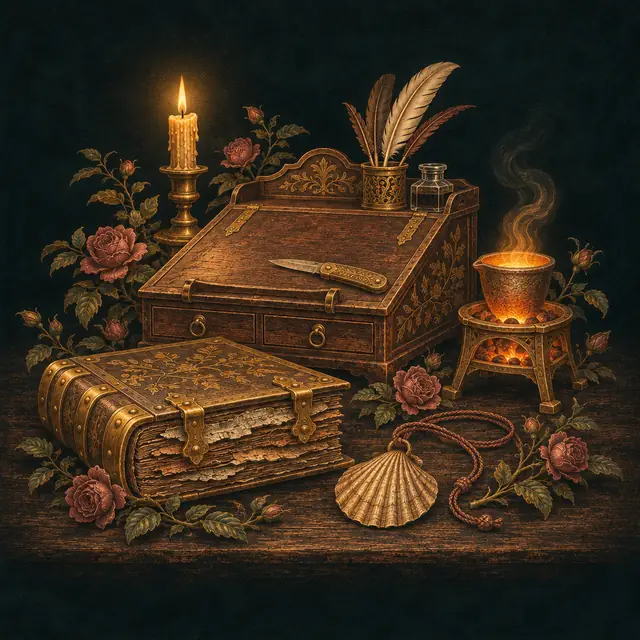
The book printed in his name two centuries after him tells another story, and teaches the work through it. Flamel buys for two florins a gilded book, old and large, its leaves not of paper or parchment but of the thin bark of young trees, its cover of copper engraved with strange signs. On its first leaf, in letters of gold, Abraham the Jew, prince, priest, Levite, astrologer and philosopher, greets the people of the Jews scattered in France by the wrath of God. It has twenty-one leaves, three times seven, and every seventh leaf bears pictures and no writing: a rod with serpents swallowing one another, a serpent fastened to a cross, and a desert with fair fountains from which serpents crept out.
Other leaves show Mercury, young and winged at the ankles, and an old man with an hourglass and a scythe coming to cut off his feet; a flower on a high mountain shaken by the north wind, with dragons and griffins about it; a rose tree in a garden beside a hollow oak, and at its foot a spring of white water that blind men dig for and cannot find; and a king whose soldiers kill little children, their blood gathered in a vessel where the Sun and the Moon come to bathe.
The pilgrimage and the projection
For years he cannot read the pictures. He vows himself to Saint James and goes on pilgrimage to Compostela, and at León he meets a physician, Master Canches, a Jew turned Christian, who knows the book and explains its first figures before he dies at Orléans on the road home. Back in Paris he finds the first agent, and with Pernelle, the book says, he makes the projection: on 17 January 1382, at noon, on half a pound of quicksilver, into pure silver, and on 25 April of that year, about five in the evening, with the red stone, into gold. The gold goes to hospitals, churches and chapels, for in this telling the art is for the poor and for God.
The figures read as the work
The second half of the book reads the figures Flamel had carved at the Innocents as the stages of the art. Two dragons stand at the start, one with wings and one without. The wingless one is the sulphur, the fixed, hot and dry; the winged one is the quicksilver, the volatile, cold and moist. Shut in the vessel, they fight and kill each other and rot together into blackness, and from that death the work begins.
The man and the woman are the two natures again, to be joined; the bodies rising from their graves are the matter coming back to life after its rotting; and the colours follow in their order, black, then white, then a citrine yellow, and last the red of the finished stone. The slain children's blood is the mineral spirit of the metals, in which the Sun and the Moon, gold and silver, are bathed and dissolved. The carvings themselves were ordinary religious images; the reading of them belongs to the book.
Orders and memberships
No order is documented. He is described as a sworn bookseller of the University of Paris and was a parishioner of Saint-Jacques-de-la-Boucherie. His name stands in the list of Grand Masters of the Priory of Sion, which is a hoax of the 1960s.
The legend
That he bought a strange book of bark pages by “Abraham the Jew”, learned its secret on a pilgrimage to Compostela, and in 1382 turned mercury into silver and then gold with Pernelle; and that the two never died and were seen in India and at the Paris Opera centuries later. Treasure hunters dug up his house and his grave and found nothing.
What was forged, or is false
The Book of Hieroglyphic Figures, the source of the whole story, was first printed in 1612, almost two centuries after his death, and is a work of that time written in his name. The carvings it explains as alchemy were ordinary religious images.
Their works
- Book of Hieroglyphic FiguresBook, printed 1612
A book printed at Paris in his name, telling how he bought the book of Abraham the Jew, learned its meaning on a pilgrimage to Compostela, and made gold with Pernelle in 1382, and reading the carvings he set up at the Holy Innocents as alchemy. It is the source of his whole legend.
It was written in his name almost two centuries after his death.
Ask the Oracle about it - House of Nicolas FlamelBuilding, 1407
The house he built in the rue de Montmorency with lodging for the poor, who were asked in return to pray for the dead. It still stands, with its carved inscription, and is counted among the oldest stone houses in Paris.
Ask the Oracle about it - Tombstone of Nicolas FlamelMonument, before 1418
The small stone he designed for his grave at Saint-Jacques-de-la-Boucherie, carved with Christ, Saint Peter and Saint Paul and a dead body, now in the Musée de Cluny. It is a plain Christian memorial that later writers read as a sign of his alchemy.
Ask the Oracle about it - Harry Potter and the Philosopher’s StoneNovel, 1997
The first of the Harry Potter novels, in which Flamel is named as the maker of the philosopher’s stone, living at six hundred and sixty five with his wife Perenelle. Through it his legend became known to millions of children.
Ask the Oracle about it
How the house tells a life
This life is told from the record, with what is documented, what is legend and what was forged kept apart. A membership in an order is stated only where documents show it. A person’s chart explains none of their deeds.
The arts it feeds
Lives near it in time
Lives and legends
Abu Ma’sharMichael ScotAbraham AbulafiaMoses de LeónArnald of VillanovaJacques de MolayJohannes TrithemiusCornelius AgrippaParacelsusNostradamusJohn DeeIsaac LuriaThe whole tree

