
Johannes Trithemius
1462 to 1516
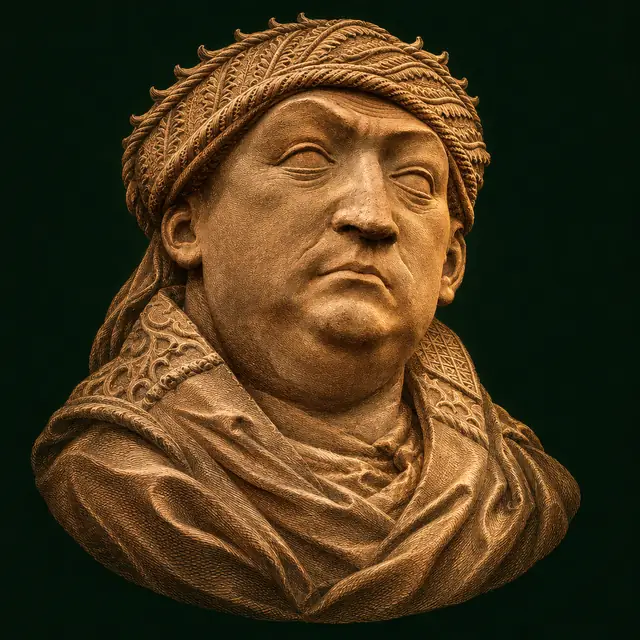
Who was Johannes Trithemius, and what is truly known of them?
What is known
German Benedictine, born at Trittenheim on the Moselle. He was chosen abbot of Sponheim in 1483, at twenty-one, and built its library from a few dozen books to about two thousand; from 1506 he was abbot of St James at Würzburg, where he died. His Steganographia, written about 1499, reads as a manual for sending messages by spirits. It went round in manuscript, was printed in 1606 and put on the Index in 1609. Its first two books are a treatise on ciphers, and in the 1990s the third was shown to be one as well. His Polygraphia, printed in 1518, is the first printed book on cryptography. The young Agrippa sent him the first draft of his book on magic in 1510.
The teaching
Taught from his own books, above all the Steganographia, the Polygraphia and On the Seven Secondary Intelligences.
Writing that hides itself
Trithemius teaches the art of writing so that a message cannot be seen. In the Steganographia each method is given the name of a spirit, and the letter that carries the message is dressed as a prayer or a conjuration to that spirit. The words of the conjuration are the cover. The message is read by taking certain letters of certain words in a set order and passing over the rest, so that a page of strange invocations hides a plain sentence that only one who knows the rule can read.
The third book, with its angels of the planets and its tables of numbers, hides messages in the same way. One of them, read again in our own time, says that the bearer of the letter is a rogue and a thief, to be guarded against. The angels and the rites are the dress; the art beneath them is the cipher.
The square of shifting alphabets
The Polygraphia gives the same art in the open. In one part every letter of the alphabet is given a long column of words, so that a message written word by word reads as a Latin prayer. In another he sets the alphabet in its order, then again beneath it shifted by one place, and again by two, until every shift stands in a square. A message is written by taking its first letter from the first row, its second from the second, and so on down, so that each letter is written in a different alphabet, and the counting of letters, which breaks a simple cipher, finds nothing to count.
The angels of the ages
Under God, the first mind, seven angels, the minds of the planets, govern the world in turn, each for three hundred and fifty-four years and four months; their names and their order are taught on the page of Daimons and intelligences, under The spirit realm. Each age takes the nature of the angel who rules it, and Trithemius reads the history of the world, from the creation through the Flood and the kingdoms to his own day, as the succession of their reigns, so that the turning of the angels gives a measure for the great changes of the world.
Hay for the ox
When the young Agrippa sent him the first draft of his book on magic, Trithemius praised it and gave him one rule to keep: speak of common things to common people, and of higher and hidden things only to higher and trusted friends. Give hay to the ox, he wrote, and sugar to the parrot. What is taught must fit the one who is taught, and a teaching given to those who cannot bear it is wasted or turned to harm.
Against sorcery
He drew the line between the wisdom of nature and the help of demons sharply. In his book against sorcery, the Antipalus, he lists the books of magic he judges evil and teaches remedies against bewitchment drawn from the Church: confession, prayer, the sacraments, holy water and blessed salt, and the sign of the cross. He counted the witches of his day as real servants of the devil, a teaching of his age that fed the trials, whose record is taught on the page of The witch trials, under Magic and protection.
In praise of scribes
To his monks he taught that copying books is holy work. The scribe preaches with his hands to readers not yet born; the words he copies are fixed in his own mind as he writes them; and the labour keeps him from idleness. A book written on parchment, he says, can last a thousand years, while printed books on paper will not last nearly so long, and so the copyist's work outlasts the press.
Orders and memberships
A Benedictine monk from 1482 and an abbot for thirty-three years. He belonged to the humanist society gathered by Conrad Celtis on the Rhine. A secret brotherhood of magicians under his rule is a later invention.
The legend
That he called up the dead wife of the emperor Maximilian, a tale told later in the sixteenth century. That Paracelsus was his pupil rests on one line in which Paracelsus names an abbot of Sponheim among his teachers, and the dates fit badly.
What was forged, or is false
He forged sources himself. Hunibald and Meginfrid, the old chroniclers he cites for the early Franks and for the abbey of Hirsau, never existed; historians hold them to be his inventions.
Their works
- SteganographiaBook, written about 1499; printed 1606
A book that reads as a manual for sending messages by spirits. Its first two books are a treatise on ciphers dressed in the names of angels, and the third, long thought pure magic, was shown in the 1990s to be one as well. It was put on the Index in 1609.
Ask the Oracle about it - PolygraphiaBook, printed 1518
The first printed book on cryptography, with long tables of words standing for letters and the square table of shifting alphabets that bears his name. It is the plain, open form of the art hidden in the Steganographia.
Ask the Oracle about it - On the Seven Secondary IntelligencesBook, 1508; printed 1522
A short book naming the seven angels of the planets who rule the world in turn, each for three hundred and fifty four years, with a history of the ages under them. It was much read by later writers on angels and the end of time.
Ask the Oracle about it - In Praise of ScribesTreatise, 1492
De laude scriptorum, a call to his monks to go on copying books by hand, as work that serves God and lasts. Written as printing spread, it was itself printed, and shows the abbot who built the library of Sponheim.
Ask the Oracle about it - Annals of HirsauChronicle, finished 1514
A long history of the abbey of Hirsau and of Germany in his own time and before it, which he said rested on old chroniclers, among them a monk named Meginfrid. It shows the learned abbot as a historian and as a maker of sources.
The chronicler Meginfrid never existed; historians hold him to be Trithemius’s invention.
Ask the Oracle about it
How the house tells a life
This life is told from the record, with what is documented, what is legend and what was forged kept apart. A membership in an order is stated only where documents show it. A person’s chart explains none of their deeds.
The arts it feeds
Lives near it in time
Lives and legends
Michael ScotAbraham AbulafiaMoses de LeónArnald of VillanovaJacques de MolayNicolas FlamelCornelius AgrippaParacelsusNostradamusJohn DeeIsaac LuriaRudolf IIThe whole tree

