
Allan Kardec
1804 to 1869
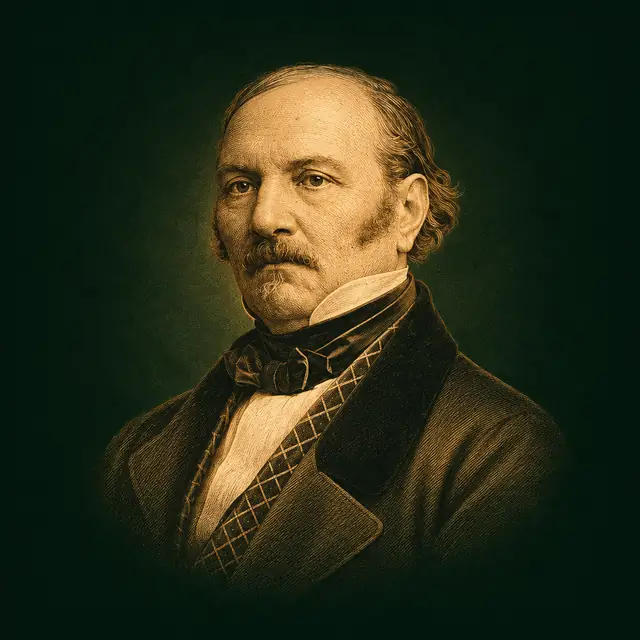
Who was Allan Kardec, and what is truly known of them?
What is known
Pen name of Hippolyte Léon Denizard Rivail, a French teacher born at Lyon and schooled at Pestalozzi’s institute at Yverdon, who wrote textbooks in Paris for thirty years. From 1855 he attended sittings where tables were said to move, put ordered questions through several mediums, and arranged the answers as Le Livre des Esprits (1857). The Mediums’ Book (1861) and The Gospel According to Spiritism (1864) followed. He coined the word spiritisme, and in 1858 founded the Revue Spirite and a society for its study in Paris. In 1861 three hundred Spiritist books, his among them, were burned by order of the bishop of Barcelona. Spiritism is a living religion today, above all in Brazil.
The teaching
Taught from his own books, above all The Spirits' Book (1857), The Mediums' Book (1861) and Heaven and Hell (1865).
A science and a philosophy
Spiritism, as Kardec defines it, is at once a science of observation and a philosophical doctrine. As a practical science it consists in the relations that can be set up with spirits; as a philosophy it takes in all the moral consequences that follow from those relations. Its subject is the nature, origin and destiny of spirits and their relations with the bodily world. He made new words for it on purpose. Spiritualism, in the French of his day, meant any belief in a soul as against the materialists, so he called the doctrine founded on communication with spirits spiritisme, and those who hold it spirites.
Its method is ordered questioning. A question is put, the answer is written down as it comes, and the answers are compared. A teaching belongs to the doctrine only when many spirits give it in agreement, through many mediums who do not know one another, in many places, and when it stands up to reason; he calls this the universal control of the teaching of the spirits. A single message proves nothing, whatever great name it signs.
God, spirit and matter
The Spirits' Book opens with its first question: what is God? God is the supreme intelligence, the first cause of all things. Kardec reasons from the axiom that there is no effect without a cause: the order of the universe is an intelligent effect, so its cause must be an intelligence above it. God is eternal, unchanging, immaterial, one, all-powerful and sovereignly just and good. What God is in essence a human being cannot yet grasp, the spirits answer, because the sense for it is lacking.
Beneath God the universe holds two general elements, spirit and matter. Between them is a universal fluid, a matter so fine that spirit can act on it, and through it on the grosser matter of bodies. The forces of nature come from its changes, and from it each spirit draws its envelope.
The three parts of a person
The spirits are the intelligent beings of creation, and they people the universe beyond the visible world. Each begins simple and ignorant and rises by its own free will, some quickly and some slowly, none favoured by God above another. A human being is such a spirit in a body, and has three parts: the body; the soul, which is the spirit incarnate; and the perispirit, a fine envelope drawn from the universal fluid, which binds the two together in life and which the spirit keeps after death as its body in the world of spirits.
Incarnation has a double purpose. It is the road to perfection, since only through the trials of bodily life does a spirit learn; for some it is an expiation and for others a mission. It also gives the spirit its share in the work of creation, because through a body it works on matter and on the world.
Many lives on many worlds
Rebirth, for Kardec, is the only teaching that reconciles the inequality of human lots with the justice of God. One child is born gifted and another slow, one rich and one in want, one for a long life and one for a short one; if each soul had this life alone, God would be unjust. If each life follows earlier ones and prepares later ones, every lot is a lesson, a trial or a reparation fitted to the spirit that bears it, and inborn gifts and leanings are what the spirit has brought with it.
The worlds of space are inhabited, and not all alike. The Gospel According to Spiritism ranks them under the saying of Jesus that in his Father's house are many mansions: primitive worlds, where spirits take their first bodies; worlds of trial and expiation, where evil still outweighs good; worlds of regeneration, where souls who have amends still to make find rest; happy worlds, where good outweighs evil; and celestial or divine worlds, the home of purified spirits. The earth is a world of trial and expiation, and it rises toward a world of regeneration as the spirits who live on it improve.
The ten moral laws
The law of God, the natural law, is written in the conscience, and Jesus summed it up in the rule of doing to others as one would be done by. The Spirits' Book divides it into ten laws: of worship, of labour, of reproduction, of preservation, of destruction, of society, of progress, of equality, of liberty, and last of justice, love and charity, which holds all the others. Charity, as Jesus meant it, is benevolence toward everyone, indulgence for the faults of others and forgiveness of offences.
The true Spiritist, Kardec writes, is known by his moral transformation and by the efforts he makes to master his bad inclinations. The practical means he gives is the old counsel to know oneself, with the practice that an answer signed by Saint Augustine adds to it: at the end of each day to question one's conscience, pass in review what one has done, and ask whether one has failed in any duty and whether anyone has cause to complain. When unsure of an act, one asks how one would judge it if another had done it.
Heaven, hell and the three conditions
Heaven and Hell sets aside eternal punishment. Joy or pain after death is not a sentence passed from outside but the natural outcome of what the soul has made of itself: every imperfection it keeps is a source of suffering and every virtue a source of happiness. No suffering is endless. It lasts as long as the spirit clings to the evil that causes it, and it ends when the spirit turns. Three conditions wipe out a fault: repentance, expiation and reparation, which is the good done where harm was done.
No being is created for evil alone. Angels are spirits who have reached perfection by their own effort, along the road every spirit walks, and demons are imperfect spirits who have not yet turned and in time will. The book prints messages it gives as from the dead of every condition, the happy, the suffering, suicides and the hardened, as witnesses to the states the doctrine describes.
Mediums and obsession
Everyone who feels the influence of spirits in any degree is in that degree a medium, The Mediums' Book teaches, but the name is kept for those in whom the gift is marked. It sorts them by their gifts: mediums of physical effects, of hearing, of speech, of sight, of healing, and above all of writing, which Kardec counts the most useful, since it leaves a record that can be weighed. A writing medium is mechanical when the hand moves without the mind taking part, intuitive when the thought passes through the medium's own mind, and semi-mechanical between the two.
The danger of mediumship is obsession, the hold of an imperfect spirit over a person, and it has three degrees. In simple obsession a spirit thrusts itself into the communications and will not be sent away. In fascination it deludes the medium, who takes its absurdities for wisdom and defends them. In subjugation it bears down on the person's own will. Pride is its chief door, for a proud medium will not hear that a message is false. The remedy he gives is humility, prayer, patience and firmness, and the medium's own moral betterment, which draws better spirits.
He warns against developing mediumship in children, or in anyone of weak health or excitable nerves, and against using it for amusement, curiosity or gain. The general teaching of the Spiritualist circles and their cautions is given in Mediums and Spiritualism.
Faith face to face with reason
Kardec holds that the only unshakeable faith is one that can look reason in the face in every age. Spiritism binds itself to science accordingly: his Genesis says that if new discoveries show it to be wrong on any point, it will change on that point. In the same spirit he reads the miracles of the Gospels as natural facts whose laws were not yet known, the action of spirit on the universal fluid, and the six days of creation as the long ages of the earth's forming.
Orders and memberships
No order is documented. He is often called a Freemason, and no lodge record has been produced. The Parisian Society of Spiritist Studies he founded in 1858 was a public body with printed rules.
The legend
That the name Allan Kardec was his own in an earlier life as a Druid in Gaul, revealed to him by a spirit. That is the movement’s own tradition about its founder, held in faith by Spiritists, and no record can bear on it.
Their works
- The Spirits’ BookBook, 1857
The founding book of Spiritism, arranged from the answers that he said spirits gave through several mediums to his ordered questions. It treats God, the soul, the spirit world and rebirth in numbered questions and answers. It is still read as scripture by Spiritists, above all in Brazil.
Ask the Oracle about it - The Mediums’ BookBook, 1861
A guide to mediumship and to the kinds of communication Spiritists believed in, with warnings against fraud and against spirits that deceive. It was meant as the practical companion to The Spirits’ Book.
Ask the Oracle about it - The Gospel According to SpiritismBook, 1864
A reading of the moral teaching of the Gospels in the light of Spiritism. His books were placed on the Church’s Index of forbidden books in 1864, and it remains one of the most read books in Brazil.
Ask the Oracle about it - What Is Spiritism?Book, 1859
A short introduction in the form of dialogues with a critic, a sceptic and a priest. It was written for newcomers to the movement. In it he answers the common objections to Spiritism and warns against those who make a trade of mediumship.
Ask the Oracle about it - Heaven and HellBook, 1865
A book on the life after death as Spiritism describes it, setting aside eternal punishment in favour of growth through many lives. It prints messages said to come from the dead about their state.
Ask the Oracle about it - GenesisBook, 1868
His last book, on the creation, miracles and prophecies read in the light of the science of his day and of Spiritism. It was the fifth of the books his followers count as the core of the teaching.
Ask the Oracle about it - Revue SpiriteJournal, from 1858
The monthly journal he founded and edited until his death, reporting sittings, letters and debates from across Europe. It is still published today. Through it the word spiritisme and the movement he founded spread from Paris to Spain, Latin America and beyond.
Ask the Oracle about it
How the house tells a life
This life is told from the record, with what is documented, what is legend and what was forged kept apart. A membership in an order is stated only where documents show it. A person’s chart explains none of their deeds.
The arts it feeds
Lives near it in time
Lives and legends
Adam WeishauptNapoleon BonaparteMarie Anne LenormandFrancis BarrettMarie LaveauEdward Bulwer-LyttonAlbert PikeÉliphas LéviPaschal Beverly RandolphAndrew Jackson DavisHelena BlavatskyHenry Steel OlcottThe whole tree

