
Éliphas Lévi
1810 to 1875
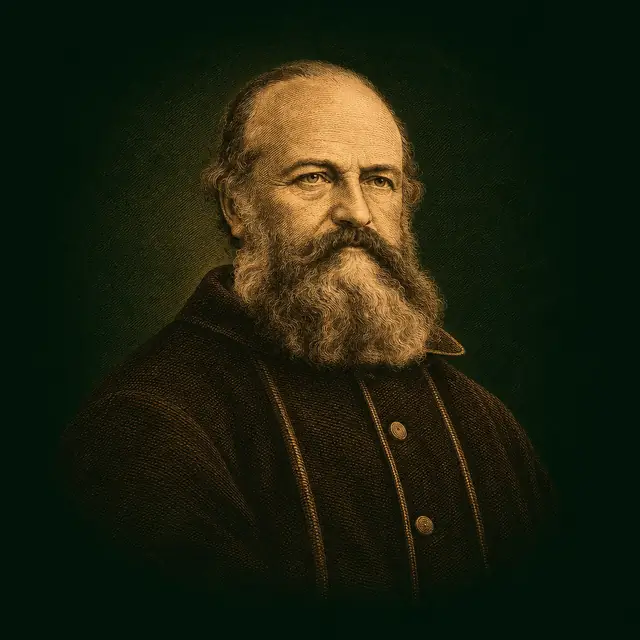
Who was Éliphas Lévi, and what is truly known of them?
What is known
French writer, born Alphonse-Louis Constant, who trained for the Catholic priesthood and left before ordination. His Dogme et Rituel de la Haute Magie (1854 to 1856) shaped modern occultism: he tied the twenty-two tarot trumps to the Hebrew letters and drew the goat-headed figure of Baphomet as an emblem of balanced opposites.
The teaching
Taught from his Dogme et Rituel de la Haute Magie (1854 to 1856) and the books on magic that followed it.
To know, to dare, to will, to keep silent
Four conditions open the way, and Lévi calls them the four words of the magus: an intelligence lit by study, a boldness nothing can check, a will nothing can break, and a discretion nothing can corrupt or intoxicate. To know, to dare, to will and to keep silent are written, he says, on the four symbolic forms of the sphinx, the man, the lion, the bull and the eagle.
The magus is first master of himself. Until his passions obey him he commands nothing, and the long preparations of the old books are, in Lévi's reading, a schooling of the operator rather than a charm.
The great magical agent
All of Lévi's magic rests on one agent. There is, he teaches, a fluid and a force spread through all nature, at once bodily and spiritual, which he calls the astral light: a universal plastic mediator, the common receptacle of the vibrations of movement and of the images of forms, which may be called the imagination of nature. The ancients knew it under many names. It is the Telesma of Hermes, the Azoth of the alchemists, the serpent of the old symbols and the magnetic fluid of Mesmer. It keeps the images of all that has been, and from it come visions, dreams and the pictures that seers see.
The astral light is the instrument of the will. It moves by two forces, attraction and repulsion, and a trained will can gather it, project it and fix it. Everything magic does, it does through this light: the magus is one who has learned to direct it, and the visionary and the sorcerer are carried by it. Left blind and serving error, it is the serpent of temptation; ruled, it is the light of the work.
Balance, the law of all things
The law that rules the astral light, and everything else, is equilibrium. Every force rests on its opposite, and nothing stands that is not held between two: light and darkness, mercy and severity, the active and the passive, the man and the woman. The two pillars of Solomon's temple, Jachin and Boaz, one white and one black, are its sign, and the life of the world moves between them. Harmony, Lévi teaches, is born from the analogy of contraries, and the third term that reconciles two is the secret of the triangle. His Baphomet, which gathers every pair of opposites into one body, is taught part by part in Baphomet.
Analogy is the key to the whole science. The visible is the manifestation of the invisible, so that what is above is like what is below, and the small world of a human being answers to the great world in every part. Knowing the law of one level of being, the magus reasons to the others.
The will and the rite
The will grows by acts. An intention that never passes into an act is a vain intention, Lévi teaches, and the magus trains his will as an athlete trains the body, by steady action and by doing what is hard. Ceremonies, signs, perfumes and instruments have no power of their own. They gather the imagination and fix the will, and their worth is exactly the help they give to a will already formed. Superstition, he says, is what the word means: a sign that survives after its meaning is lost.
The pentagram and the elements
The sign of the will's rule is the pentagram, the star of the microcosm, and his rule of its points is taught in The pentagram. By it the magus commands the spirits of the four elements, the sylphs of air, the undines of water, the salamanders of fire and the gnomes of earth. He consecrates it by the elements, breathing on it, sprinkling it with water and drying it in the smoke of perfumes. But the elements obey only one who has first mastered them in himself.
The magic chain
No great work is done alone. To form the magic chain, Lévi teaches, is to create a current of ideas that produces faith and draws many wills into one circle of action. The chain is made by a shared rite, a shared sign and a discipline kept at fixed hours, and once formed it carries more force than any of its members could alone. It is how a master is followed, how a church endures and how a movement takes hold of a crowd, for good or for ill.
The tarot, the book of keys
Lévi holds the tarot to be a very old book of the Kabbalah, the book of Hermes, a key to every science. Its twenty-two trumps answer to the twenty-two letters of the Hebrew alphabet: the Juggler to Aleph, the High Priestess to Beth, and so on down the series, with the unnumbered Fool placed at Shin, the twenty-first letter, and the World at Tau, the last. The four suits answer to the four letters of the divine name, wands to Yod, cups to He, swords to Vau and coins to the final He. His Dogme and his Rituel keep the same plan: each has twenty-two chapters, one for each letter and trump.
A prisoner with no books but a tarot, he writes, could in a few years gain a universal science by learning to use it, for its figures and numbers can be combined into every idea.
Evocation and its dangers
Lévi tells of one evocation of his own, in London in 1854, when after long preparation by abstinence and meditation he called on Apollonius of Tyana and a figure appeared before him. He does not claim that the dead returned. He holds that such rites work through the astral light on the imagination of the operator, that what appears is an image kept in that light and shaped by the operator's own mind rather than the soul of the dead, and that the work is dangerous: it exhausts the body, unsettles the reason and is never to be undertaken from curiosity. The house repeats his warning, performs nothing from his rite, and adds that no one whom a fast could harm should fast.
Black magic, in his teaching, is the will set to serve the passions and to harm, and it destroys the one who works it before anyone else. The devil, for Lévi, is no rival god but force put for a time at the service of error, and the magus whose will is joined to the order of the world has no pact to make with anything.
Orders and memberships
Trained in a Catholic seminary; never a Jesuit. He was received into a Masonic lodge in Paris in 1861 and soon left it.
The legend
That his Baphomet is an idol the Templars worshipped, or a picture of the devil. He drew it himself in the 1850s as a symbol; the charge against the Templars came from confessions under torture.
Their works
- Dogme et Rituel de la Haute MagieBook, 1854 to 1856
His two volumes on the doctrine and ritual of high magic, which shaped modern occultism. He tied the twenty-two tarot trumps to the Hebrew letters, and the second volume opens with his drawing of Baphomet. Waite put it into English as Transcendental Magic.
Ask the Oracle about it - BaphometDrawing, 1856
The goat-headed figure he drew as the frontispiece of his Ritual, with wings, a torch between its horns and arms pointing up and down, as an emblem of balanced opposites. It is his own symbol, not an idol of the Templars nor a picture of the devil, though it is often taken for both.
Ask the Oracle about it - Histoire de la MagieBook, 1860
A history of magic from the earliest times to his own day, read for its colour more than for its accuracy. It shaped how the Victorian occultists saw the past of their art.
Ask the Oracle about it - La Clef des grands mystèresBook, 1861
The Key of the Great Mysteries, the third of his large books on magic, on the problems of religion, philosophy and nature. Aleister Crowley, who thought himself Lévi reborn, later put it into English.
Ask the Oracle about it - La Science des espritsBook, 1865
A book on the spirits and on the Spiritist movement of his day, which he treated with suspicion. In it he also wrote on the Jewish and Christian scriptures and their hidden meanings as he saw them.
Ask the Oracle about it - La Bible de la libertéBook, 1841
A book of radical Christian socialism published under his own name, Alphonse-Louis Constant, before he took up magic. It was seized, and he served eight months in prison for it.
Ask the Oracle about it
How the house tells a life
This life is told from the record, with what is documented, what is legend and what was forged kept apart. A membership in an order is stated only where documents show it. A person’s chart explains none of their deeds.
The arts it feeds
Magic and protectionTarot, runes, I ChingThe Tree of LifeSymbols
Lives near it in time
Lives and legends
Marie Anne LenormandFrancis BarrettMarie LaveauEdward Bulwer-LyttonAllan KardecAlbert PikePaschal Beverly RandolphAndrew Jackson DavisHelena BlavatskyHenry Steel OlcottDaniel Dunglas HomeThe Fox sistersThe whole tree

