
Athanasius Kircher
1602 to 1680
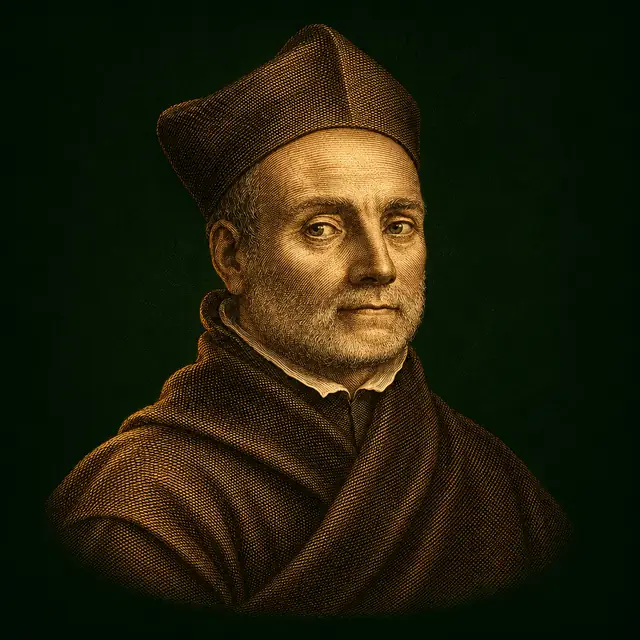
Who was Athanasius Kircher, and what is truly known of them?
What is known
German Jesuit scholar, born at Geisa near Fulda. He entered the Society of Jesus in 1618, taught at Würzburg until the Swedish army came in 1631, and from 1634 lived in Rome at the Jesuits’ Roman College, first as professor of mathematics and then with leave to study and write. In 1638 he had himself lowered into the crater of Vesuvius to see it. He published some forty large illustrated books: on the magnet, on light and shadow, on music, on the world underground, on China, and on Egypt, whose hieroglyphs he claimed to read as sacred symbols. He was right that Coptic descends from the old Egyptian tongue. Looking at the blood of plague victims through a microscope in 1656, he reported small worms and blamed them for the disease. His museum at the college drew visitors from all Europe.
The teaching
Taught from his own books, above all the Oedipus Aegyptiacus, the Magnes and the Musurgia universalis.
All things bound by hidden knots
Kircher teaches that the world is one great web of attractions. On the title page of his book on the magnet he sets the motto that all things rest, joined together by hidden knots. The lodestone that draws iron is only the plainest case of a power that runs through everything: the Moon draws the sea into its tides, the sunflower turns its face after the Sun, plants seek some neighbours and shun others, and creatures are drawn to one another in love and driven apart in hatred. He calls all of these magnetism, in a wide sense, and the old lore of sympathies and antipathies becomes in his hands a single science.
The chain ends in God. The last part of the Magnes turns to the magnetism of love, by which souls are drawn to one another and the whole creation is drawn back towards its maker, from whom every attraction comes.
The cure of the tarantula
The proof of the hidden knots he returns to in two books is the tarantula of Apulia. Those it bites, he reports, fall into a heavy sadness and stupor, and they are cured by music: the players try one tune after another until the right one is found, the sufferer begins to dance, and dances for hours or days until the poison is sweated out. Each patient answers to a particular tune, and often to a particular colour, and he prints the tunes themselves in his book so that the remedy can be played. His explanation is at once mechanical and sympathetic: the sound moves the air, the air moves the fine spirits of the body, and the spirits, shaken in a measure that matches the poison, drive it out.
This is his teaching and the belief of his age. Medicine has long since set it aside, and it is no guide to any bite or sickness.
The organ of the six days
Music, in the Musurgia universalis, is the image of the order of creation. Kircher pictures God making the world in six days as an organist drawing the six stops of a great organ, one register for each day, so that the whole creation sounds as one instrument. The same harmony runs, in his account, through the elements, the motions of the heavens, the pulse and humours of the body, the passions of the soul and the choirs of angels, and music moves a hearer because the numbers of its intervals answer to numbers already present in the hearer's own frame.
He gathers the music of everything into the scheme. He writes down in notes the songs of the nightingale, the cuckoo and the cock, and he teaches which modes and rhythms stir which passions: some to courage, some to sorrow, some to devotion.
The ark that composes
For those who know no music he builds the Arca musarithmica, the musical ark: a box of wooden slats on which ready phrases are written in numbers. The user counts the syllables and the metre of a line of verse, takes out the slat that fits, reads its numbers as the notes of the chosen mode and sets them to one of the given rhythms, line after line, until a hymn stands complete in four parts. The lesson is that harmony is combination: from a few fixed elements, rightly joined, the art brings forth a great many pieces, as nature brings forth many bodies from a few principles.
The hieroglyph as a sacred symbol
Kircher teaches that the hieroglyphs of Egypt are not letters for sounds but symbols, each holding a whole sacred meaning. The priests of Egypt, in his account, had received from Hermes Trismegistus a high theology of one God, of the spirits who serve him and of the soul's return, and they hid it from the crowd in figures carved on obelisks and temples, to be read only by the wise. A hieroglyph is therefore read as an emblem is read: by asking what hidden truth a scarab, a hawk or a serpent stands for, and how the figures beside it qualify it.
Read in this way the signs say a great deal. A short group on an obelisk in Rome, which spells a title of the Roman emperor, becomes in his reading a long sentence about Osiris as the author of fruitfulness and the powers he draws down from heaven, and the bronze Table of Isis becomes a map of the whole Egyptian theology. The plain fact is that the signs mostly write the sounds and words of a language, and his readings, however learned, were not right.
One doctrine under many veils
Behind the hieroglyphs he sets a teaching shared by all the ancient peoples. The Egyptian theology, as he gives it, passed to the Greeks through Orpheus, Pythagoras and Plato and to the Jews in the Kabbalah, and in broken and corrupted forms to the idols of the Chaldeans, the Indians, the Chinese and the peoples of America. He sets the ten sefirot, the Hermetic books and the Platonists beside the Egyptian figures to show one doctrine under many veils: one God above all, a chain of intelligences beneath him, and the soul's descent and ascent. What the old sages glimpsed in figures was, for him, given whole in the Christian revelation, and the study of their symbols leads the reader back to it.
Coptic, the key to the old tongue
Here his lesson was sound. He teaches that Coptic, the language of the Christians of Egypt, written in Greek letters with a few signs of its own, is the last form of the tongue of the pharaohs, and that whoever would understand ancient Egypt must learn it first. He printed a grammar and a word list for the purpose, and the road he pointed to is the one that led, two centuries later, to the true reading of the signs.
The fire beneath the Earth
In the Mundus subterraneus the Earth is a living body with a fire at its heart. Channels of fire run from the central fire through the rock like veins and break out as volcanoes where they reach the surface; channels of water run beside them, so that the sea passes underground, is drawn up and sweetened, and comes out as springs and rivers in the mountains. In the same hidden workshops metals and stones grow from vapours and from a seed-like power in the rock.
Kircher allows that nature makes metals, slowly and in her own vessels, but he holds that the gold makers who promise to do it in a flask are deceived or deceivers, and he warns his readers against them.
Light and its shadow
In the Ars magna lucis et umbrae light is the first thing created and the image of God, and shadow is its lack. He teaches the great art of both: how light is reflected and bent, how a sundial is drawn for any wall and any place, how mirrors multiply and distort images, and how with a mirror, a lens and sunlight pictures and letters can be thrown onto a distant wall. Every such art is for him a way of reading the order God has laid into light.
Orders and memberships
A Jesuit from 1618 to his death, and a priest from 1628. No secret order is documented. The Voynich manuscript was sent to him in the 1660s for an opinion; none from him is known.
The legend
That he read the hieroglyphs: his translations were guesses, and the reading of 1822 by Champollion showed them wrong. That he invented the magic lantern: he described projecting images with mirrors and lenses, and the lantern itself is credited to Christiaan Huygens.
Their works
- Oedipus AegyptiacusBook, printed 1652 to 1654
His vast work on Egypt in several volumes, claiming to read the hieroglyphs as sacred symbols, and gathering the Hermetic writings, the Kabbalah and the religions of the world into one learned survey. His readings were guesses, overturned by Champollion in 1822.
Ask the Oracle about it - Musurgia universalisBook, printed 1650
The universal art of music: its history, its instruments, the harmony of the cosmos and the healing powers ascribed to song, with a machine for composing by combination. It was long a standard work on music.
Ask the Oracle about it - Mundus subterraneusBook, printed 1665
The world underground, with its fires, waters and metals, and with engravings of a burning core feeding volcanoes. Its chapters on alchemy are sharply critical of the claim to make gold.
Ask the Oracle about it - MagnesBook, printed 1641
A study of the magnet and of every kind of attraction, from the pull of the Moon on the sea to the love between creatures, with the old belief that the bite of the tarantula is cured by music. It shows his habit of joining physics to the lore of sympathies.
Ask the Oracle about it - Ars magna lucis et umbraeBook, printed 1646
The great art of light and shadow, on optics, sundials, mirrors and the projection of images, which describes showing pictures on a wall with mirror and lens. Later legend wrongly made him the inventor of the magic lantern.
Ask the Oracle about it - China illustrataBook, printed 1667
A richly illustrated book on China drawn from the reports of Jesuit missionaries, with the Nestorian stele of Xi’an, Chinese writing and its religions. It shaped European pictures of China for a century.
Ask the Oracle about it - The Kircherian MuseumCollection, from 1651
His museum at the Roman College, with antiquities, curiosities, machines and speaking tubes, which drew visitors from all Europe. Its pieces were later scattered among museums in Rome.
Ask the Oracle about it
How the house tells a life
This life is told from the record, with what is documented, what is legend and what was forged kept apart. A membership in an order is stated only where documents show it. A person’s chart explains none of their deeds.
The arts it feeds
Lives near it in time
Thinkers and teachers
Tycho BraheGiordano BrunoFrancis BaconTommaso CampanellaJohannes KeplerJakob BöhmeRobert BoyleEmanuel SwedenborgThe Baal Shem TovBenjamin FranklinGeorge WashingtonThomas PaineThe whole tree

