
Jakob Böhme
1575 to 1624
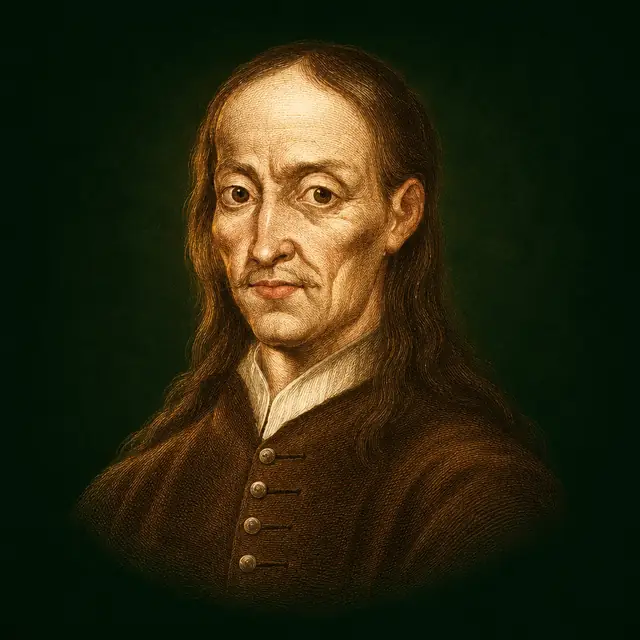
Who was Jakob Böhme, and what is truly known of them?
What is known
German shoemaker and religious writer, born at Alt Seidenberg near Görlitz. He set up as a master shoemaker in Görlitz in 1599. In 1600, his first biographer says, sunlight caught on a pewter dish opened to him a sight into the ground of things, and after twelve years he wrote it down in Aurora, which he left unfinished. A copy reached the chief pastor, Gregor Richter, who denounced him from the pulpit, and in 1613 the town council took the manuscript and forbade him to write. He kept silence for some five years, then wrote about thirty works, among them The Three Principles, The Signature of All Things and Mysterium Magnum, borrowing the language of Paracelsus and the alchemists for the inner life. Only The Way to Christ was printed in his lifetime, in 1624, the year he died.
The teaching
Taught from his own books, above all Aurora, The Three Principles, The Signature of All Things and The Way to Christ.
The Unground
Böhme begins before the beginning. Before any nature or creature God is the Unground, the groundless: an eternal nothing, without place, time or ground, a will with nothing yet to will. That will longs to find and know itself, and so it makes a mirror in which to see itself, the eye of eternity, which is the divine Wisdom. From this longing, which he calls a hunger or a desire, eternal nature is born within God, and all that follows is God becoming manifest to himself.
Yes and No
All things stand in Yes and No. The Yes is pure power and life, the truth of God; the No is its counter-stroke, set against it so that it can be known. Without the No the Yes would be still and could never be felt or revealed, as there would be no light without something for it to shine upon and no joy without something it overcomes. Contrariety is not evil in itself; it is the way anything at all becomes manifest. Evil begins when the No sets itself up on its own, apart from the Yes.
The seven spirits of nature
Eternal nature works in seven qualities, which he calls the source spirits. The first is a harsh desire that draws in and contracts, and makes dark, hard and cold. The second is the bitter sting of motion that pulls against the first. The third is anguish, the turning wheel in which the two drive each other round. The fourth is fire, the flash in which the darkness breaks and the light breaks out: the turning point of all. The fifth is light, which is love, a gentle fire that gives instead of taking. The sixth is sound, or tone, in which everything speaks and is understood. The seventh is essence, or body, in which all the others take form and dwell together.
The first three make the dark world, the last three the world of light, and fire stands between them, burning as wrath on the one side and shining as love on the other. In Aurora he names the seven somewhat differently, but the movement from contraction through fire to light and form is the same.
The three principles
From these come three principles. The first is the dark fire, the world of wrath, which belongs to God as the burning ground of his nature. The second is the world of light, God's love, which shines in that fire as the Son is born of the Father. The third is the outward world we see, brought forth from the other two as their outward image, in which light and darkness, good and evil, are mixed.
A human being has all three in himself and is free to turn his will toward the light or toward the dark. Lucifer wanted to rule in the fire without the light, and fell into the dark fire he had chosen.
The signature of all things
The whole outward world is a sign of the inward one. Every thing shows its inner nature in its outward form, its colour, smell, taste and sound, as a lute shows its tune when it is struck; the spirit within is the player and the form is the instrument. So a thing can be known by its signature, and a person by voice, bearing and speech. Adam before the fall named every creature in the language of nature, by its inner being, and Böhme takes the physicians' old teaching of signatures in plants and turns it to the reading of the soul.
Sophia
Sophia, the Wisdom of God, is a noble virgin, the mirror in which God beholds his wonders. Adam was made in her likeness, whole, neither only man nor only woman, with the virgin in him. When he turned his desire to the outward world he fell into a deep sleep, the woman was made from him, and he lost the virgin. Christ brings her back: in the soul that turns and is born anew the noble Sophia draws near, and the soul is betrothed to her.
The inward alchemy
He borrows the language of Paracelsus and the alchemists for the new birth. The soul is the matter of the work. The old Adam must first go down into darkness and death, as the alchemists' matter blackens and rots in the vessel; then the fire tries and purifies it, and the tincture of Christ, the true philosopher's stone, turns its lead to gold. The new self grows out of the old like a lily from the earth, and he speaks of a time of the lily to come, when that new birth flowers in many.
Resignation
The way is repentance and resignation. The soul turns its will from itself, sinks it into the mercy of God, and gives up its own willing altogether, so that God may will in it. In a dialogue in The Way to Christ a disciple asks his master how he may come to see God and hear him speak. If you can throw yourself, the master answers, even for a moment, into that where no creature dwells, you hear what God speaks: stand still from your own thinking and willing, stop the wheel of the imagination and the senses, and the eternal hearing, seeing and speaking are opened in you.
Heaven and hell are not far places. They are in the soul, according to which way its will is turned.
Genesis in every soul
His Mysterium Magnum reads Genesis as the inward story of every soul. Cain and Abel are the self-will and the yielded will in each person; the Tower of Babel is reason trying to climb to heaven by its own power; and the roads of the patriarchs are stages of the new birth. Scripture read in this way is not only a history of the past but a mirror held up to the reader.
Orders and memberships
No order. He was a Lutheran layman and a member of the shoemakers’ guild of Görlitz, and he took the sacrament on his deathbed after being questioned on his faith. Rosicrucian and Masonic writers later claimed him; his readers in England were called Behmenists.
The legend
That a stranger came into the shop where he was an apprentice, called him by name and foretold what he would become: the story is his first biographer’s. That Newton took the law of gravity from him, which William Law asserted and no paper of Newton’s bears out.
Their works
- AuroraBook, written 1612
His first book, left unfinished, writing down what he had seen in 1600 into the ground of things: God, nature and man, the fall of Lucifer and the strife of light and darkness. A copy reached the chief pastor of Görlitz, who denounced him, and the town council forbade him to write.
Ask the Oracle about it - The Way to ChristBook, printed 1624
A group of short treatises on repentance, prayer and the new birth, the only one of his books printed while he lived. Its printing renewed the pastor’s attack in the year of his death.
Ask the Oracle about it - The Signature of All ThingsBook, 1622
A treatise on how every created thing shows its inner nature in its outward form, borrowing the teaching of signatures and the language of the alchemists for the birth of God in the soul.
Ask the Oracle about it - Mysterium MagnumBook, 1623
A long commentary on Genesis, reading the creation, the fall and the stories of the patriarchs as the inner history of every soul. It is the largest of his works.
Ask the Oracle about it - The Three Principles of the Divine EssenceBook, 1619
The first book he wrote after his years of silence, on the dark fire, the light and the outward world, the three principles from which he held all things to arise. Its English translation by John Sparrow helped to make the Behmenists of England.
Ask the Oracle about it
How the house tells a life
This life is told from the record, with what is documented, what is legend and what was forged kept apart. A membership in an order is stated only where documents show it. A person’s chart explains none of their deeds.
The arts it feeds
Lives near it in time
Thinkers and teachers
John of the CrossTycho BraheGiordano BrunoFrancis BaconTommaso CampanellaJohannes KeplerAthanasius KircherRobert BoyleEmanuel SwedenborgThe Baal Shem TovBenjamin FranklinGeorge WashingtonThe whole tree

