
George Washington
1732 to 1799
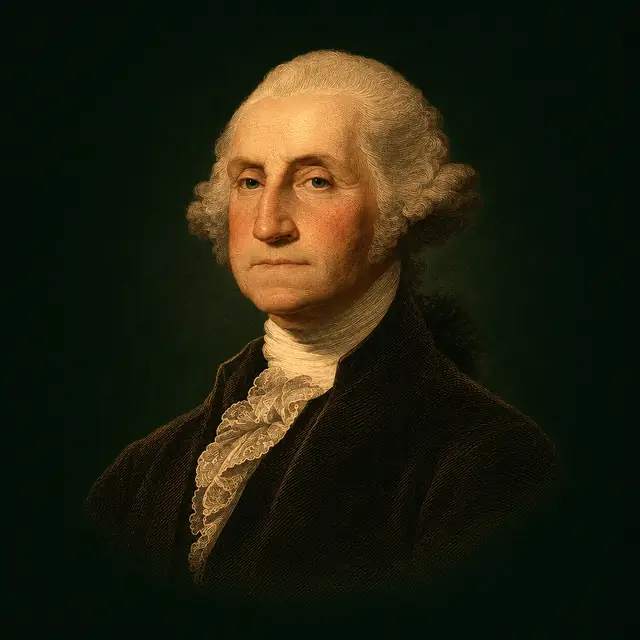
Who was George Washington, and what is truly known of them?
What is known
Virginian planter and surveyor, commander of the Continental Army from 1775 to 1783, president of the Constitutional Convention in 1787 and first President of the United States from 1789 to 1797. On 18 September 1793 he laid the cornerstone of the Capitol in a Masonic ceremony, wearing an apron. In a letter of 1798 to a clergyman who feared the Illuminati, he wrote that he did not believe the lodges of America were touched by their doctrines, and that he had himself been in a lodge only once or twice in thirty years. He died at Mount Vernon in December 1799 and was buried with Masonic rites.
The teaching
Taught from the Rules of Civility he copied as a boy, his letters and addresses, and the rites of his lodge.
The rules of civility
Washington taught no doctrine; he kept a rule. As a boy he copied out a hundred and ten rules of conduct in company, and they describe the man he made of himself. Every action done in company ought to be done with some sign of respect to those present. Sleep not when others speak, and sit not when others stand. Show no gladness at the misfortune of another, though he were your enemy. Speak no evil of the absent, for it is unjust. Undertake nothing you cannot perform, and be careful to keep your promise. Let your recreations be manful, not sinful. The last rule is the one that lasted: labour to keep alive in your breast that little spark of celestial fire called conscience.
The square and the cornerstone
In the craft Washington practised what the lodge teaches: to act by the square, to meet on the level and to walk upright. That teaching is given in full in the branch on the Freemasons, among the orders and mystery schools. The rite by which he laid the cornerstone of the Capitol shows it in use. The stone is tried with the square, the level and the plumb and found true, and it is consecrated with corn, wine and oil, the wages of the craftsmen in the old story, as emblems of plenty, refreshment and joy, with a prayer that the building may stand and serve the good of those who use it.
Doctrines and lodges
When a clergyman sent him a book warning that the Illuminati were working through the American lodges, Washington drew a distinction and kept to it. He did not doubt, he wrote in his second letter, that the doctrines of the Illuminati and the principles of the Jacobins had spread in the country. What he did not believe was that the lodges, as societies, had set out to spread them; that some individual Masons might have done so, he allowed. The rule he drew is to judge a society by what it does and teaches as a body, and not by the opinions of some of its members.
Under his own vine and fig tree
To the Jews of Newport he set out the rule of a free country in the words of the prophet Micah: that everyone shall sit in safety under his own vine and fig tree, and there shall be none to make him afraid. Toleration, he wrote, is no longer to be spoken of as the indulgence of one class of people towards another, as though it were a favour. Liberty of conscience is a natural right that all possess alike, and the government asks only that those who live under its protection behave as good citizens.
Faith, party and the union
In his Farewell Address he warns his people against supposing that morality can long be kept without religion, and against the spirit of party, which he calls the worst enemy of popular government, because it sets citizens against one another and opens the door to foreign influence. A free people, he holds, should cherish its union as the main pillar of its liberty, and keep good faith and justice towards all nations.
Orders and memberships
A Freemason on the record: initiated on 4 November 1752 in the lodge at Fredericksburg, Virginia, and raised a Master Mason on 4 August 1753. In 1788 he was named first Master of the lodge at Alexandria under its Virginia charter. No other order is documented.
The legend
That the capital’s streets hide Masonic figures, and that the eye and pyramid on the dollar are his lodge’s mark. The street plan is Pierre L’Enfant’s; the reverse of the seal was designed in 1782 by men not known to be Masons, and reached the dollar bill only in 1935.
What was forged, or is false
“Washington’s Vision”, an angel showing him the future of the Union at Valley Forge. It was first printed in 1861 by the journalist Charles Wesley Alexander, who wrote such pieces under the name Wesley Bradshaw; nothing from Washington’s lifetime mentions it.
Their works
- Farewell AddressLetters, 1796
His public letter to the American people at the end of his presidency, warning against faction, sectional strife and lasting foreign alliances, and calling religion and morality the props of a free government.
Ask the Oracle about it - Letters to G. W. SnyderLetters, 1798
His replies to a clergyman who feared the Illuminati were working through the American lodges. He wrote that he did not believe they were, and that he had been in a lodge only once or twice in thirty years.
Ask the Oracle about it - Letter to the Hebrew Congregation in NewportLetters, 1790
His letter to the Jews of Newport, Rhode Island, promising a government that gives to bigotry no sanction and to persecution no assistance, the first such pledge from an American president.
Ask the Oracle about it - Rules of CivilityTeaching, about 1744
One hundred and ten rules of good manners copied out in his school book as a boy, from an English version of a French Jesuit list. They show the upbringing of a Virginian gentleman.
Copied by him, not written by him.
Ask the Oracle about it - DiariesDiary, 1748 to 1799
The diaries he kept on and off for fifty years, mostly of weather, crops, travels and visitors, with a few lines on great events. They show the planter and surveyor behind the legend.
Ask the Oracle about it
How the house tells a life
This life is told from the record, with what is documented, what is legend and what was forged kept apart. A membership in an order is stated only where documents show it. A person’s chart explains none of their deeds.
The arts it feeds
Lives near it in time
Thinkers and teachers
Jakob BöhmeAthanasius KircherRobert BoyleEmanuel SwedenborgThe Baal Shem TovBenjamin FranklinThomas PaineAugustin BarruelCharles-François DupuisLouis-Claude de Saint-MartinJohann Wolfgang von GoetheWolfgang Amadeus MozartThe whole tree

