
Johann Wolfgang von Goethe
1749 to 1832
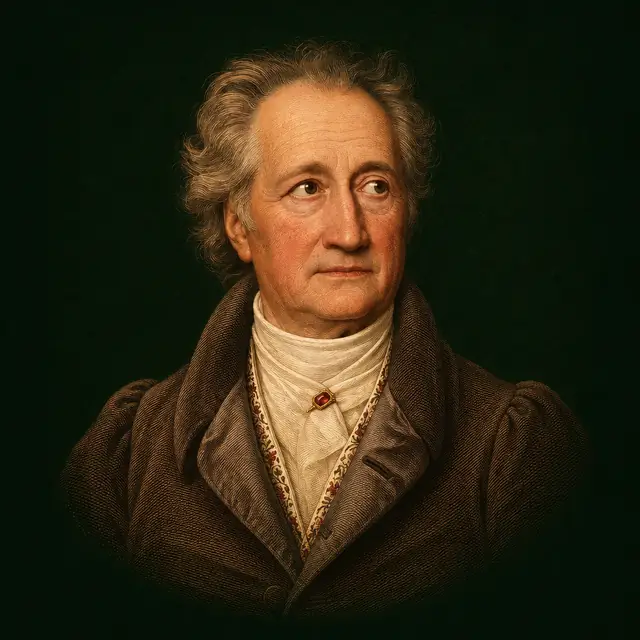
Who was Johann Wolfgang von Goethe, and what is truly known of them?
What is known
German poet, playwright, statesman and student of nature, born at Frankfurt. Ill at home in 1768 and 1769, he read Paracelsus, Basil Valentine and other alchemical and Hermetic books with a family friend, Susanna von Klettenberg, and set up a small furnace. From 1775 he lived at Weimar as a minister of the duke. He worked on Faust for sixty years: Part One was printed in 1808 and Part Two after his death in 1832. He also wrote on the metamorphosis of plants (1790), a Theory of Colours (1810) against Newton, and a symbolic Fairy Tale of the green snake and the lily (1795). His autobiography opens with the positions of the planets at his birth.
The teaching
Taught from his own works, above all Faust, The Metamorphosis of Plants, the Theory of Colours and the Fairy Tale.
Faust, briefly
Faust is Goethe's great teaching play, and its story, from the wager in heaven to the angels who carry off its hero's immortal part, is told whole in the branch on Faust, among Forbidden knowledge. Its lesson can be given in two of its own sayings: that a human being errs as long as he strives, and that whoever strives with constant effort can be redeemed. The scholar is lost only if he ever lies down content. What follows is the rest of Goethe's teaching, which he gave as a student of nature as much as a poet.
The leaf
In The Metamorphosis of Plants he teaches that every part of a flowering plant is one organ changed. The seed leaves, the leaves of the stem, the sepals of the cup, the petals, the stamens, the pistil and the fruit are all the leaf, drawn out or drawn together, thinned or thickened, as the plant rises from the ground to its flower. The plant works by alternation: it expands in the leaves of the stem, contracts in the cup, expands again in the petals, contracts in the stamens and pistil, swells in the fruit and gathers itself at last into the seed, from which it begins again.
From this came his thought of the archetypal plant, the Urpflanze: not one plant to be found in a garden but the form behind them all, with which, he wrote, one could go on inventing plants without end that would be consistent, plants that could exist even if they do not. To study a living thing is to watch one form unfold through its changes, not to sort finished parts into boxes.
Polarity and intensification
Goethe names the two great driving wheels of all nature: polarity and intensification. Polarity is the pull and push of opposites that belong together: the plant's contraction and expansion, breathing in and breathing out, light and darkness, attraction and repulsion. Nothing in nature stands still, and each of its movements calls up its answer. Intensification is the rising of a thing to higher forms through those movements, as the leaf rises to the petal and the petal to the flower. Polarity belongs to matter as we think of it materially, intensification to matter as we think of it spiritually, and the two together make the life of nature.
Light, darkness and the turbid medium
His Theory of Colours begins from what the eye sees, not from a prism in a darkened room. Colours, he writes, are the deeds of light, its deeds and sufferings. They arise where light and darkness meet through what he calls a turbid medium, anything half clear, such as air, mist, smoke or clouded glass. Light seen through a turbid medium turns yellow, and as the medium thickens, orange and red, which is why the Sun reddens as it sinks through the haze. Darkness seen through a lit turbid medium turns blue, which is why the sky is blue and far mountains look blue, and as the medium thins the blue deepens towards violet.
Yellow and blue are thus the first pair of colours, one on the side of light and one on the side of darkness. Mixed, they make green, in which the eye rests. Raised by intensification, each towards the end of the other, they meet in the deepest red, the purple he holds highest of all, which joins the two.
The eye and its demands
The eye, for Goethe, is no passive window. It is sunlike, he says after Plotinus, or it could never see the sun. And it demands wholeness. Look long at a red patch and then at a white wall, and a green one appears: the eye calls up the colour opposite to the one it has been given. From these demands he draws his circle of colours, with yellow, orange and red on the side of light and warmth, blue and violet on the side of shade and cold, and green and purple where the two sides meet, each colour standing across from the one it calls for.
The two sides also work on feeling. The warm colours quicken and gladden; the cool ones draw the mind into longing and stillness. A painter who knows this can set a mood as a musician sets a key.
The phenomenon is the teaching
His method is as much his teaching as his findings. Seek nothing behind the phenomena, he says; they themselves are the teaching. The student does not leap from one striking case to a theory but sets the experiments in a series, each beside its neighbour, until the primal phenomenon appears, the simplest case in which the thing shows itself, as light and darkness meet in the turbid medium. Beyond that there is nothing to explain, only more to see. He calls this a delicate empiricism, which makes itself one with its object by long and loving attention, and he holds that the student is changed by it: every object, well looked at, opens a new organ in us.
The tale of the green snake
His symbolic tale tells of a land divided by a river. Two will-o'-the-wisps, who shed gold whenever they shake themselves, are ferried across by an old ferryman, who may take no gold for the river and is paid in fruits of the earth instead. A green snake swallows the gold they scatter and begins to shine, and by her light she finds under the earth a temple with four kings: one of gold, one of silver, one of bronze, and one cast of all three mixed. An old man comes there with a lamp whose light turns stones to gold, and when the snake tells him a secret he cries that the time is at hand. Across the river lives the beautiful Lily, whose touch kills whatever lives and brings the dead to life, and the young prince who loves her and is wasting away for her falls dead at her touch.
At midnight the snake gives herself up. Her body becomes a bridge of jewels across the river; the temple moves beneath the river and rises up into the light, and the ferryman's hut, turned to silver, stands within it. The three kings give the prince their gifts: the bronze king a sword, the silver king a sceptre with the charge to feed the sheep, and the golden king a crown of oak leaves with the charge to know the highest, while the mixed king sinks into a shapeless heap. The prince, alive again, is joined with Lily, and the people stream across the bridge, which from that day is never empty.
Goethe never explained it. The tale gives its one key in the old man's words: three rule upon the earth, wisdom, appearance and power; love does not rule, but it forms, and that is more.
Die and become
Two short poems carry the rest of his teaching. In The Sorcerer's Apprentice the pupil, left alone, speaks his master's spell and sets a broom to fetch water, and cannot stop it: the spirits that I called, he cries, I cannot now be rid of, until the old master returns and sends them back, for only the master may call them up, and only for his own purpose. And in Blessed Longing, in the West-Eastern Divan, the moth that flies into the candle flame is praised for wanting to die into a higher life: as long as you do not have this, die and become, you are only a gloomy guest on the dark earth.
Orders and memberships
A Freemason on the record: received in the Weimar lodge Anna Amalia of the Three Roses on 23 June 1780 and made a Master in 1782. He joined the Illuminati in 1783 under the name Abaris. Both are documented. He was never a Rosicrucian, though he left an unfinished poem about a brotherhood of the rose and cross.
The legend
That Faust and the Fairy Tale are coded rites of initiation, a reading Rudolf Steiner did much to spread when he named his centre the Goetheanum. That his last words, “More light”, were a mystic’s farewell: by the nearest report he was asking for a shutter to be opened.
Their works
- Faust, Part OnePlay, 1808
The scholar who has studied every faculty and turns to magic, summons the Earth Spirit and makes his wager with Mephistopheles. Goethe worked on it from his youth, and it draws on the chapbooks of Doctor Faustus and on the alchemical reading of his own early years. It is the most famous work in the German language.
Ask the Oracle about it - Faust, Part TwoPlay, printed 1832
Finished just before his death and printed after it, a vast second part in which Faust passes through an imperial court, classical Greece and a final redemption. It holds the alchemist Wagner making the little man Homunculus in a flask, and a Walpurgis Night of the ancient gods.
Ask the Oracle about it - The Fairy Tale of the Green Snake and the Beautiful LilyTale, 1795
A symbolic tale that closes his Conversations of German Emigrants, in which a snake gives herself to become a bridge and a temple rises from under a river. Goethe never explained it. Rudolf Steiner read it as a rite of initiation, which is his reading and not Goethe’s.
Ask the Oracle about it - The Metamorphosis of PlantsEssay, 1790
A short work arguing that the parts of a flowering plant are changed forms of one organ, the leaf. It is his best regarded work as a student of nature, and its way of seeing one form unfold through many was taken up by later thinkers on nature and spirit.
Ask the Oracle about it - Theory of ColoursBook, 1810
His long study of colour as it is seen, written against Newton’s optics. Physicists do not accept its attack on Newton, but its account of how colours appear to the eye and act on feeling has been valued by painters and philosophers since.
Ask the Oracle about it - The MysteriesPoem, 1784 to 1785
An unfinished poem in which a young monk finds a brotherhood of knights in a house marked with a cross wreathed in roses. Goethe left it as a fragment, and it is the nearest he came to writing of Rosicrucians, though he was never one.
Ask the Oracle about it - The Sorcerer’s ApprenticePoem, 1797
The ballad of a pupil who speaks a spell to make a broom fetch water and does not know the word that stops it. He took the plot from Lucian, and it became a proverb for any power that runs ahead of its user.
Ask the Oracle about it - Poetry and TruthBook, 1811 to 1833
His autobiography of his early years, which opens with the positions of the planets at his birth. It tells of his illness at home and of the alchemical and Hermetic books he read then with Susanna von Klettenberg.
Ask the Oracle about it
How the house tells a life
This life is told from the record, with what is documented, what is legend and what was forged kept apart. A membership in an order is stated only where documents show it. A person’s chart explains none of their deeds.
The arts it feeds
AlchemyForbidden knowledgeOrders and mystery schoolsThe Hermetic principles
Lives near it in time
Thinkers and teachers
Benjamin FranklinGeorge WashingtonThomas PaineAugustin BarruelCharles-François DupuisLouis-Claude de Saint-MartinWolfgang Amadeus MozartWilliam BlakeGodfrey HigginsRobert TaylorPhineas QuimbyRalph Waldo EmersonThe whole tree

