
Ralph Waldo Emerson
1803 to 1882
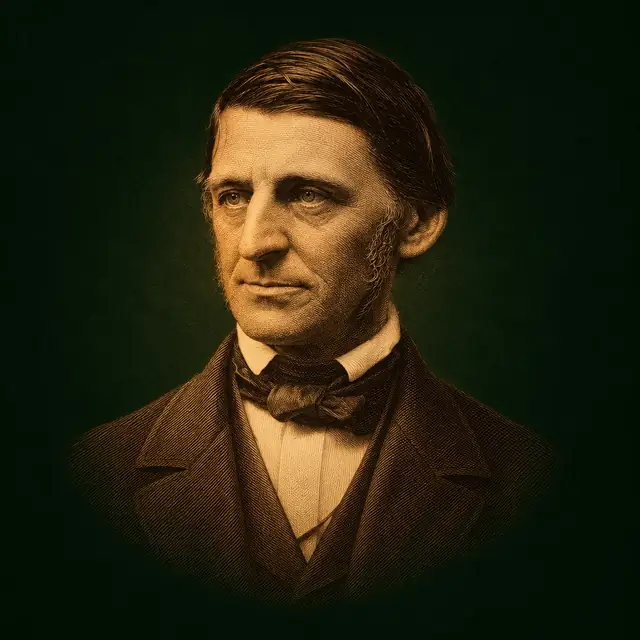
Who was Ralph Waldo Emerson, and what is truly known of them?
What is known
American essayist and lecturer, born in Boston. He was ordained a Unitarian minister in 1829 and resigned his pulpit in 1832, unable in conscience to administer communion. Nature (1836) and the address to the Harvard Divinity School in 1838 set out what was soon called Transcendentalism: that the divine is met directly, in nature and in the self, and not at second hand. The first series of Essays (1841) holds “Self-Reliance” and “The Over-Soul”; a second series followed in 1844. He read the Hindu scriptures in the translations of his day, and lived at Concord, Massachusetts, where he died.
The teaching
Taught from his own essays and addresses, above all Nature (1836), Self-Reliance and The Over-Soul (1841).
An original relation to the universe
Emerson's teaching opens with a complaint and a demand. Our age is retrospective, he writes at the start of Nature: it builds the sepulchres of the fathers, and the generations before beheld God and nature face to face, while we see them through their eyes. Why should not we also enjoy an original relation to the universe, a poetry and philosophy of insight and not of tradition, and a religion by revelation to us, and not the history of theirs? The sun shines today also. The whole of his work answers that question: the divine is met at first hand, in nature and in the self, by anyone who will look.
The transparent eyeball
He tells plainly the experience at the root of it. Crossing a bare common at twilight, under a clouded sky, with no special good fortune in his thoughts, he felt a perfect exhilaration, and in the woods he found it again. Standing on the bare ground, his head bathed by the blithe air and uplifted into infinite space, all mean egotism vanishes. I become a transparent eyeball, he writes; I am nothing; I see all; the currents of the Universal Being circulate through me; I am part or particle of God.
Nature met in this way is not a heap of things but a presence. The lover of nature, he says, is the one whose inward and outward senses are still truly adjusted to each other, who has kept the spirit of infancy into the years of manhood.
Nature is the symbol of spirit
Nature serves the soul in rising degrees: as commodity, feeding and sheltering us; as beauty, delighting us; as language; and as discipline, training the understanding and the conscience. Of language he gives three rules. Words are signs of natural facts. Particular natural facts are symbols of particular spiritual facts. And nature is the symbol of spirit. Right first meant straight and wrong meant twisted; spirit first meant wind; a lamb is innocence, a snake is subtle spite, and light and darkness are our speech for knowledge and ignorance. The world is emblematic, and to read it is to read the mind that made it.
Trust thyself
Self-Reliance turns the same faith inward. To believe your own thought, to believe that what is true for you in your private heart is true for all, that is genius. Trust thyself: every heart vibrates to that iron string. Whoso would be a man must be a nonconformist, for nothing is at last sacred but the integrity of your own mind. A foolish consistency is the hobgoblin of little minds: speak what you think now in hard words, and tomorrow speak what tomorrow thinks in hard words again, though it contradict everything you said today.
The self he trusts is not the small and wanting self. It is what he calls the aboriginal Self, on which a universal reliance may be grounded, the deep force through which all things are present to us. To rely on it is to rely on God, and when a person lives with God, he writes, his voice shall be as sweet as the murmur of the brook and the rustle of the corn.
The Over-Soul
Within every person is the soul of the whole. We live in succession, in division, in parts, in particles, Emerson writes; meantime within man is the soul of the whole, the wise silence, the universal beauty, to which every part and particle is equally related, the eternal One. He calls it the Over-Soul, within which every person's particular being is contained and made one with all others. Its coming into the mind is revelation, an influx of the divine mind into ours, and it comes not by straining after it but when we stop obstructing it, for the soul's communication of truth is the highest event in nature.
It is known by its effects. It makes us humble and simple; it speaks through the character more than through words; and before it the distinctions of learning, rank and creed fall away, so that the simplest person who in his integrity worships God, he says boldly, becomes God.
Compensation
Every act, Emerson holds, rewards and punishes itself. Polarity, action and reaction, runs through every part of nature, in darkness and light, heat and cold, the ebb and flow of waters, and the same law runs through the moral world. Every excess causes a defect, and every defect an excess; for everything you have missed you have gained something else, and for everything you gain you lose something. Crime carries its punishment within it and virtue its reward, not in a later reckoning but in the very doing, for the soul is altered by what it does. The dice of God, he writes, are always loaded.
Religion at first hand
To the young ministers at Harvard he gave the same teaching for the churches. The religious sentiment, the sense that the moral law is real and binds us, is the essence of all religion, and it cannot be received at second hand; it is an intuition. Historical Christianity, he told them, has dwelt with noxious exaggeration about the person of Jesus, whereas the soul knows no persons. His charge was to go alone, to refuse the good models, even those most sacred in the imagination of men, and dare to love God without mediator or veil.
Brahma
His poem Brahma speaks in the voice of the One beyond all opposites. If the red slayer think he slays, or if the slain think he is slain, they know not well the subtle ways I keep, and pass, and turn again. Far or forgot to me is near; shadow and sunlight are the same; the vanished gods to me appear; and one to me are shame and fame. The poem, drawn from the Bhagavad Gita and the Upanishads he read in translation, ends with the turn of all true seeking: find me, and turn thy back on heaven.
Experience
The later essays add the shadow. In Experience, written after the death of his small son, he finds that even grief slides off and teaches little: I grieve that grief can teach me nothing, he writes. Life is a train of moods like a string of beads, and as we pass through them they prove to be many-coloured lenses which paint the world their own hue. Dream delivers us to dream, and there is no end to illusion.
Yet the counsel is not despair but patience: to live in the present hour, to do the work at hand, and to trust the deeper life of the soul beneath the moods, for the true romance which the world exists to realise, he ends, is the transformation of genius into practical power.
Orders and memberships
No order is documented. The “Transcendental Club” that met from 1836 was an open circle of friends with no rites or oaths, and no lodge record names him.
The legend
That he founded New Thought or taught a law of attraction. Its writers quoted him freely, but the movement formed after his death and he belonged to nothing of the kind.
What was forged, or is false
Several sayings passed round under his name are not in his works. The lines on what it is “to have succeeded” come from a piece by Bessie Anderson Stanley of 1905, and the sentence about what lies behind us and before us has been traced to a book of 1940 by another hand.
Their works
- NatureEssay, 1836
His first book, a short essay arguing that the divine is met directly in nature and in the self. It became the first statement of Transcendentalism and shaped a long line of American seekers.
Ask the Oracle about it - The Divinity School AddressLecture, 1838
His address to the graduating class of the Harvard Divinity School, urging them to seek religion at first hand rather than through tradition. It caused a scandal, and he was not invited to speak at Harvard again for nearly thirty years.
Ask the Oracle about it - Essays: First SeriesEssay, 1841
The book that holds Self-Reliance, Compensation and The Over-Soul, his picture of one mind shared by all people. Writers of New Thought later quoted these essays freely, though he belonged to no such movement.
Ask the Oracle about it - Essays: Second SeriesEssay, 1844
His second book of essays, among them The Poet and Experience, written after the death of his young son Waldo. It turns from the confidence of the first series to a more searching tone.
Ask the Oracle about it - Representative MenLectures, 1850
Lectures on six great figures, among them Plato, Swedenborg as the mystic, Montaigne and Shakespeare. The lecture on Swedenborg weighs the visionary with admiration and with doubt.
Ask the Oracle about it - BrahmaPoem, 1857
A short poem in the first number of The Atlantic Monthly, spoken in the voice of the Hindu godhead and drawn from his reading of the Bhagavad Gita and the Upanishads. Many readers were puzzled by it in its day.
Ask the Oracle about it
How the house tells a life
This life is told from the record, with what is documented, what is legend and what was forged kept apart. A membership in an order is stated only where documents show it. A person’s chart explains none of their deeds.
The arts it feeds
Lives near it in time
Thinkers and teachers
Johann Wolfgang von GoetheWolfgang Amadeus MozartWilliam BlakeGodfrey HigginsRobert TaylorPhineas QuimbyGiuseppe MazziniGerald MasseyLahiri MahasayaRamakrishnaWilliam JamesFrederic MyersThe whole tree

