
Robert Taylor
1784 to 1844
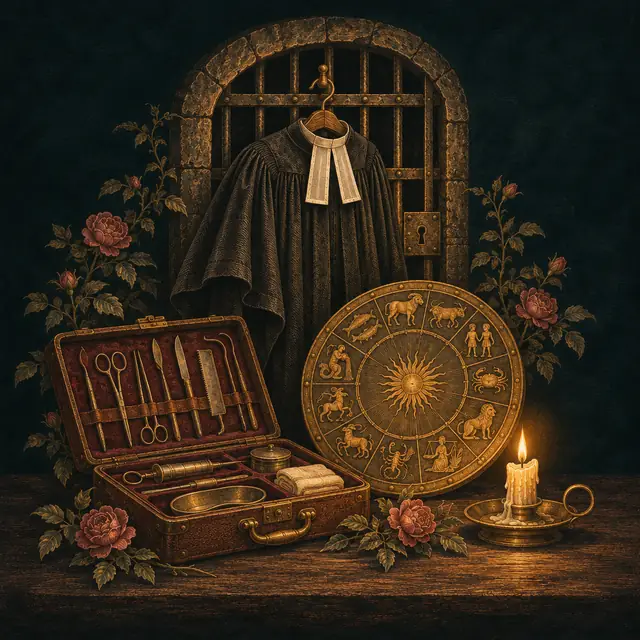
Who was Robert Taylor, the Devil’s Chaplain, and what is truly known of him?
What is known
English clergyman turned freethinker. Trained first as a surgeon, he took a Cambridge degree in 1813 and was ordained in the Church of England, then gave up his belief and by 1824 was lecturing in London against Christianity. He was jailed for blasphemy in 1828 and again in 1831. In Oakham Gaol he wrote the Syntagma and The Diegesis (1829), which argue that the Gospels were drawn from older pagan and Egyptian sun worship. In 1829 he toured with the publisher Richard Carlile, and his sermons at the Rotunda in London were printed as The Devil’s Pulpit; they read the Bible’s stories as the Sun’s passage through the zodiac. The radical Henry Hunt gave him the name “the Devil’s Chaplain”. He died at Tours in 1844.
The teaching
Taught from his own books and sermons, above all The Diegesis (1829) and The Devil's Pulpit (1831).
A gospel before the Gospels
Taylor's central claim is that Christianity is older than Christ. Everything the Gospels tell, he argues, was told before in the mysteries of Egypt and the East: a god born of a virgin, a teacher with his chosen band, a death and a rising, a sacred meal. The Gospels are not the record of a life but the books of an earlier mystery, turned into history by people who no longer understood them, and the evidence offered for that history is, in his judgement, weak: late books, of uncertain authors, telling of wonders no outside witness records.
The record answers him in part: the letters of Paul, written in the fifties of the first century, already speak of Christ crucified, and the Roman historian Tacitus records his execution under Pontius Pilate.
The Therapeutae
In The Diegesis he names the authors he believes in. Philo of Alexandria describes the Therapeutae, a community of ascetics by Lake Mareotis in Egypt who lived in prayer, read their scriptures as allegory and kept vigils with hymns and sacred meals. Eusebius, the church historian, took Philo's account for a picture of the first Christians. Taylor takes Eusebius at his word and turns the claim round: if these Egyptian monks were the first Christians, they were there before Christ, and the Gospels are their mystery books, written in Egypt and brought out into the world as the life of a man.
Philo's own account shows a Jewish community, and the plain record does not support the turn.
The Bible read as the sky
The Devil's Pulpit reads the stories of the Bible one by one as the Sun's passage through the year. The twelve sons of Jacob and the twelve apostles are the twelve signs; the virgin mother is the Virgin of the zodiac; and John, whose feast falls at midsummer, says of Jesus, whose feast falls at midwinter, that he must increase and I must decrease, as the days do from each solstice. Each sermon takes a familiar text, a parable, a miracle or a saint's story, and shows its hearers what Taylor believes to be the calendar beneath it.
The Devil as the darkness
His sermons on the Devil read the adversary of the Bible as the darkness and the winter, the power that takes the Sun's place in the lower half of the year, and the serpent of Eden as the Serpent among the stars, rising as the year falls. Good and evil, God and the Devil, are the light and dark halves of the year made into persons, and the war in heaven is the yearly struggle of the long nights against the long days.
The lodge as an allegory of the Sun
With Richard Carlile he read Freemasonry from outside in the same way. The lodge is the world, its Master in the east is the rising Sun, and the legend of Hiram is the Sun's year: the master builder struck down by three ruffians is the Sun struck down as the year declines into winter, buried and mourned, and raised again in the spring. The craft, in their reading, keeps the old worship of the Sun without knowing it, and its secrets are astronomy in costume.
Reason against the pulpit
Taylor's aim, like that of Dupuis before him, is freedom from the churches. He preached from a pulpit, in the forms of a church service, so as to turn its own texts against it, and he told his hearers to judge every claim by evidence and reason and to take no doctrine on authority. His readings are taught here as his own. The system they belong to, and the answers to it, are given in the branches on what astrotheology claims and on its authors, among The sky in the scriptures.
Orders and memberships
No order is documented. With Richard Carlile he lectured on Freemasonry from outside, reading its rites as an allegory of the Sun, and Carlile printed an exposure of the grades.
The legend
That he showed the Gospels to be star lore and nothing more. His word derivations are not accepted by scholars of language, and historians and biblical scholars do not accept that the Gospels are myth alone. Later astrotheology repeats many of his readings, often without his name.
Their works
- The DiegesisBook, 1829
Written in Oakham Gaol, where he was held for blasphemy, a long argument that the Gospels were drawn from older pagan and Egyptian sun worship. Scholars do not accept it, and later astrotheology repeats many of its readings, often without his name.
Ask the Oracle about it - Syntagma of the Evidences of the Christian ReligionBook, 1828
His answer to the defenders of Christianity, written in prison, arguing that the evidence for the Gospels is weak. It belongs to the same years of prison and lecturing as The Diegesis.
Ask the Oracle about it - The Devil’s PulpitSermons, 1831
His sermons given at the Rotunda in London in 1830 and 1831, printed weekly. They read the stories of the Bible as the Sun’s passage through the zodiac, and they earned him the name the Devil’s Chaplain and a second prison sentence.
Ask the Oracle about it
How the house tells a life
This life is told from the record, with what is documented, what is legend and what was forged kept apart. A membership in an order is stated only where documents show it. A person’s chart explains none of their deeds.
The arts it feeds
Lives near it in time
Thinkers and teachers
Charles-François DupuisLouis-Claude de Saint-MartinJohann Wolfgang von GoetheWolfgang Amadeus MozartWilliam BlakeGodfrey HigginsPhineas QuimbyRalph Waldo EmersonGiuseppe MazziniGerald MasseyLahiri MahasayaRamakrishnaThe whole tree

