
Giuseppe Mazzini
1805 to 1872
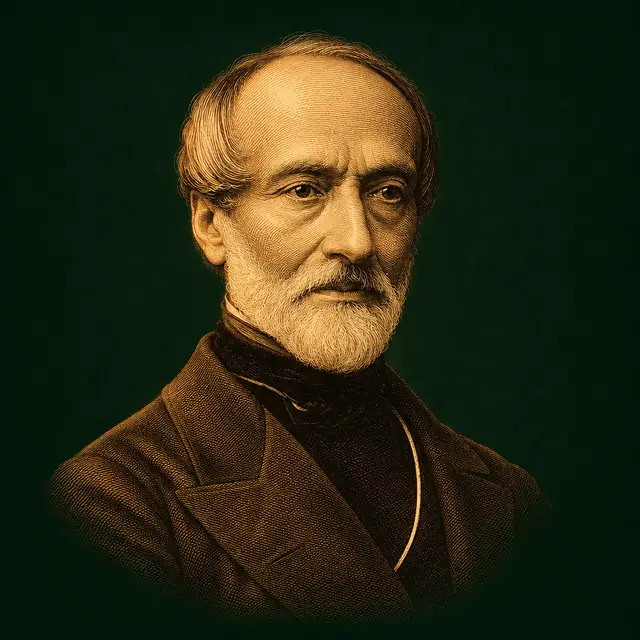
Who was Giuseppe Mazzini, and what is truly known of them?
What is known
Italian patriot and writer, born in Genoa. He joined the Carbonari, the secret revolutionary society of his day, in 1827, was betrayed and imprisoned at Savona in 1830, and went into exile. At Marseille in 1831 he founded Young Italy, a society sworn to a united republic, and in 1834 Young Europe. He lived for most of his life in London, was one of the three who governed the short-lived Roman Republic of 1849, and died at Pisa under an assumed name.
The teaching
Taught from his own writings, above all The Duties of Man (1860) and Faith and the Future (1835).
God and the people
Mazzini's politics is a religion. Its watchwords are his own: God and the people, and thought and action. There is one God, the author of the moral law, and the people, humanity gathered into nations, is the means by which that law is worked out on earth. A political movement without that faith, he holds, is a quarrel of interests; with it, it is a duty.
Duties before rights
The Duties of Man is addressed to the working men of Italy, and its first lesson is that rights are not enough. The great revolution of the century before, he argues, preached the rights of the individual, and on rights alone the strong grew stronger and each person was left to fend for himself. A right is the fruit of a duty done. So he teaches the duties in their order: to humanity first, since all people are children of one God; then to one's country; then to the family; and then to oneself, to grow in mind and conscience so as to serve the rest.
The law of progress
God's law, for Mazzini, is the law of progress. Humanity is one collective being that lives and learns through the ages, and each age is given a part of the law to understand and carry out. A person learns what the law asks by two lights together: his own conscience, and the tradition of humanity, the common agreement of the peoples across history. Where the two agree there is truth; conscience alone may err, and tradition alone may harden. Revelation is never closed, for it goes on through the whole life of humanity.
The country as a workshop
A country, in this teaching, is not a piece of ground but a mission. God divided humanity into peoples so that each might do its part of the common work, and a person's country is his workshop, the field from which his labour goes out to the good of the whole earth. Without a country, he tells the workers, they are soldiers without a banner; but a country that oppresses another betrays its own reason for being. Italy's mission, as he saw it, was to rise as a free and united people and to open, after the Rome of the emperors and the Rome of the popes, a third Rome, the Rome of the people.
Association and equality
The way forward is association, not competition and not hatred between classes. Workers should join their savings and their labour in free associations, uniting capital and labour in the same hands, so that the wage, which keeps them dependent, gives way to a share in what they make. He asks for an education given by the nation to all, and for the equality of women: woman is the equal of man, his companion in the family and in the duties of the country, and a cause that leaves her out is unjust.
Education and insurrection
The rules of Young Italy set out how the faith is to be served. The society was to state its aims openly, as the old secret societies had not: a united, independent and republican Italy. Its means were two, to be used together and kept in harmony: education, to teach the people their duties and their rights, and insurrection, when the time came, made by the people themselves and not by a foreign power. A member was to teach by example, to live already as the free citizen he hoped to make, and to set the cause above himself.
A Europe of peoples
Young Europe carried the same faith across borders. Its pact, signed by exiles from Italy, Germany and Poland, takes for its watchwords liberty, equality and humanity: every people free to form its own nation, and all the nations bound together as brothers under one law of humanity. He looked for a Europe in which the peoples, each having found itself, would join in a common work, and he warned that a nation which won its freedom only to dominate others would have understood nothing of its own cause.
Orders and memberships
The Carbonari, documented from 1827, and the societies he founded himself. Whether he was ever initiated a Freemason is disputed: Italian lodges honoured him and claim him, and no record of an initiation has been produced.
The legend
That he directed the Illuminati after Weishaupt, or founded the Mafia, whose name is said to hide his initials. The Bavarian order was suppressed twenty years before his birth, and the word mafia is Sicilian and has no such origin.
What was forged, or is false
The letter Albert Pike is said to have sent him in 1871 planning three world wars. No such letter exists in any archive; the text appears only in the twentieth century, and it grew out of the hoax of Léo Taxil.
Their works
- The Duties of ManEssay, 1860
His best known work, addressed to Italian working men, teaching that duties to God, humanity, country and family come before rights. It was read widely across Europe and in India.
Ask the Oracle about it - Faith and the FutureEssay, 1835
A statement of his religious politics, written in exile in Switzerland, holding that the peoples of Europe have a mission given by God. It gave his movement its tone of faith.
Ask the Oracle about it - General Instructions for the Members of Young ItalyRules, 1831
The founding rules of the society he formed at Marseille, sworn to a united and republican Italy. Unlike the Carbonari it was meant to state its aims openly and to educate as well as plot.
Ask the Oracle about it - The Pact of Young EuropeRules, 1834
The pact signed at Berne by exiles from Italy, Germany and Poland, joining their national movements in one brotherhood of free peoples. It shows his hope for a Europe of nations rather than of kings.
Ask the Oracle about it
How the house tells a life
This life is told from the record, with what is documented, what is legend and what was forged kept apart. A membership in an order is stated only where documents show it. A person’s chart explains none of their deeds.
The arts it feeds
Orders and mystery schoolsConspiracies, examinedPower and influence
Lives near it in time
Thinkers and teachers
Wolfgang Amadeus MozartWilliam BlakeGodfrey HigginsRobert TaylorPhineas QuimbyRalph Waldo EmersonGerald MasseyLahiri MahasayaRamakrishnaWilliam JamesFrederic MyersFriedrich NietzscheThe whole tree

