
Friedrich Nietzsche
1844 to 1900
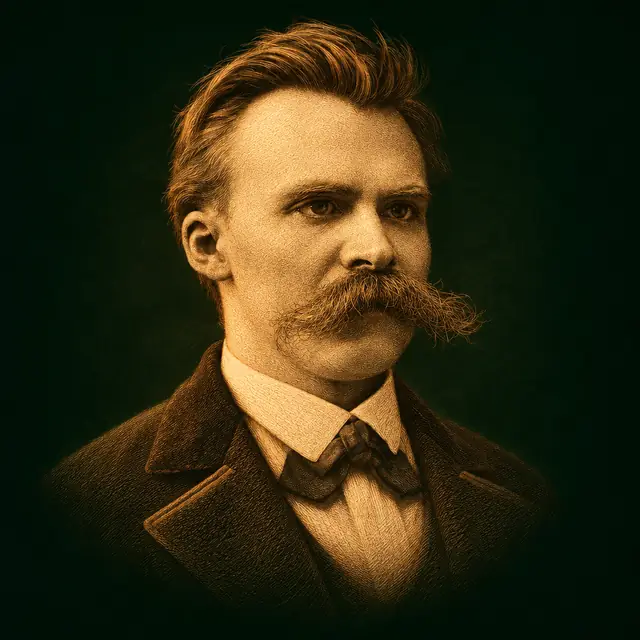
Who was Friedrich Nietzsche, and what is truly known of them?
What is known
German philosopher, professor of classical philology at Basel at twenty-four, who left the university in 1879 for his health and wrote his major books in ten wandering years: The Gay Science, Thus Spoke Zarathustra, Beyond Good and Evil, On the Genealogy of Morality. He collapsed in Turin in January 1889 and never recovered his mind. “God is dead” is his diagnosis of his age, not a cry of triumph; the Übermensch is a person who creates their own values, not a race.
The teaching
Taught from his own books, above all The Birth of Tragedy, The Gay Science, Thus Spoke Zarathustra and the Genealogy.
The will to power, briefly
Nietzsche teaches that life itself is will to power, a drive to grow, to overcome and to give form, and that its highest form is not rule over others but mastery of oneself; that values are made, not found; that the Übermensch, the overman, is the human being who creates new values and stays true to the earth; and that the strongest yes a person can say is to will their own life again, just as it is, without end. That core, from the tablets of the peoples to the love of fate, is taught in the branch on the will to power, among Power and influence. What follows is the rest of his teaching.
Apollo and Dionysus
His first book reads Greek tragedy as the meeting of two powers of art, named for two gods. Apollo is the god of form, measure and the clear image, of dream, in which the world appears as beautiful shapes, each bounded and distinct. Dionysus is the god of intoxication and the dance, in which the bounds of the self break down and a person is swept into the oneness of nature, its joy and its terror together. Apollo gives the individual; Dionysus dissolves it. Tragedy is born when the Dionysian chorus, singing the sufferings of the god, is given Apollonian form on the stage, so that the spectator can look into the abyss of existence and not be destroyed.
Only as an aesthetic phenomenon, he writes, are existence and the world eternally justified. The Greeks in his reading were not serene because life was easy for them but because they suffered deeply and made art of it, and Socrates, with his faith that reason can understand and correct being, marks the end of that tragic wisdom.
God is dead
In The Gay Science a madman runs into the market place with a lantern in the bright morning, crying that he seeks God, and the unbelievers there laugh at him. Where is God, he cries; we have killed him, you and I. Who gave us the sponge to wipe away the whole horizon? What were we doing when we unchained this earth from its sun? Are we not straying as through an infinite nothing? Then he falls silent: he has come too early, and the deed is still more distant from them than the most distant stars, though they have done it themselves.
The parable is his diagnosis of his age. Belief in the Christian God has become unbelievable, and with it falls the ground of the morality built on it, though most have not yet noticed. The danger he sees is nihilism, the sense that nothing has any value at all; the task he sets is to create values that stand on their own, with no world beyond to lean on.
The camel, the lion and the child
Zarathustra's first speech names three changes of the spirit. First the spirit becomes a camel, the bearer that kneels to be loaded with the heaviest burdens, the duties and reverences it has been taught, and hurries with them into the desert. There it becomes a lion, which wants to seize its freedom and be lord in its own desert, and it fights the great dragon whose every scale glitters with the words thou shalt; against it the lion says I will. The lion can win the freedom for new creation, but it cannot create. For that the spirit must become a child: innocence and forgetting, a new beginning, a game, a wheel rolling of itself, a holy yes.
The last man
Against the overman Zarathustra sets his opposite, the last man, the most contemptible thing he can show the crowd. We have discovered happiness, say the last men, and they blink. They want comfort, a little pleasure for the day and a little for the night, neither poverty nor riches, neither ruling nor obeying, for all of it is too much trouble. Everyone wants the same, everyone is the same, and whoever feels otherwise goes of his own accord into the madhouse. The crowd, hearing him, cries out to Zarathustra to give them this last man and keep his overman. The danger Nietzsche fears is not that humanity will grow cruel but that it will grow small.
Perspectives
There is only a perspective seeing, he teaches, only a perspective knowing. No one sees from nowhere: every eye looks from a place and with an interest, and the more eyes, different eyes, we can bring to bear on one thing, the more complete our idea of it will be. To ask for a pure knowing, an eye turned in no direction, is to ask for an absurdity. The free spirit is the one who can change perspectives at will and knows that his own is one among many.
From the same thought comes his fable of how the true world finally became a fable. The world beyond, first held by the wise, then promised to the pious, then only thought of, then of no use, is at last abolished, and with it, he adds, the merely apparent world as well, so that this world is left standing in its own right.
The ascetic ideal
The third essay of the Genealogy asks what ascetic ideals mean: the denial of the body, the senses and the world that so many religions and philosophies have praised. His answer is that they mean almost everything. To the suffering they give suffering a meaning, and a meaning, even one turned against life, is better than none. The ascetic priest is the physician of the sick, who soothes pain by changing its direction: someone must be to blame for my suffering, thinks the sufferer, and the priest answers that he himself is that someone. Nietzsche asks his readers not to despise the ascetic but to see what the ideal does, and whether they need it.
Masks and the hammer
Everything that is profound loves the mask, he writes; every deep spirit needs one, because the shallow will misread whatever it says. His own books are written in masks, aphorisms, songs and parables, and he asks to be read slowly, as a good philologist reads, with doors left open. He philosophises with a hammer, used as a tuning fork, sounding the idols of the age to hear whether they ring hollow. And out of life's school of war comes his saying that what does not destroy me makes me stronger: a rule for the one who must overcome his own sickness, not a praise of harm.
Orders and memberships
He belonged to no order, broke with Richard Wagner, and wrote with contempt of antisemites and of German nationalism.
The legend
That he embraced a beaten horse in the street as he collapsed: the story appears only years later.
What was forged, or is false
The Will to Power is not a book he wrote. His sister Elisabeth, who controlled his papers and later courted the Nazis, had it assembled from his notebooks after his collapse. The Nazi use of his name leaned on that editing and on her promotion of him.
Their works
- Thus Spoke ZarathustraBook, 1883 to 1885
A book of speeches in the voice of a prophet named after the founder of the Persian religion, teaching the Übermensch and the eternal return. The Übermensch is a person who creates their own values, not a race. Many esoteric writers have read it, often against its meaning.
Ask the Oracle about it - The Birth of TragedyBook, 1872
His first book, reading Greek tragedy as the meeting of two powers, the Apollonian and the Dionysian. Its picture of the rites of Dionysus has shaped how the mysteries are imagined.
Ask the Oracle about it - The Gay ScienceBook, 1882
A book of aphorisms and poems in which the madman announces that God is dead, a diagnosis of his age rather than a cry of triumph. Here the thought of the eternal return first appears.
Ask the Oracle about it - Beyond Good and EvilBook, 1886
A prelude to a philosophy of the future, questioning the hidden assumptions of philosophers and of morality. It holds his remarks on masks and on the free spirit.
Ask the Oracle about it - On the Genealogy of MoralityBook, 1887
Three essays on how ideas of good and evil, guilt and the ascetic ideal came to be. It is his most closely argued book. It traces the ascetic ideal, the priest and the bad conscience, and it has been much read by students of religion.
Ask the Oracle about it - Ecce HomoBook, printed 1908
His own account of his life and books, written in the autumn of 1888, weeks before his collapse in Turin. It was held back by his sister and printed twenty years later.
Ask the Oracle about it - The Will to PowerCollection, 1901 and 1906
A book assembled from his notebooks after his collapse by his sister Elisabeth, who controlled his papers and later courted the Nazis. The Nazi use of his name leaned on that editing.
Not a book he wrote: its order and selection are his sister’s.
Ask the Oracle about it
How the house tells a life
This life is told from the record, with what is documented, what is legend and what was forged kept apart. A membership in an order is stated only where documents show it. A person’s chart explains none of their deeds.
The arts it feeds
Lives near it in time
Thinkers and teachers
Giuseppe MazziniGerald MasseyLahiri MahasayaRamakrishnaWilliam JamesFrederic MyersSri YukteswarNikola TeslaÉmile CouéArthur Conan DoyleWallace WattlesWilliam Walker AtkinsonThe whole tree

