
William James
1842 to 1910
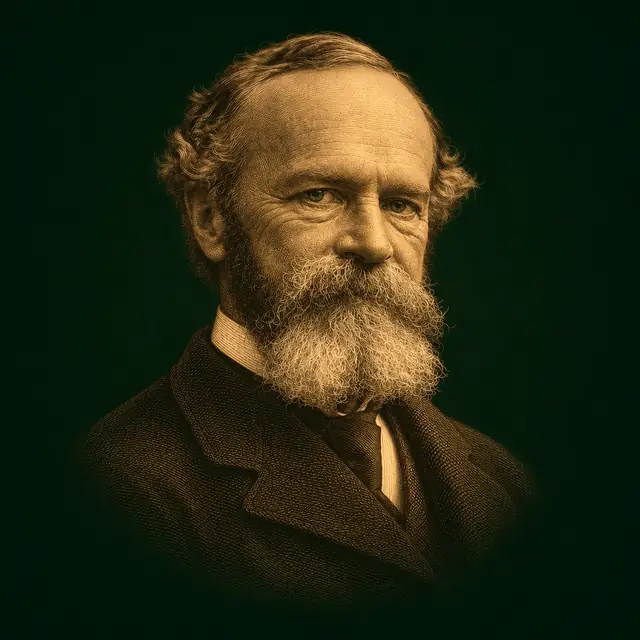
Who was William James, and what is truly known of them?
What is known
American philosopher and psychologist, brother of the novelist Henry James. He took a medical degree at Harvard in 1869 and taught there for over thirty years. The Principles of Psychology (1890) helped to found the subject in America, and The Varieties of Religious Experience (1902), given as lectures at Edinburgh, treated conversion, prayer and mystical states as facts of human life, to be described and weighed by their fruits. From 1885 he studied the Boston trance medium Leonora Piper. He judged that she knew things she could not have learned in the ordinary way, and he never concluded that the dead spoke through her.
The teaching
Taught from his own books, above all The Varieties of Religious Experience (1902) and The Will to Believe (1897).
Religion as experience
William James studies religion where it is lived. For his lectures he defines it as the feelings, acts and experiences of individual men in their solitude, so far as they apprehend themselves to stand in relation to whatever they may consider the divine. Churches, theologies and rites come after; first-hand experience is the root, and it is best studied in its extreme cases, the saints, mystics and converts in whom it burns strongest. He judges it not by where it comes from but by what it does: by their fruits ye shall know them, not by their roots. Its tests are immediate luminousness, philosophical reasonableness and moral helpfulness.
The once-born and the twice-born
Temperaments divide. The healthy-minded, the once-born, see the world as good and look away from evil; their religion is gladness, and the mind-cure movement of his day is one of its forms. The sick soul cannot look away. It feels the evil at the heart of things, the vanity of success and the fear beneath pleasure, and it needs to be born a second time. Its self is divided, and conversion is the process, gradual or sudden, by which a self hitherto divided, and consciously wrong, inferior and unhappy, becomes unified and consciously right, superior and happy, through its firmer hold on religious realities.
In conversion, ideas that stood at the edge of a person's mind move to its hot centre and become the habitual centre of his personal energy. Often the change comes when striving stops and the person surrenders, and the work finishes itself below the threshold of awareness.
The fruits of saintliness
Saintliness has the same marks in every creed. The saint feels a wider life than this world's selfish little interests, and a friendly continuity with an ideal power; an immense elation and freedom as the outlines of the confining self melt down; and a shift of the emotional centre towards loving and harmonious affections. Its practical fruits are asceticism, strength of soul, purity and charity. James weighs them honestly. Carried to excess, devotion becomes fanaticism, purity a shrinking from the world and austerity self-torment, and these he does not praise; but taken as a whole he finds the saints' way of life justified by its fruits.
Four marks of the mystical
Mystical states have four marks. They are ineffable: they defy expression and must be experienced to be known. They are noetic: they feel like states of knowledge, insights into depths of truth unplumbed by the discursive intellect. They are transient: half an hour, or at most an hour or two, is their usual limit before they fade into the light of common day. And they are passive: though they may be prepared for, by fixing the attention or by other practices, when they come the subject feels his own will in abeyance, as if grasped and held by a superior power.
Our normal waking consciousness, he concludes, is but one special type of consciousness, whilst all about it, parted from it by the filmiest of screens, there lie potential forms of consciousness entirely different. No account of the universe in its totality can be final which leaves them disregarded.
What the mystic may claim
He draws three conclusions. Mystical states, when well developed, usually are, and have the right to be, absolutely authoritative over the individuals to whom they come. No authority goes out from them that should make it a duty for those who stand outside them to accept their revelations uncritically. And they break down the authority of the non-mystical or rationalistic consciousness, based on the understanding and the senses alone, by showing it to be only one kind of consciousness, and so they open out the possibility of other orders of truth.
The more
At the end of the lectures he names what all religions share: an uneasiness and its solution. The uneasiness is a sense that there is something wrong about us as we naturally stand; the solution is a sense that we are saved from the wrongness by making proper connection with the higher powers. The person who finds it becomes conscious that his higher part is continuous with a more of the same quality, which is operative in the universe outside him and which he can keep in working touch with.
On its hither side, James suggests, the more is the subconscious continuation of our conscious life. On its farther side it goes where each faith's over-beliefs carry it, and a person's over-beliefs, honestly held, are often the most interesting and valuable things about him.
The will to believe
Where evidence cannot decide, a person may rightly choose. An option is genuine when it is living, both sides being real possibilities for us; forced, with no way to stand aside; and momentous, the chance unique and the stakes high. Faced with such an option on a question the intellect cannot settle, our passional nature not only lawfully may but must decide, for to refuse to choose is itself a choice, with the same risk of losing the truth. Against the rule that it is wrong always, everywhere and for anyone to believe anything on insufficient evidence, he sets his own: on such questions the risk of error is better than the loss of the truth.
The stream and the habit
Two teachings of his psychology reach furthest. Consciousness does not appear to itself chopped up in bits; it is nothing jointed, it flows, and a river or a stream is the metaphor by which it is most naturally described: the stream of thought. And habit is the enormous flywheel of society, which keeps each person in his groove, and its law can be put to work. Launch every new habit with as strong and decided an initiative as possible; never suffer an exception until it is securely rooted; seize the very first chance to act on every resolution; and keep the faculty of effort alive by a little needless exercise every day.
Trees joined at the roots
His long inquiry into mediums ended, as he said, where it began in theory, but it left him an image. We with our lives are like islands in the sea, or like trees in the forest, separate on the surface and joined beneath, for the trees commingle their roots in the darkness underground. There is, he suggests, a continuum of cosmic consciousness, against which our individuality builds but accidental fences, and into which our several minds plunge as into a mother sea.
In his lecture on immortality he gives the reason it may be so. The brain may not produce thought, as a kettle produces steam, but transmit it, as coloured glass or a prism transmits light, so that the death of the brain need not be the end of the mind. He offers this as a possibility left open, not as a proof.
Orders and memberships
He helped to found the American Society for Psychical Research in the mid 1880s and was president of the British Society for Psychical Research in 1894 and 1895. Both were open learned societies. No lodge or secret order is documented.
The legend
That he proved life after death, or was converted to Spiritualism. In his last paper on the subject, in 1909, he wrote that after twenty-five years of inquiry he was in theory no further on than at the start. Messages said to come from him after 1910 were published by several mediums and by the writer Jane Roberts; they are their authors’ work.
What was forged, or is false
The sentence about the greatest discovery of his generation being that people can change their lives by changing their attitudes of mind. It is printed under his name everywhere and has not been found in anything he wrote.
Their works
- The Varieties of Religious ExperienceLectures, 1902
His Gifford Lectures at Edinburgh, treating conversion, prayer, saintliness and mystical states as facts of human life to be weighed by their fruits. It remains the founding book of the study of religious experience.
Ask the Oracle about it - The Principles of PsychologyBook, 1890
His great textbook, twelve years in the writing, which helped to found the subject in America. It holds his account of the stream of thought and of habit and the self.
Ask the Oracle about it - The Will to BelieveEssay, 1897
An essay and the book named after it, arguing that where evidence cannot decide, a person may rightly choose to believe. The book also holds his paper on what psychical research had shown.
Ask the Oracle about it - Human ImmortalityLectures, 1898
His Ingersoll Lecture at Harvard, arguing that the dependence of thought on the brain does not rule out a life after death. He left the question open. The lecture series was founded for that very question, and his was among its best known lectures.
Ask the Oracle about it - The Final Impressions of a Psychical ResearcherEssay, 1909
His last paper on the subject, written after twenty-five years of inquiry, in which he wrote that in theory he was no further on than at the start. It is the plainest statement of where he stood.
Ask the Oracle about it
How the house tells a life
This life is told from the record, with what is documented, what is legend and what was forged kept apart. A membership in an order is stated only where documents show it. A person’s chart explains none of their deeds.
The arts it feeds
Lives near it in time
Thinkers and teachers
Phineas QuimbyRalph Waldo EmersonGiuseppe MazziniGerald MasseyLahiri MahasayaRamakrishnaFrederic MyersFriedrich NietzscheSri YukteswarNikola TeslaÉmile CouéArthur Conan DoyleThe whole tree

