
Émile Coué
1857 to 1926
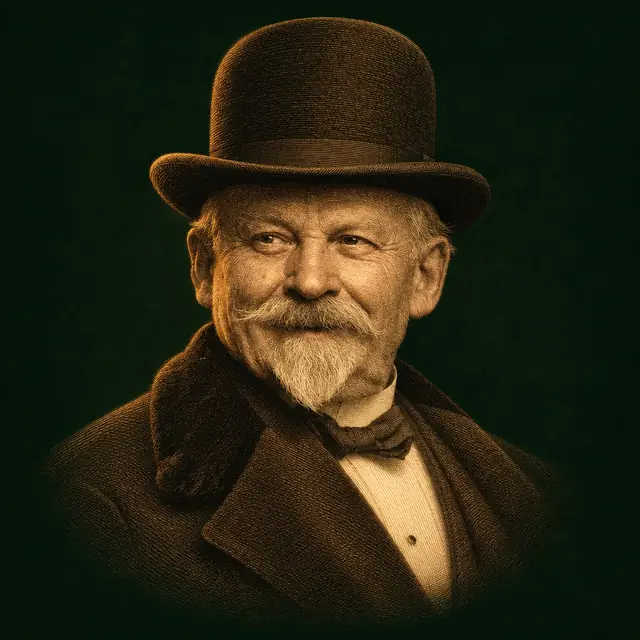
Who was Émile Coué, and what is truly known of them?
What is known
French pharmacist, who kept a shop at Troyes from 1882 to 1910. He noticed that customers did better when he praised a remedy as he handed it over, studied hypnotism at Nancy under Liébeault and Bernheim, and then gave up hypnosis for what he called conscious autosuggestion. From 1910 he held free sessions at Nancy, where patients were taught to repeat, twenty times each morning and night and counting on a knotted string, that every day in every way they were getting better and better. His short book on self-mastery was read across Europe and America, and he lectured in Britain in 1921 and in the United States in 1923.
The teaching
Taught from his book Self Mastery Through Conscious Autosuggestion, with the notes of his sessions at Nancy.
The formula, in short
Coué's four laws of the will and the imagination, his sentence said twenty times on waking and on going to bed while counting knots on a string, and the limits he set on it, are taught in full in the branch The words you repeat of Imagination and intention. Their core is that when the will and the imagination are at odds, the imagination always wins, so it is the imagination that must be trained. What follows is the rest of his method as he taught it at Nancy.
The two selves
Each person, he teaches, has a conscious self and an unconscious self. The conscious self has an unreliable memory; the unconscious has a marvellous memory that records the smallest events of a life, and it is credulous, accepting with unreasoning docility whatever it is told. Through the brain it runs every organ of the body, so that if it believes an organ works well or badly, the organ does. It also presides over all our actions, and this is what he calls the imagination. The sleepwalker who rises in the night and finishes the work he left undone shows it at work without the conscious self knowing.
Most of the ills we suffer by our own doing, he holds, come from bad autosuggestions made unconsciously: the person who tells themselves they cannot sleep, cannot remember, cannot cope. The cure is to make good autosuggestions consciously, and above all without effort, since effort means the will, and the will set against the imagination only strengthens what it fights.
The four experiments
Before giving any suggestion he shows the subject the power of the imagination in their own body, with four experiments he took from Sage of Rochester. In the first the subject stands stiff as an iron bar, feet together, ankles loose as hinges, and lets themselves fall back into the operator's arms like a plank tipped on its base. In the second the subject thinks of nothing but the words I am falling backwards, with the operator's fist at the nape of the neck and a hand on the forehead, which are slowly drawn away; the subject sways back and falls, and if they stop themselves it is because they thought instead that they might be hurt. The operator stands braced behind, one leg well back, so that no one falls to the ground. In the third the same is done forwards.
In the fourth the subject clasps the hands as tightly as possible and thinks I cannot do it while trying to pull them apart: the harder they try, the tighter the fingers lock, until they are told to think I can do it, and the hands open. The lesson is the whole method in small: it is not the operator's suggestion that acts but the subject's own autosuggestion that follows it.
The session
Once the experiments are understood, the subject sits and closes their eyes, not to be put to sleep, which he gave up because it frightened people, but so that nothing in the room distracts them. The operator then speaks in a monotonous, soothing voice a series of general suggestions: that the person feels hungry at mealtimes, chews food to a soft paste and digests it well; that they sleep deeply and calmly; that they gain confidence; and that whatever is reasonable, and whatever is their duty, is easy. The suggestions for their own particular trouble follow, then a closing word on good health of body and mind.
The one who gives the suggestions, he says, is not a master who gives orders, but a friend, a guide, who leads the patient step by step. He told those who came that suggestion did not prevent them from going on with their usual treatment, and he held that it is the method, not the person, that acts.
It is passing
For any discomfort of body or mind during the day or night, his rule is this. Affirm to yourself that you are not going to add to it consciously and that you are going to make it go; then withdraw as far as you can, pass your hand over your forehead if the trouble is mental, or over the painful place if it is physical, and repeat very quickly, moving the lips, it is going, it is going, for as long as is needed. In French the words are ça passe. He says that with a little practice the discomfort goes in some twenty or twenty-five seconds. He gives it for passing troubles; pain that is severe, lasting or new is a matter for a doctor.
The children
Parents, he teaches, can use the method for their children. When the child is asleep, one of them enters quietly, stops about a yard from the bed, and murmurs fifteen or twenty times what they wish for the child's health, work, sleep and conduct, then leaves without waking them; in sleep the conscious self rests, and the unconscious, awake and credulous, takes the words in. By day the same law forbids ever telling a child that they are lazy and good for nothing, which plants the very fault; a lazy child should be told, the first time the work is a little better, that it is much better than usual, and illness should never be talked of in front of children.
Orders and memberships
No order is documented. In 1913 he founded the Lorraine Society of Applied Psychology at Nancy, an open society, and followers opened institutes under his name in Paris, London and New York.
The legend
That the formula cures bodily disease. He claimed improvement in organic illness as well as in nerves, and kept no controlled record; later research on placebo finds that expectation can ease symptoms such as pain and does not remove disease. He is often called a doctor or a psychologist. He was a pharmacist, and he said that he healed no one and only taught people to help themselves.
Their works
- Self Mastery Through Conscious AutosuggestionBook, about 1920
His short book, first in French, setting out his method: the imagination outweighs the will, and a formula repeated morning and night while counting knots on a string can change a person’s outlook. It also gives the questions and answers of his sessions at Nancy. It was read widely in Europe and America in the early 1920s.
Ask the Oracle about it - The Practice of Autosuggestion by the Method of Emile CouéAccount, 1922
A book by C. Harry Brooks, an English visitor who watched the sessions at Nancy and described them for British readers, with a foreword by Coué. It did much to make the method known in Britain before his lecture tour there. It records the method as its followers saw it, and its cases are their reports.
Ask the Oracle about it - My MethodBook, 1923
Published in New York at the time of his American tour, with his notes on the country. It restates the method in simple terms and insists, as he always did, that he healed no one and only taught people to help themselves. Its accounts of improvement are his own and were never tested.
Ask the Oracle about it
How the house tells a life
This life is told from the record, with what is documented, what is legend and what was forged kept apart. A membership in an order is stated only where documents show it. A person’s chart explains none of their deeds.
The arts it feeds
Lives near it in time
Thinkers and teachers
RamakrishnaWilliam JamesFrederic MyersFriedrich NietzscheSri YukteswarNikola TeslaArthur Conan DoyleWallace WattlesWilliam Walker AtkinsonVivekanandaMargaret MurrayJames AllenThe whole tree

