
Arthur Conan Doyle
1859 to 1930
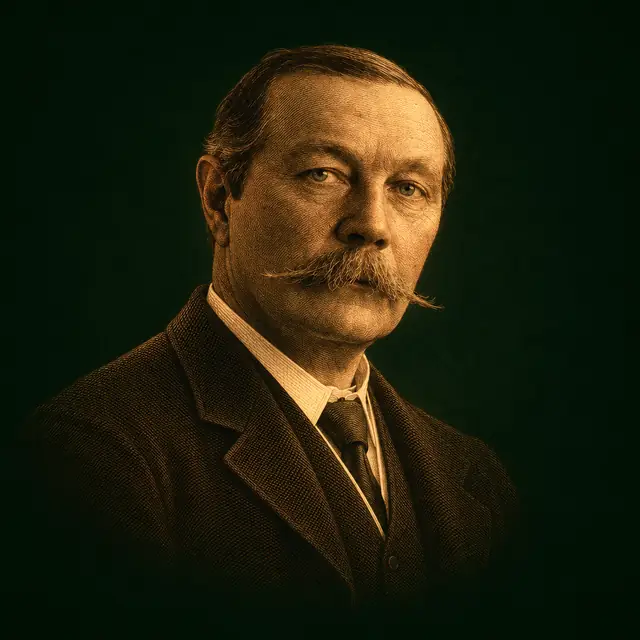
Who was Arthur Conan Doyle, and what is truly known of them?
What is known
Scottish physician and writer, born in Edinburgh, who created Sherlock Holmes in A Study in Scarlet (1887). He joined the Society for Psychical Research in 1893 and in 1916 declared in print that he accepted Spiritualism; from then until his death he gave much of his money and his time to it, lecturing in Britain, Australia and America and writing The New Revelation (1918) and a two-volume History of Spiritualism (1926). His friendship with Harry Houdini ended after a sitting at Atlantic City in 1922, when Lady Doyle produced pages of writing said to come from Houdini’s mother.
The teaching
Taught from his own books, above all The New Revelation (1918) and The Coming of the Fairies (1922).
The bell and the message
Doyle teaches that the physical phenomena of the séance room, the raps, the moving tables and the voices, matter only as a signal. A telephone bell, he says, is a childish thing in itself, but it may announce a vital message; the phenomena are bells that have rung to make the human race rouse itself and attend, and what counts is the message that follows them. He calls that message a new revelation, still in its John the Baptist stage, and it comes chiefly through automatic writing, through words spoken in trance and through voices heard at sittings. The doctrine and practice of the movement he served are taught in full in the branch Mediums and Spiritualism of The spirit realm; what follows is the revelation as he read it.
Evidence, not faith
Faith, in his teaching, is beautiful in one person and dangerous in a crowd, because one faith cannot prove itself against another and the stronger has always been tempted to persecute the weaker. It is no virtue to claim what cannot be proved. His movement, as he sees it, sets religion on facts: messages that tell true things about this world, which can be tested, deserve to be trusted about the next, which cannot, and many independent accounts that agree in details nobody expected have a claim to be believed.
The passing
The dead, by the messages he gathered, agree that dying is usually easy and painless, and is followed by a great peace. A person finds themselves in a spirit body that is the exact counterpart of the old one, without its disease, weakness or deformity, standing or floating beside the body and aware of the people in the room. At that moment the spirit is nearer to matter than it will ever be again, which is why so many apparitions are seen at the hour of death. Then familiar faces appear, the loved and lost take the newcomer's hand, and with a more radiant being as guide the spirit passes through solid walls and out into its new life. It is simply the person, with all their strength and weakness, wisdom and folly.
Before the new life begins there is a sleep, sometimes hardly any, sometimes of weeks or months; Raymond, the son of Oliver Lodge, reported six days. Doyle guesses that its length answers to the troubles brought from this life, and that a little child needs none. The spirit wakes weak, as a baby is weak after birth, and soon grows strong.
No hell, but a hospital
Hell drops out altogether: as a permanent place it does not exist, and the idea of it is an insult to the Creator. Punishment is real, since without it there would be no justice, but it purifies and it ends, nearer to purgatory than to hell. The grosser souls find themselves in lower states, knowing that their own deeds placed them there, with the hope that their expiation and the help of higher spirits will raise them. Those states are better thought of as a hospital for weak souls than as a prison, and helping them is part of the work of those above.
Like goes to like
Beyond, the reports agree, life is pleasant and full of interest and occupation, and no one wishes to return. Like goes to like, and all who love one another or share an interest are together. The spirits have bodies as solid to them as ours are to us, but beautified; there is no age, no pain, no rich and poor; they wear clothes and take nourishment. Married couples are not necessarily reunited, but love continues, freed of what spoils it here. After a time, usually shorter than a lifetime on earth, a spirit passes on to a further state, which is why most messages come from those who have died recently, and why they fade.
The home of the dead is very near, so near that we visit them in our sleep. We remember nothing of it, but the comfort carries over, which explains the quiet resignation of many who have lost those they loved; and when the forgetting slips for a moment, the dreamer wakes trailing clouds of glory, and from such moments come prophetic dreams. He gives one of his own: in 1917 he woke with the name Piave, a river in Italy, in his head, had a note of it signed and witnessed, and months later the Italian line fell back to that river and held there.
Christianity must change
Christianity, he writes, must change or perish. People have left the churches because their reason and their sense of justice cannot accept a vicarious sacrifice, or a God appeased by one; and since the long ascent of life shows no fall, the doctrines of the fall, the atonement and original sin have lost their ground. Too much has been made of Christ's death and too little of his life, tolerant, charitable, brave and open to new ideas, which is the true centre of the faith.
The guides, as he reports them, speak of many higher spirits, whom we may call angels, and above them the Christ Spirit, nearer to God but not God, whose special care is the earth and who came down to give the lesson of an ideal life. Paul's list of the gifts of the spirit, prophecy, healing, miracles and the rest, he reads as the gifts of a powerful medium, and the early Church as full of the same powers.
Fairies and vibrations
The Coming of the Fairies carries the same reasoning to nature spirits. There may be, he argues, a population on this planet as numerous as our own, living its own life and separated from us only by a difference of vibrations. We see only the colours within our spectrum, with endless vibrations unused on either side of it; beings made of a material that gave out shorter or longer vibrations would be invisible unless we could tune ourselves up to them, and that power of tuning is what makes a clairvoyant. The pictures that began the book were, by the later word of the cousins who took them, paper figures.
Orders and memberships
Made a Freemason in Phoenix Lodge No. 257 at Southsea in 1887; he left, rejoined in 1902 and resigned in 1911. A member of the Society for Psychical Research from 1893 until 1930, when he resigned in protest at a sceptical review, and of the Ghost Club. All documented.
The legend
That grief for his son Kingsley, who died in 1918, turned him to the spirits. He had made his belief public two years earlier. It is also told that the creator of Holmes weighed evidence as Holmes does; in the séance room he defended mediums whom others had caught in fraud.
What was forged, or is false
The Cottingley fairy photographs, which he published in The Strand Magazine in 1920 and defended in The Coming of the Fairies (1922). In 1983 the two cousins who had taken them as girls said that the fairies were paper cut-outs held up with hatpins, though one of them held to the end that the last picture was real.
Their works
- A Study in ScarletNovel, 1887
The first story of Sherlock Holmes and Dr Watson, printed in Beeton’s Christmas Annual. Holmes’s method of close observation and reasoning made Doyle famous and has made his later beliefs seem a puzzle to many readers. It belongs here because the man who wrote it went on to give his last years to Spiritualism.
Ask the Oracle about it - The New RevelationBook, 1918
His first book on Spiritualism, setting out why he had come to accept it after some thirty years of interest. He describes the sittings and messages that convinced him and offers the movement as a new revelation for a world in mourning after the war. It began the public campaign that filled the rest of his life.
Ask the Oracle about it - The Coming of the FairiesBook, 1922
His defence of the Cottingley photographs taken by two cousins in Yorkshire, which he had first published in The Strand Magazine in 1920. He argued that the fairies were real and printed the pictures with the reports of those who examined them. In 1983 the cousins said that the figures were cut from paper.
The photographs the book defends were confessed to be faked by the girls who took them.
Ask the Oracle about it - The History of SpiritualismBook, 1926
A history in two volumes from Swedenborg and the Fox sisters to his own day. It is written by a believer and passes lightly over the cases in which mediums were caught in fraud. It remains a useful record of the movement’s people and events as its supporters told them.
Ask the Oracle about it - The Land of MistNovel, 1926
A novel in which his Professor Challenger, the hero of The Lost World, is led through séances and psychic research until he accepts Spiritualism. It is a story with an open purpose, drawing on sittings and mediums Doyle knew. It is the one place where his fiction and his faith fully meet.
Ask the Oracle about it - The Edge of the UnknownEssays, 1930
A collection of his essays on psychic subjects, printed in the year of his death. It includes his long piece on Houdini, in which he argued that the escape artist himself had powers beyond the natural, a view Houdini always denied. It shows how firmly he held his beliefs to the end.
Ask the Oracle about it
How the house tells a life
This life is told from the record, with what is documented, what is legend and what was forged kept apart. A membership in an order is stated only where documents show it. A person’s chart explains none of their deeds.
The arts it feeds
Lives near it in time
Thinkers and teachers
William JamesFrederic MyersFriedrich NietzscheSri YukteswarNikola TeslaÉmile CouéWallace WattlesWilliam Walker AtkinsonVivekanandaMargaret MurrayJames AllenW. B. YeatsThe whole tree

