
W. B. Yeats
1865 to 1939
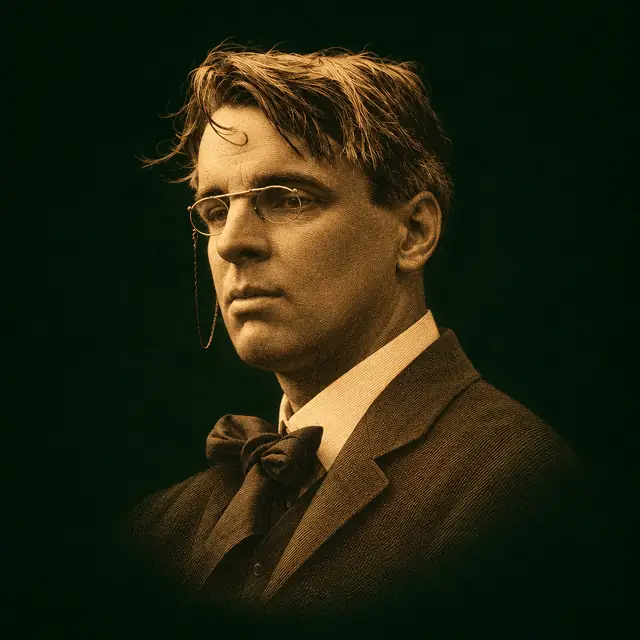
Who was W. B. Yeats, and what is truly known of them?
What is known
Irish poet and playwright, born in Dublin, a founder of the Abbey Theatre, a senator of the Irish Free State and winner of the Nobel Prize in Literature in 1923. He helped found the Dublin Hermetic Society in 1885, joined the Theosophists in London, and was initiated into the Golden Dawn in 1890; in 1900 he led the London members who turned Aleister Crowley out of the order’s rooms. In 1917 his wife Georgie began the automatic script that, over some hundreds of sittings, became his book A Vision (1925, revised 1937). He said that the study of magic stood next to poetry in his life.
The teaching
Taught from his own prose, above all the essays Magic and The Symbolism of Poetry, Per Amica Silentia Lunae (1918) and A Vision.
Three doctrines of magic
Yeats states his belief at the opening of his essay Magic: in the practice and philosophy of what we call magic, in the evocation of spirits, though he does not know what they are, and in visions of truth in the depths of the mind when the eyes are closed. And he believes in three doctrines, handed down, as he thinks, from early times, which are the foundations of nearly all magical practice. That the borders of our minds are ever shifting, and that many minds can flow into one another, as it were, and create or reveal a single mind, a single energy. That the borders of our memories are as shifting, and that our memories are a part of one great memory, the memory of Nature herself. And that this great mind and great memory can be evoked by symbols.
The rituals, grades and visions he worked in the Golden Dawn for some thirty years are taught in full in the branch The Golden Dawn of Orders and mystery schools. What is his own is what he made of them.
Symbols and the great memory
He tells of an evocation he once witnessed: an evoker of spirits with a wooden mace and a tablet of coloured squares repeated a form of words, and at once his imagination began to move of itself, bringing images with a life of their own that he could not change or shape. From years of such experiments he learned that a symbol called up its own typical scene, event or person, and hardly ever the particular one he had in mind.
Symbols act, he concludes, because the great memory associates them with certain events and moods and persons. Whatever the passions of man have gathered about becomes a symbol in the great memory, and in the hands of one who knows how to use it, it is a caller-up of angels or of devils. The poet, the musician and the artist are the successors of the masters of magic, and use the same power half unconsciously.
The trance of rhythm
In The Symbolism of Poetry he teaches that all sounds, colours and forms, by their own energies or by long association, call up emotions that cannot be defined and are yet precise. The purpose of rhythm is to prolong the moment of contemplation, the moment when we are both asleep and awake, which is the one moment of creation: it hushes us with an alluring monotony and holds us waking by variety, keeping us in that state of perhaps real trance in which the mind, freed from the pressure of the will, unfolds in symbols. As some fall into trance listening to the ticking of a watch, rhythm is that ticking made soft and various, and the patterns of the artist are the same enchantment for the eye.
The mask and the anti-self
Per Amica Silentia Lunae teaches that we make out of the quarrel with others, rhetoric, but of the quarrel with ourselves, poetry. The poet seeks not his own image but his opposite, the other self, the anti-self, which comes only to those who are no longer deceived and whose passion is reality.
From this he draws a discipline of the mask. If we cannot imagine ourselves as different from what we are and try to take on that second self, he writes in an old diary, we cannot impose a discipline on ourselves, though we may accept one from others; so active virtue, as against the passive keeping of a code, is theatrical and consciously dramatic, the wearing of a mask. St Francis and Cesare Borgia alike made themselves over by turning from the mirror to meditation on a mask.
Anima Mundi and the dead
Our daily thought is but the line of foam at the edge of a vast luminous sea, the Anima Mundi of Henry More. We carry our memory into it at death, and that memory is for a time our outer world: passionate moments recur again and again, since passion desires its own recurrence, and this is why old deeds seem to be acted over again in certain houses and fields. The toil of the living, he writes, is to free themselves from an endless sequence of objects, and that of the dead to free themselves from an endless sequence of thoughts.
He names two realities: the terrestrial, where all opposites meet and so all power and full freedom of choice are found, together with evil, which is the strain of opposites on one another; and the condition of fire, where is all music and all rest. Between them is the condition of air, where images have only a borrowed life.
The Great Wheel
A Vision, built from the script his wife began in 1917, sets every kind of human life on a wheel of twenty-eight phases of the moon. At the dark of the moon, phase one, is complete objectivity, and at the full, phase fifteen, complete subjectivity; neither is a human life, and every other phase is a type of person, more objective or more subjective, through which each soul passes in its many lives. A person at a given phase is described by four faculties: the Will, the ordinary self; the Mask, the image of what it would become; the Creative Mind; and the Body of Fate, the events forced on it from outside. Will and Mask stand opposite each other on the wheel, as do Creative Mind and Body of Fate, and a character is the tension between its opposites. When he offered to give his life to piecing the script together, the communicators answered that they had come to give him metaphors for poetry.
The gyres
History, too, turns in a pattern he draws as two cones, or gyres, interpenetrating: as one widens the other narrows, the primary, objective tide and the antithetical, subjective one taking each other's place. Each era of about two thousand years opens with an annunciation and runs through the phases of the wheel. Leda and the swan begin the age of Greece; the Annunciation to Mary begins the Christian age; and in The Second Coming that age ends, turning and turning in the widening gyre, until the falcon cannot hear the falconer and a rough beast slouches towards Bethlehem to be born. Many poems of his later years read the events of his own time by this clock.
Orders and memberships
A member of the Theosophical Society in London from 1887 and of its Esoteric Section until he was asked to resign in 1890. Initiated into the Isis-Urania Temple of the Golden Dawn on 7 March 1890; he stayed with its successor, the Stella Matutina, into the early 1920s. A member of the Ghost Club from 1911. All documented.
The legend
That spirits dictated A Vision. What is recorded is that his wife wrote and spoke the material, and that by her own later account she began by meaning to feign a sentence or two to please him. It is also told that his magic was a poet’s pose; his order papers show thirty years of regular work.
Their works
- A VisionBook, 1925
His system of history and the soul, built from the automatic script his wife Georgie began in 1917, with its gyres and its twenty eight phases of the moon. He revised it heavily for the edition of 1937. It lies behind many of his later poems.
What is recorded is that his wife wrote and spoke the material; that spirits dictated it is his and her claim.
Ask the Oracle about it - The Celtic TwilightBook, 1893
A book of Irish folk tales and stories of fairies, ghosts and seers, many gathered from country people in Sligo and Galway. It helped give its name to the Irish literary revival. It shows his early belief that Irish folk tradition kept a living sense of the unseen.
Ask the Oracle about it - Ideas of Good and EvilEssays, 1903
A collection of essays that includes Magic, his statement of belief in the power of symbols and in a great memory shared by all minds. Other essays deal with Blake, Shelley and the theatre. It is his fullest early prose on why magic mattered to his poetry.
Ask the Oracle about it - Per Amica Silentia LunaeEssays, 1918
Two linked essays on the poet’s self and its opposite, the anti self, and on the soul and the spirits. Written just before his marriage, it reads in places as a first sketch of A Vision. It is one of his most personal books of prose.
Ask the Oracle about it - The Second ComingPoem, 1920
His poem of a world coming apart at the end of an age, with its image of a widening gyre and a rough beast. It draws on the cycles of history he was then working out with his wife. It is among the most quoted poems of the twentieth century.
Ask the Oracle about it - The TowerPoem, 1928
A book of poems that includes Sailing to Byzantium and Leda and the Swan, written in the years of A Vision. Many of its poems use the gyres and phases of his system. It is often counted his finest single book.
Ask the Oracle about it
How the house tells a life
This life is told from the record, with what is documented, what is legend and what was forged kept apart. A membership in an order is stated only where documents show it. A person’s chart explains none of their deeds.
The arts it feeds
Orders and mystery schoolsThe Hermetic principlesDeath and what follows
Lives near it in time
Thinkers and teachers
Arthur Conan DoyleWallace WattlesWilliam Walker AtkinsonVivekanandaMargaret MurrayJames AllenGeorge GurdjieffCharles HaanelD. T. SuzukiWalter RussellFlorence Scovel ShinnSri AurobindoThe whole tree

