
George Gurdjieff
About 1866 to 1949; the year of his birth is disputed
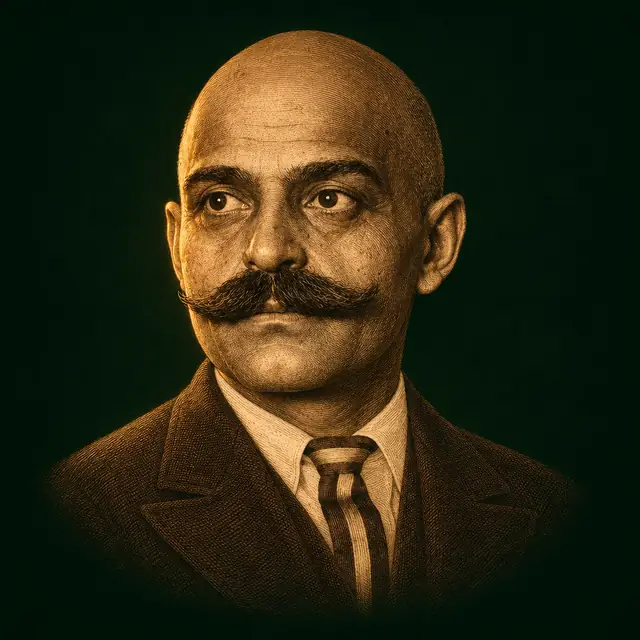
Who was George Gurdjieff, and what is truly known of them?
What is known
Teacher of Greek and Armenian parentage, born at Alexandropol in Russian Armenia, now Gyumri. He appeared in Moscow about 1912 with a teaching he called the Work: that people live mechanically, as if asleep, and can wake by long effort of attention. He left Russia in the revolution and in 1922 opened his Institute for the Harmonious Development of Man at the Prieuré near Fontainebleau, where pupils laboured, studied and learned his dances, the Movements. After a car crash in 1924 he turned to writing; Beelzebub’s Tales to His Grandson appeared in 1950. He died at Neuilly near Paris.
The teaching
Taught from Beelzebub's Tales and his other books, with his talks as Ouspensky recorded them in In Search of the Miraculous.
Asleep
Gurdjieff's teaching begins with a hard fact about ordinary people: they are asleep. The state they call waking is only another kind of sleep, in which they walk, talk and work without being present to themselves. Man is a machine: everything he does, says and thinks happens to him, set going by outside influences, and in his present state he cannot do. Nor is he one. He has no permanent I but a crowd of small I's, each calling itself I: one promises, another forgets, a third breaks the promise, and none of them is master.
He pictures a person as a carriage, a horse and a coachman. The carriage is the body, the horse the feelings, the coachman the mind, and the master who should give the orders is absent or asleep, so the coachman drives wherever the horse pulls or the passing hirer asks.
Self-remembering
The first work is to see the machine as it is, by self-observation without judging or trying to change what is seen. The second is self-remembering: to be aware of oneself in the very moment of attending to something else, so that attention points both inward and outward at once. Most of the time a person is identified, lost in a thing, a person, a mood or an argument, and so forgets themselves; much of their energy goes on considering, worrying what others think of them, and on the expression of negative emotions, which the work asks them to stop expressing. Every such effort is small and must be made again and again, and he holds that only such efforts, kept up, can wake a person.
Centres, essence and personality
The human machine has its centres: the intellectual, the emotional, the moving and the instinctive, with the sex centre, each working at its own speed and each often doing the work of another badly. There are also a higher emotional and a higher intellectual centre, fully formed but cut off from ordinary consciousness. A person whose centre of gravity is in the moving centre is man number one, in the emotional man number two, in the intellectual man number three; man number four is balanced by work on himself; man number five has a unity, a crystallised I; and the higher numbers go beyond. People are not born with a soul, in this teaching, but may make one, by long work.
Essence is what is one's own, what a person is born with; personality is what is acquired, learned, borrowed. In most people essence stops growing in childhood while personality grows over it, and the work makes personality passive so that essence can grow. Buffers are the devices that keep a person from seeing their own contradictions and so from feeling the shock that conscience would give.
The law of three and the law of seven
Every phenomenon, he teaches, arises from three forces: an active force, a passive force, and a third, neutralising force that brings them into relation, and people are blind to the third. Beelzebub's Tales calls this the sacred Triamazikamno. The second fundamental law, the Heptaparaparshinokh of the Tales, is the law of seven, the law of octaves. Any process develops like a musical scale, do, re, mi, fa, sol, la, si, do, but the vibrations slow at two places, between mi and fa and between si and do. At those intervals a line of action turns aside unless a shock enters from outside, which is why good intentions so often end in their opposite, and why a person who wants to keep a direction must know where the intervals fall.
On these laws stands the ray of creation, the world as a descending octave: the Absolute, all worlds, all suns, our sun, all planets, the earth and the moon. Each step down is under more laws, one, three, six, twelve, twenty-four, forty-eight and ninety-six, so that humanity on earth lives under forty-eight laws, and to grow is to free oneself from some of them.
The enneagram
The enneagram is a circle with nine points. A triangle joins points three, six and nine, which is the law of three; a six-pointed figure joins one, four, two, eight, five and seven, the repeating digits of one divided by seven, which is the law of seven, with the shocks entering at three and six. He taught it as a universal symbol of any process that sustains itself, which can be read only by someone who understands it, and his pupils also learned it in movement, walking its lines on the floor.
Three foods and the fourth way
The human body is a factory of three storeys fed by three foods: ordinary food, air and impressions. Impressions are the most important, and ordinarily they enter and are lost; self-remembering at the moment impressions are received is the first conscious shock, which lets their octave go on and makes finer substances in the body.
There have long been three ways: the way of the fakir, who works on the body; the monk, who works on the feelings; and the yogi, who works on the mind, each beginning with renunciation of ordinary life. The fourth way works on all three at once, in the conditions of ordinary life, with no retreat from the world, and needs a school and a teacher. His Movements, sacred dances in which the arms, legs and head follow separate patterns while the attention holds them all together, are a practice of this way, since no one can do them while asleep in themselves.
Kundabuffer and conscious labour
Beelzebub's Tales tells the same truth as a myth. Early in the life of humanity, the higher powers set in human beings an organ called Kundabuffer, which made them see reality upside down and take pleasure in what they saw, so that they would not perceive why they existed and refuse their part in the order of the cosmos. The organ was later removed, but its consequences had crystallised in human nature as vanity, self-love, envy and the rest. Of all the sacred impulses only conscience survives, buried in the subconscious, and the messenger Ashiata Shiemash taught people to build their lives on it.
The way out is conscious labour and intentional suffering, and the five strivings of a true being: to have what is really necessary for the body; to feel a constant need for self-perfection; to know ever more of the laws of world creation and world maintenance; to pay as quickly as possible for one's own arising and individuality, so as to be free to lighten the sorrow of our common Father; and to help other beings toward the same perfection.
Orders and memberships
No order is documented. He said that his teaching came from a hidden brotherhood in Central Asia, which he called the Sarmoung; no independent trace of it has been found. The groups that carry on his work were formed by his pupils.
The legend
His first forty years. The travels through Central Asia, Tibet and Egypt among the “Seekers of Truth” are known only from his own Meetings with Remarkable Men, which mixes memoir with parable. That he served as a Russian agent in Tibet is an old guess that has never been shown.
What was forged, or is false
The enneagram of nine personality types is not his. He taught the nine-pointed figure as a diagram of how any process unfolds; the personality types were laid over it by Oscar Ichazo and Claudio Naranjo from the 1960s.
Their works
- Beelzebub’s Tales to His GrandsonBook, printed 1950
A vast allegory in which Beelzebub, travelling through space, tells his grandson of the strange beings of the earth and why they live as if asleep. He wrote and rewrote it for years after his car crash of 1924, and meant it to be hard to read. It is the first part of the series he called All and Everything.
Ask the Oracle about it - Meetings with Remarkable MenBook, printed 1963
The second part of All and Everything, telling of his youth and his travels with the Seekers of Truth through Central Asia and the East. It is the only source for his first forty years, and it mixes memoir with parable. Peter Brook made a film of it in 1979.
How much of it is memoir and how much parable cannot be told; no other source confirms the travels.
Ask the Oracle about it - Life Is Real Only Then, When I AmBook, printed 1974
The unfinished third part of All and Everything, with talks given in New York in the early 1930s. It is more direct than the earlier books about his work and his difficulties as a teacher. It was published long after his death by his pupils.
Ask the Oracle about it - The MovementsTeaching, from about 1919
Sacred dances and exercises he taught his pupils, which demand close attention to body and mind at once. They were shown in public in Paris and New York in 1923 and 1924. His groups still practise them, and filmed records of them survive.
Ask the Oracle about it - Music with Thomas de HartmannMusic, 1920s
Several hundred pieces for piano, written down and set by the composer Thomas de Hartmann from melodies Gurdjieff played or sang. Many were used for the Movements, and they draw on the music of Armenia, the Caucasus and Central Asia. They are still played and recorded.
Ask the Oracle about it
How the house tells a life
This life is told from the record, with what is documented, what is legend and what was forged kept apart. A membership in an order is stated only where documents show it. A person’s chart explains none of their deeds.
The arts it feeds
Lives near it in time
Thinkers and teachers
Wallace WattlesWilliam Walker AtkinsonVivekanandaMargaret MurrayJames AllenW. B. YeatsCharles HaanelD. T. SuzukiWalter RussellFlorence Scovel ShinnSri AurobindoP. D. OuspenskyThe whole tree

